


 Shkruar nga Pamfleti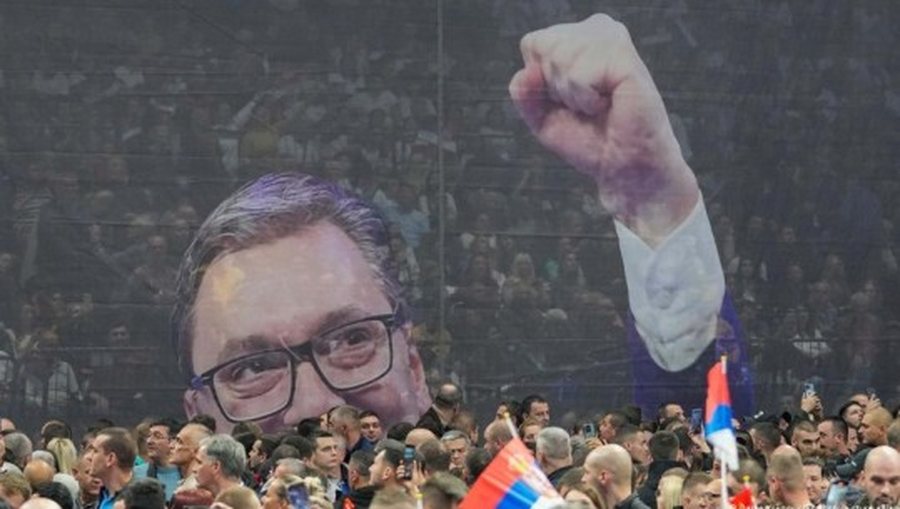
Saturday in early December: Hundreds of buses line the wide streets of New Belgrade.
Crowds flock to the Belgrade Arena, one of the largest sports venues in Europe. The central gathering of the ruling Serbian Progressive Party (SNS) will take place there. Lone Star: The President of Serbia, Aleksandar Vucic.
"The leader of our village organized the trip to Belgrade," says a man drinking from a can of beer on a bench. He comes from a village in the north of Serbia.
" Of course I support Vucic. He gave us all the money, recently 10,000 dinars, plus for the beneficiaries of social assistance."
Such election gifts are common in Serbia. Once again, Vucic decided before the December 17 parliamentary and local elections to distribute one-time payments from the state budget to pensioners, young people or the unemployed. Sometimes it is 10,000 dinars (equivalent to 85 euros), sometimes a little more and sometimes less. For many in Serbia it is almost essential for survival. The average salary in the country is only 725 euros net per month. While pensioners receive only 330 euros on average.
Vucic promises new pension increases in January - of course only if his party wins. The president himself is not running for re-election - he won his second term last year. But everything revolves around him. Every electoral roll of the SNS, even in the smallest village, bears his name.
The weekly magazine Vreme describes Vucic as a "beggar king" - he presents himself as a man who distributes money, builds roads and railways and creates jobs. The opposition's accusation is that Vucic rules the country with an iron hand and maneuvers between the EU, Russia and China. According to critics, the president's regime has close ties to the mafia and is completely corrupt. In his almost daily television appearances, Vucic accuses his critics of being traitors and thieves who only want to gain power.
In the Belgrade Arena, Vucic shouted: "Today, Serbia is one of the few countries in Europe that follows its own policy". The applause was great, but not everyone came to the rally of their own accord and cheered with conviction. A young man tells us how things go. He works in a hospital in a small town. To keep their jobs, he and his colleagues must go to the rally in Belgrade and vote for the SNS. "This is catastrophic, but what should I do?'' he says.
No one is talking about EU membership
Polls put SNS on top. Even if it will probably not be an absolute victory, it is thought that it will be enough to continue the coalition with the socialists and smaller partners. The broad pro-European coalition "Serbia against violence" wants to reach second place. This coalition was born during the large protests after two mass murders in May 2023, which deeply shocked the country. They accuse Vucic and his media of sowing an atmosphere of violence through reality shows, including insults against the opposition.
Widespread violence and abuse of power are the most important issue, says political scientist Srdan Cvijiq. The opposition no longer promises to enter the EU, because this process is taking too long. "Only a political kamikaze would insist on the EU issue during the campaign," Cvijiq told DW. "Because all the media loyal to the regime spread anti-Western agitation. What's the point of the opposition being pushed for this issue?"
Kosovo is still the main issue
The obvious decline in the popularity of the EU comes, among other things, also because of Kosovo. Serbia still does not recognize the independence of Kosovo, although Berlin and Brussels openly demand "factual" recognition. This will be implemented through the so-called Brussels Agreement. Therefore, Serbia should recognize Kosovo's documents and not obstruct Kosovo's path to UN membership. Prishtina, on the other hand, should allow an association of municipalities with a Serbian majority in Kosovo.
The third important force in Serbia is the splinter right wing conservative and nationalist parties, they are campaigning exclusively on this issue. They accuse Vucic of surrendering through various agreements and practically giving up on Kosovo.
However, Vucic's biggest problems at the moment are more related to the war in Ukraine, says Belgrade-based historian and political observer Stefan Radojkovic. Under pressure from energy prices, Serbia has one of the highest inflation rates in Europe, which threatens Vucic's narrative of the country's economic success. On the other hand, the EU and the USA want to reach a final compromise with Kosovo, according to the historian.
Possible election fraud
These are relatively quiet days in Belgrade and there is little to see from the election campaign. A few slogans here and there, while on TV almost only SNS is seen, because only it has money for paid advertising. But a petition called "ProGlas" caused a stir. Dozens of intellectuals, actors and athletes are calling for people to vote on December 17. About 170,000 people have so far supported this online petition. "We do not have a reasonable state in Serbia," says the well-known professor Vladica Cvetkovic, one of the first signatories of the petition. "We lack democracy, justice and equality. We can change this if we raise our voices."
The race is likely to be close, especially in Belgrade. Polls show that the opposition could win in Belgrade, which is seen as one of the country's most important symbols. Even the former autocrat and war leader Slobodan Milosevic first lost the elections in Belgrade and other big cities in 1996, while he left power in 2000. But both in 1996 and in 2000, Milosevic has accepted defeats only after huge protests. At the time, Milosevic's minister for information was Aleksandar Vučić.
However, for change to happen, many things must go right - for example, for pro-European and pro-Russian forces to form a coalition against Vucic. Experience from the 1990s shows that care must be taken here, says lawyer Sofija Mandiq, who is part of the election commission for the opposition. She says that there is already enough evidence that the government is preparing electoral fraud. "Voters should be able to express themselves freely," she says. "They must also be prepared to defend their political will beyond the ballot box if necessary." Some opposition politicians are already speculating about the possibility of calling for protests if the government rigs the elections. Cold December days in Belgrade, just before New Year's Eve and Orthodox Christmas, can heat up again./DW




Lini një Përgjigje