


 Shkruar nga Pamfleti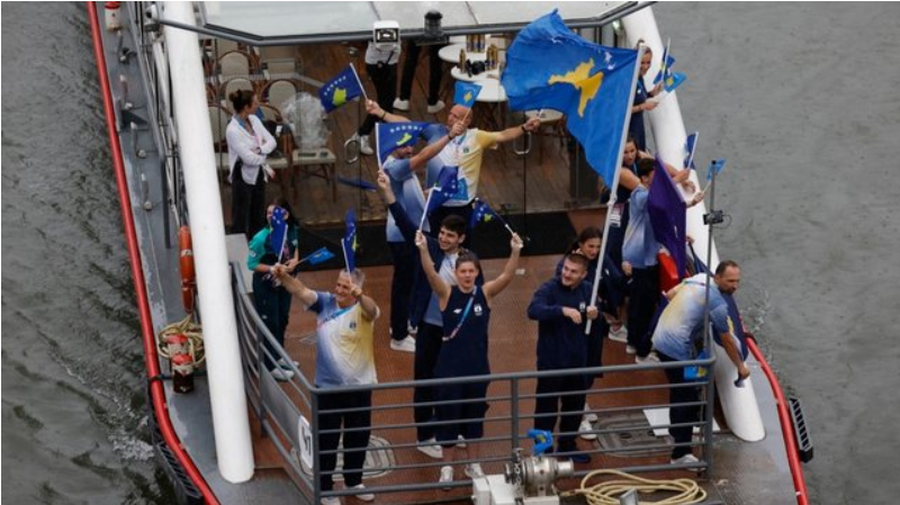
More than 10,500 athletes are competing in this year's Olympics being held in Paris – nine of whom represent Kosovo. They train in different conditions and places and by different coaches. But what makes a successful athlete? What does his routine look like, how does he manage stress and cope with loss?
" It's not the conditions that make you a champion. I have become a European, world and Olympic champion, exercising in a hall where the temperatures during the winter were minus 15 degrees Celsius. I didn't have a physiotherapist, I didn't have a psychologist, I didn't have a nutritionist ".
These are the words of Majlinda Kelmendi, the athlete who has written history in Kosovo and who has won all the main judo titles in the world. According to her, everything was possible, because she had a professional trainer close to her - Driton Kukë.
With the Summer Olympics, "Paris 2024", and all the euphoria in Kosovo, after two judokas managed to win Olympic medals, we talked to Kelmendi - now a judo coach - to understand what really takes a person to achieve Olympic standards.
Kelmendi told Radio Evropa e Lira that, when she was little, she was not known for any great talent, but she was very hardworking: " I think it's 80 percent work, 20 percent talent ."
A theory by psychologist K. Anders Ericsson, which has stood the test of time, says that 10,000 hours of work is enough for someone to become an expert in a field. Even without talent. Kelmendi's career, which started at the age of 8, has resulted in many titles: four-time European champion, two-time world champion and Olympic champion, among others.
Kelmendi said that, during the time she was preparing for competitions, including the Olympics, her routine for 20 years in a row looked like this: For 15 years, she said that she did not take a day off.
Her colleague, Distria Krasniqi, told Radio Evropa e Lire months ago that a month before the competition, she and other judokas isolate themselves: " We shut up and talk only with the coach or club mates. This helps us protect ourselves ."
The norm in the sport of judo is earned within two years. During that period, through competitions, an athlete earns Olympic points. But each sport has its own procedures. Ultimately, at the Olympic Games countries compete with qualified athletes – who reach the Olympic standard – and with athletes who are invited to participate to increase the number of competitors from countries that have traditionally had smaller teams.
" I have tried to focus on my work, not to think about many things around, not to think that people expect from me, to convince myself that I am the best, that I can and that I want to win gold medals ", said Kelmendi .
Sports psychologists have mentioned that it is very important to consider stress as a challenge and not as something that does harm.
Shane Murphy, who has mentored many Olympians over the years, has said that the key to success is loving what you do and focusing on the moment – not worrying about failure or the end result: “ Their bodies are primed for success, but usually the mind comes in between, if they let it ."
The coach of the Kosovar judo team, Driton "Toni" Kuka, has been seen at every competition of Majlinda, over the years, and now also of other judokas. Under the leadership of Kuka - once a judoka himself - Kosovo has secured five Olympic medals: three gold, one silver and one bronze. According to Kelmendi, no athlete can reach the peak, if he does not have a close and honest relationship with the coach.
" I've never gone to a race without Tony. Simply, I needed Toni to be in the room, so that I could hear his voice and see that he is present .
Although in other sports there may be a need for more investments, Kelmendi estimated that, as far as judo is concerned, the conditions are now good, as he also mentioned the help from the state and sponsors, since 2013.
Despite that, she ordered every athlete to never compare the training conditions with those in Germany or Japan: " With will, work and dedication, they can achieve anything ".
Kelmendi has admitted that her regime has sometimes been much tougher than it should have been, that maybe she hasn't enjoyed her developing career enough, but that maybe this has been the key to her success.
" It has been very difficult during my career, especially since 2013, to accept any other medal besides gold. I think this has cost me a lot psychologically, but, on the other hand, maybe it's good to be like that, to some extent, due to the fact that I have achieved all the possible titles "./REL


Lini një Përgjigje