


 Shkruar nga Pamfleti
Representatives of the Prime Minister's Office and the Parliament have presented their arguments, describing the GJKKO decision to suspend Balluk from government functions as an infringement of executive power by the judiciary. According to them, ministers enjoy immunity just like MPs, so any measure must go through the Parliament...
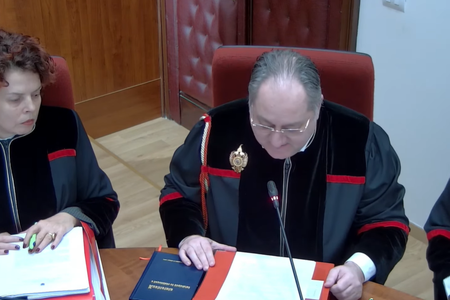
From 10:00, an open session is being held at the Constitutional Court regarding the request of Prime Minister Edi Rama, who seeks the resolution of the dispute over competence created between the Prime Minister and the Council of Ministers on the one hand, and the Special Court of First Instance for Corruption and Organized Crime, on the other hand, regarding the suspension of the exercise of the duties of a member of the Council of Ministers.
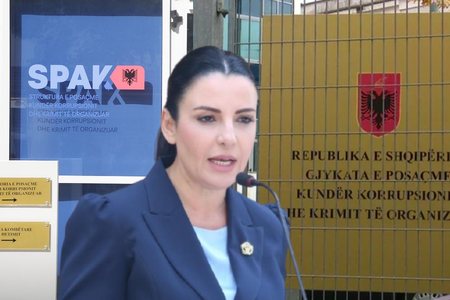
The Prime Minister's Office and the Parliament, through their representatives in the Constitutional Court session, have presented their arguments because SPAK erred, exceeding its powers, regarding the decision to suspend Belinda Balluku from government positions.
Defending the arguments of the appeal against the decision of the Constitutional Court to suspend Belinda Balluku from duty, the Prime Minister's representative in the Constitutional Court session, said that one of the powers was violated.
“ The GJKKO claims that this request cannot be filed, arguing that there is no constitutional legal relationship. We clarify that this is not an individual constitutional complaint and does not relate to the need for the defendant's protection. The requests relate to the relationship between the three branches of government. Does the criminal court have the right to suspend a minister from office? We assess that no!
For legitimacy, we clarify that the Council of Ministers comes to this judgment as an affected body, since the suspension of the minister hinders the functioning of its structures and projects. The suspended minister can no longer propose any act to the Council of Ministers, while the Prime Minister can only propose for areas that are not covered by any minister. In this way, the Prime Minister is placed in the position where he must replace a minister, which prompts the Council to request his dismissal.
Whether the consequences of this decision are permissible under the Constitution is the crux of the matter. As for the claim that all levels of the judiciary must be exceeded, this applies only to complaints made by individuals, not by the Council of Ministers. The mandate cannot be obstructed by any act of any other power, but only by the Constitution; otherwise, the balance of powers is disrupted. The suspension of the minister cannot be made in this case.
The GJKKO has jurisdiction to judge the criminal offense committed by the individual, but it does not have the authority to issue measures on his mandate. The competent body must express its opinion on the suspension. In this specific case, the Assembly has the authority to issue authorization for measures that impede the exercise of the minister's duties. The unilateral decision taken for the Deputy Prime Minister does not meet this standard and violates the principle of separation and balance of powers. The decisions on suspension from duty and blocking the passport are decisions issued in violation of the Constitution. We request the acceptance of our request , "said the representative of the Prime Minister's Office.
On the other hand, the representative of the Parliament, Mimoza Arbi, has maintained the same line as that of the Prime Minister's Office, emphasizing that despite the fact that "the minister is not a person directly elected by popular vote, she has received the vote of confidence of the Parliament, which in the case in question was overlooked by SPAK and GJKKO."
The Assembly described the decision of the GJKKO, following the request of SPAK, as a direct violation of the powers. "It is an intervention of the judiciary in the executive", said the Assembly representative, according to which such a case violates the balance between powers.
Arbi said in the Constitutional Court session on the Balluku case that according to the relevant articles, MPs enjoy immunity and cannot be obstructed, arrested or prosecuted without the approval of the People's Assembly. Criminal prosecution can only be carried out with the consent of the Assembly, she said.
" The Assembly finds the suspension from duty and the blocking of the passport for the Deputy Prime Minister in violation of the Constitution. Article 22 provides that the deputy of the Assembly enjoys immunity and cannot be obstructed, arrested or prosecuted without the approval of the People's Assembly. Criminal prosecution is carried out only with the consent of the People's Assembly. In point 3 of Article 103 of the Constitution is a fundamental provision that guarantees the executive power. When ministers enjoy immunity as deputies, this immunity is equal and creates constitutional guarantees. Article 73 of the Constitution provides that the deputy cannot be arrested and no preliminary control can be exercised against him ," said Arbi.






Lini një Përgjigje