


 Shkruar nga Pamfleti
The British Parliament will debate on the 17th of October about the Balkans and what belongs to Albania, corruption is a concern...
Corruption in Albania continues to be seen as gangrene in partner countries. On October 17, 2023, the House of Lords in the British Parliament will debate the Balkans, and this concern is expected to be raised.
Baroness Helic (Conservative) will ask His Majesty's Government what consideration they have given to the security and political situation in the Western Balkans and the challenges of the Dayton Peace Agreement inside and outside Bosnia and Herzegovina?
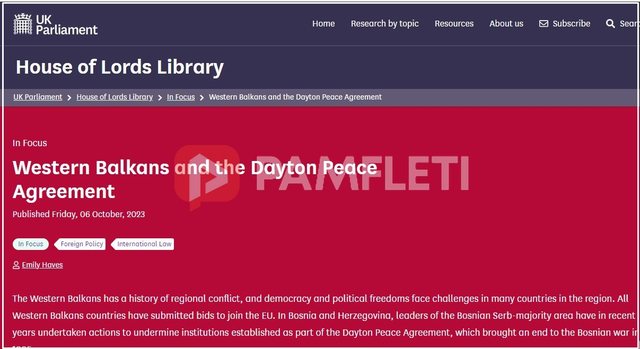
In the framework of this debate that will be held, the Parliament itself has published a report on the situation in the Balkans, including our country. As far as Albania is concerned, corruption is seen as a problem, which is said to be rampant.
" Albania's democratic institutions are challenged by clientelistic party politics, a delayed judicial verification process and rampant corruption. The Special Anti-Corruption Courts made small strides in addressing corruption during 2022, resulting in a modest improvement in scores on [Freedom House's] corruption indicator, but there was little scope for further reform before local elections held in May 2023 ", the report emphasizes, reports " Pamphleti "
The report further mentions the 2021 elections, as it is emphasized that there was vote buying and use of the state administration by the ruling party.
" In Albania, the May 2021 elections saw the return to the ballot of all parties. Observers reported concerns about misuse of state resources or functions by the ruling party and other public figures. The prosecution launched investigations into several reported cases ," the British report further states.
Also, referring to a Freedom House report, it is emphasized that " across the Western Balkans, elite-led politics and diplomacy have excluded the voices of civil society and ordinary citizens, allowing anti-democratic and authoritarian leaders to control the future of their countries ".
Further, great importance is attached to the Russian influence. According to the British, our region is coveted by Moscow.
" Russia has traditionally had a strong influence in the Western Balkans. Some argue that this influence has increased as citizens of Western Balkan countries have become disillusioned with the prospect of EU membership. However, others have argued that Russia's influence is now waning, as its actions in Ukraine reduce its attractiveness as a partner.
Russian economic activity in the region has been declining relative to the size of the regional economy, notes a briefing by the European Parliamentary Research Service:
Although Russian investment in the region has increased in absolute terms, Russia's economic footprint as part of the total economy in the Western Balkans has shrunk following international sanctions over Russia's annexation of Crimea. Although Russian economic influence is highly concentrated in the energy sector, its share as a percentage of Gross Domestic Product (GDP) is falling across the region ," the report continues. / Pamphlet





Lini një Përgjigje