


 Shkruar nga Pamfleti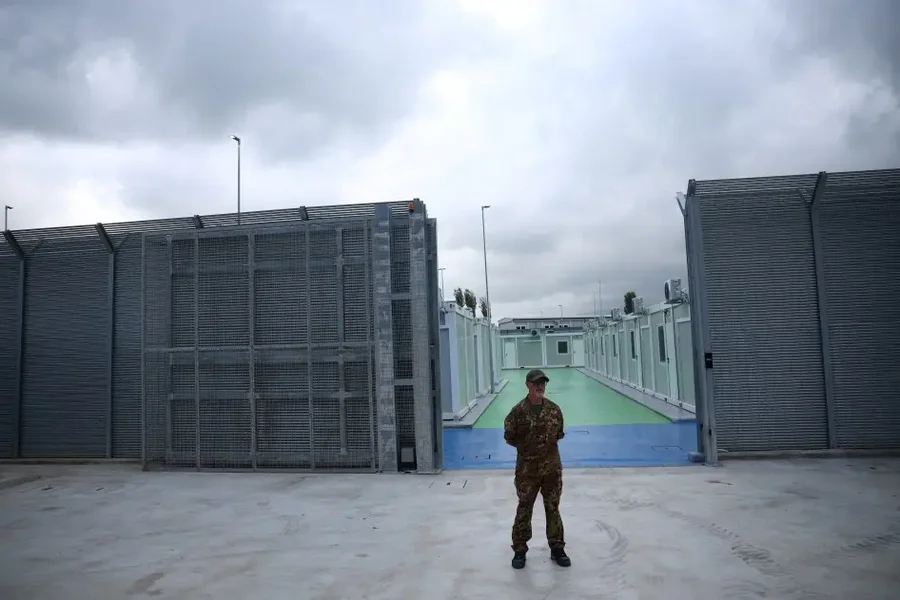
The conversion of the migrant reception center in Gjadra into a prison that will house migrants who have been deported from Italy and are awaiting return to their countries of origin is opposed by Human Rights Watch.
Meloni's new scheme, despite the support it has received from the European Commission, is considered by HRW as another risk that will emerge regarding immigrants.
Judith Sunderland, Associate Director, Europe and Central Asia Division, writes that Italy already has 10 detention centers in Italy where people can be held for up to 18 months while the government tries to deport them.
“The government doesn’t deport many of them – in 2023, only 10 percent of people under deportation orders left the country. A 2021 report described these centers as “black holes,” while a report published in 2024 denounced it as a costly and inhumane system,” Sunderland says.
" After building immigration facilities in Albania that are now empty, the Italian government has decided to turn one of them into a detention center. But this will only repeat the problems already evident in detention centers within Italy."
The facility in Gjadra, Albania, was built to accommodate and process adult male asylum seekers who were intercepted or rescued at sea by Italian ships. Under the 2023 agreement between Italy and Albania, men from countries that Italy considers “safe” would be landed directly in Albania, across the Adriatic Sea from Italy, and would undergo a fast-track asylum procedure on the assumption that they would not need protection.
But Italy's courts forced the government to return to Italy the men taken to Albania under this scheme, rightly questioning whether the countries Italy lists as "safe countries of origin" are entirely safe for everyone and declaring that it would be unlawful to detain these men under this assumption.
The European Court of Justice is expected to rule on this issue, but in the meantime the facilities, part of an investment of around 800 million euros, are empty.
Thus, the Italian government issued a decree on March 28 allowing facilities to hold undocumented immigrants, currently in Italy, who have been ordered detained pending deportation.
Italy already has 10 detention centers in Italy where people can be held for up to 18 months while the government tries to deport them. The government doesn’t deport many of them — in 2023, only 10 percent of people under deportation orders left the country. A 2021 report described the centers as “black holes,” while a 2024 report denounced it as a costly and inhumane system.
Opening such a center in Albania would replicate the problems already seen in Italy, as well as add new ones, such as the obstruction of legal aid, which could undermine accountability when there are credible allegations of abuse. And there is nothing to suggest that this change will make host countries more willing to accept returns – the main obstacle to deportations.
This move comes shortly after the European Commission endorsed the idea of “return stations” set up outside the European Union in its recently proposed Return Regulation. Attempts to offload migration responsibilities and remove people out of sight are cruel and unrealistic.
"Instead of pursuing costly, dubious deals to evade their responsibilities, Italy – and the EU as a whole – should invest in managing migration in a humane and rational way ," Sunderland stresses. /Adapted from Pamphlet/








Lini një Përgjigje