


 Shkruar nga Pamfleti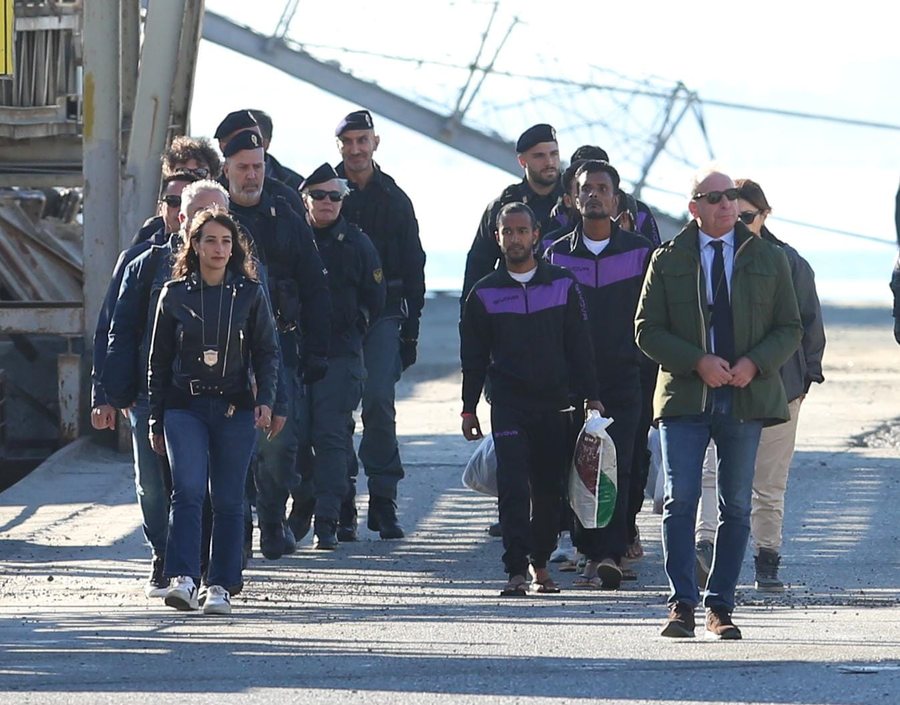
The Italian media "Avvenire" has dedicated an article to the Albania-Italy agreement on migrants. "Avvenire" writes that the Italian Interior Minister, Matteo Piantedosi, has announced the repatriation of 30 migrants from the Gjadri center in Albania and the new transfer to the center of 30 others from Italy.
The article writes that meanwhile, the ministry's website shows the number of migrants who landed this year on Italian shores, Lampedusa above all, but also Pozzallo and Siracusa in Sicily, Roccella Ionica and Crotone in Calabria and south of Sardinia.
"23,662 compared to 21,769 last year in the same period, 1,893 more. They are those who were supposed to be caught on the high seas, in international waters, 15-20 miles south of Lampedusa, to then be transported to centers in Albania. It is supposed to accommodate around a thousand people, but in the end only a few dozen arrived, all transferred to Italy after interventions by the courts and then by the Court of Appeals ," writes "Avvenire".
According to Italian media, based on the figures, there is no deterrent effect that the Albanian project should have had, reducing departures, but in fact there was an increase of almost 9 percent compared to 2024. "Avvenire" writes that among the nine nationalities reported on the website of the Italian Ministry of the Interior, we find only three countries designated as "safe", those that were supposed to end up in Albania and then be deported: Bangladesh, which has been at the top of the list of landed immigrants for months, Egypt, in third place, and Nigeria.
"What happened to the thousands who were supposed to be brought to Gjadra? There was no deterrent effect. And people are still fleeing from safe places," the Italian media emphasizes.
The full article from "Avvenire":
Numbers are not opinions. But some opinions try to use numbers. Interior Minister Matteo Piantedosi has announced the repatriation of 30 migrants from the Gjader center in Albania and the new transfer to the center of 30 others from Italy. Meanwhile, the ministry's website shows the number of migrants who landed this year on Italian shores, Lampedusa above all, but also Pozzallo and Siracusa in Sicily, Roccella Ionica and Crotone in Calabria and in southern Sardinia. How many? 23,662 compared to 21,769 last year in the same period, 1,893 more.
They are the ones who were supposed to be caught in the open sea, in international waters, 15-20 miles south of Lampedusa, to then be transported to centers in Albania. They were supposed to accommodate about a thousand people, but in the end only a few dozen arrived, all transferred to Italy after interventions first by the Tribunals and then by the Court of Appeal. And of course we do not see the deterrent effect that the Albanian project should have had, reducing departures. Which instead increased by almost 9 percent compared to 2024. Of course, last year landings were more than halved compared to 2023, a real boom year, but if we go and read the previous years, we understand that 2025 is also becoming a record year.
In 2022, the migrants who landed by May 31 had been 19,481, in 2021 even fewer 14,692, and 5,119 in 2020 and even 1,561 in 2019. Browsing through the years, we find 13,430 migrants landed in 2018 and in the two previous years alone other record numbers: 60,228 in 2017 (the site reports that 58,258 came from Libya) and 47,883 in 2016. Other numbers, but also different historical and geopolitical periods. But numbers are not enough to explain a situation. Because behind the numbers there are people, lives, paths, suffering. The first reflection has to do with the place of departure of the ships.
In recent months, almost all have set off from the Libyan coast of Tripolitania, while departures from Tunisia and Cyrenaica have almost disappeared and those from Turkey have been very limited. If we add to those who have landed, almost 10 thousand captured and brought back to Libya, a situation of strong tensions in that country clearly emerges. As always, the management of migrant trafficking is a symptom or a weapon of pressure, in the hands of militias, political factions and foreign allies. A few days ago, the Farnesina had to urgently evacuate some embassy employees in Tripoli to Tunisia after an armed attack on the hotel where they were staying. The news, revealed by Rai News 24 correspondent Angela Caponnetto, has not had official comments. Libya is not mentioned, nor the record number of landings. And also who is landing.
Among the nine nationalities reported on the Interior Ministry website, we find only three countries designated as "safe", those that were supposed to end up in Albania and then be deported: Bangladesh, which has been at the top of the list of migrants disembarked for months, Egypt, in third place, and Nigeria. Tunisians have disappeared. Syrians, Afghans, Iraqis and Iranians have dwindled considerably, countries that are not safe, but which are clearly affected by the almost complete blockade of departures from Turkey and Cyrenaica. Instead, Eritreans (in second place) and Ethiopians (in fifth place) have reappeared, a clear sign of a return of tension in those countries, which is pushing thousands of people to flee. But even this is not talked about, except when these nationalities appear in the tragic shipwrecks that never diminish.







Lini një Përgjigje