


 Shkruar nga Pamfleti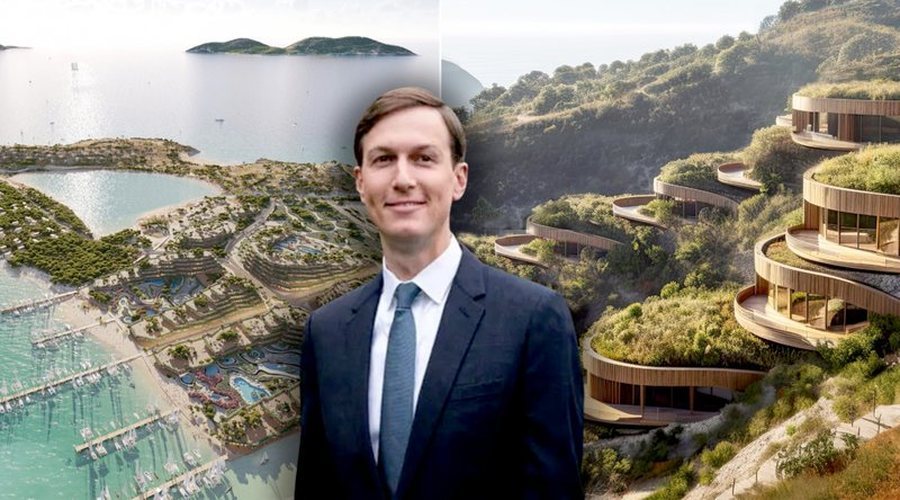
Albania's Vjosë River is known as Europe's last wild river and its pristine delta is a haven for migratory birds. As plans for luxury developments there — spearheaded by Donald Trump's son-in-law Jared Kushner — move forward, conservatives are sounding the alarm.
It is the jewel of the Adriatic. Its shimmering waters feed a rare colony of Dalmatian pelicans, the world's largest freshwater birds, support the endangered Albanian water frog and shelter loggerhead turtles in its surrounding dunes. The Narta Lagoon is at the heart of Albania's vast and largely unspoiled Vjos River Delta, which researchers consider the most pristine large river delta in Europe.
But this assessment will not save him. The Vjosa Delta and its lagoon are under siege. They will become victims of a series of massive coastal tourism developments, partly financed by a company created by Donald Trump's son-in-law, Jared Kushner. The luxury hotels and villas will accommodate up to a million visitors arriving each year at a new international airport currently being built on the salt marshes around the lagoon.
Until the fall of the Iron Curtain that surrounded communist Eastern Europe from the capitalist West, Albania was the 20th century equivalent of North Korea, a virtual prison state under the control of strongman Enver Hoxha. But today, its government wants to welcome the world and is determined to turn the country's remote southern coastal region into what it calls an Albanian riviera.
The delta "is one of the most vital places for biodiversity, not only within Albania, but throughout Europe," says an environmentalist.
Kushner's development projects, which will be a key part of that, were revealed last month by The New York Times. The ecological damage they will cause is likely to be unnoticed outside of Albania until now. But that is likely to change, if activists have their way.
"Vjosë-Nartë is one of the most vital places for biodiversity, not only within Albania, but throughout Europe," says Aleksandër Trajçe, executive director of the Protection and Conservation of the Natural Environment in Albania (PPNEA), the first environmental organization in the country . "These developments are very alarming and we are very concerned about the loss of the last natural coastal areas in the Mediterranean," says Annette Spangenberg, head of conservation at EuroNatur, an environmental NGO based in Germany.
South Albania is a rare European oasis for nature. The Vjosë River is often called Europe's last untouched river outside of Russia. It flows freely for 170 miles from the Pindis Mountains in Greece, where it rises, and through canyons in the remote Albanian highlands, before spreading unrestricted across a vast floodplain and emptying into the Adriatic through its 59,000-acre delta.
The delta of the Vjosë River, the site of the planned development.
Its survival as a damless river is largely thanks to international activists, who for the past decade have successfully prevented the Albanian government from building large hydroelectric dams upstream. Last year, the Albanian government conceded defeat on its hydro-dam plans for the river and declared the newly created Egër Vjoë River National Park off-limits to development.
But the euphoria over this decision was short-lived, as the government's environmental statements clashed with its economic priorities.
It turns out that protection for the river only covers the stream itself. The Delta remains exempt and ripe for construction, especially now that its limited protection is subject to the Prime Minister's veto. Meanwhile, the government has in recent weeks changed the law to allow it to bypass environmental protections to light up market tourism developments in the delta's protected areas.
The ecological importance of the Vjoa delta to Europe is underlined in a soon-to-be-published study of 258 river deltas around the Mediterranean, seen exclusively by Yale Environment 360. It finds that the delta is one of only a handful of deltas around the sea that are almost pristine - and the biggest of them all. Ulrich Schwarz, a Vienna-based consultant who compiled the report for EuroNatur and RiverWatch, another European NGO, calls it "of great importance for the Mediterranean".
The Albanian parliament approved a measure that allows the prime minister to override existing protections for the delta.
At its heart is the 10,000-hectare Narta lagoon, a key breeding and feeding ground for south-east Europe's most iconic waterbirds, including the Dalmatian pelican, whose wingspan rivals that of the great albatross, and flamingos and spoons.
But near the lagoon, construction of the airport with its two-mile runway is nearing completion. It is scheduled to open for business next spring. PPNEA's pelican conservation coordinator, Zydjon Vorpsi, says the development it will unleash will "transform the area, resulting in the complete urbanization of the delta".
Even if the lagoon survives as a body of water, Vorps warns, its hydrology will be destroyed; the extensive dunes that have been built on the outer edge of the delta will be at extreme risk; and noise and lights from the airport will disorient and scare birds and turtles. It will be an extinction of wild animals.
One of the confirmed investors for the new tourism developments the airport will spark is Affinity Partners, a Miami-based private equity firm formed by Kushner in 2021. It is said to have a $3.1 billion investment, most from the public of Saudi Arabia.
Investment Fund, a government sovereign wealth fund. Working with Kushner to facilitate projects in Albania is Richard Grenell, who served as Acting Director of National Intelligence in the Trump administration. Affinity's local partner is Albanian billionaire Shefqet Kastrati, whose Kastrati Group is involved in everything from fuel trading to building and managing luxury hotels.
Kushner's plans reportedly focus on two areas around the delta. One is the currently uninhabited island of Sazan, which once housed a military bunker complex. It is a short boat ride from the new airport. The second is the Zvrnec peninsula, a promontory connected by a wooden bridge to an island in the Narta lagoon, which houses the remains of a 13th-century Byzantine monastery.
Shifting political winds threaten progress on Europe's green goals.
The peninsula has a pine forest with a large population of bats, attractive beaches and an existing population of several hundred, mostly elderly, permanent residents, supplemented by a larger group of home owners who spend the summer in the countryside or take them with them. rent their houses to tourists. But Kushner reportedly has something much grander in mind, with plans for up to 10,000 hotel rooms and villas, according to Bloomberg News.
Both the island of Sazan and the peninsula of Zvrnec are theoretically protected. Sazan is located in the Karaburun-Sazan marine national park and Zvërneci is within the Pishë Poro-Nartë protected area.
But in February this year, the Albanian parliament rushed through an amendment to the law on protected areas, known as Law 21/2024, that environmentalists say will allow Prime Minister Edi Rama to override existing protection laws to allow the construction of five-star tourist resorts. “The president [former military chief Bajram Begaj] ratified the law just three days after Kushner's plans became public. We have no doubt that the two are connected," says Vorpsi.
While Western European countries are breaking down barriers to wild rivers, those in the East are going in the opposite direction.
PPNEA and EuroNatur are among several conservation groups taking the government to court over the issue. They say the change goes against international conventions the government has signed up to, including the Berne Convention to protect Europe's nature. Last year, the convention's Standing Committee asked the government to halt construction of the airport, pending a proper environmental impact assessment.
Flowing rivers are among the most threatened ecosystems worldwide, and Europe's rivers are more interrupted than any other. Very few are now free-flowing, even for short stretches. A recent European Union-sponsored study concluded that there are at least 1.2 million dams and other barriers across its rivers, an average of more than one per mile, about 20 times the density recorded in the United States. . "Europe has probably the most fragmented rivers in the world," says Carlos Garcia de Leaniz, professor of aquatic bioscience at Swansea University in Wales, who coordinated the project, known as AMBER, for the Adaptive Management of Barriers in European Rivers project.
Two-thirds of the barriers are levees, culverts, canals and dykes less than 2 meters high. Although individually they are often only of minor importance, they can create local flood risks, increase pollution and are together a major reason for Europe's loss of 93 percent of its migratory fish population in the last half century much larger than the 28 percent decline in North America, says Garcia de Leaniz.
However, these small barriers are often uncharted and previously unknown even to river authorities. About a thousand were registered for the first time in the survey, which included field visits to a thousand kilometers of rivers as well as satellite images. But Garcia de Leaniz says the picture remains "woefully incomplete", with tens of thousands more to be identified. To fill the gaps, the project launched a smartphone app to encourage citizens across Europe to report additional river barriers in their localities.
Many of the barriers that disfigure Europe's rivers and disrupt its freshwater ecosystems are outdated. About 13 percent are "legacy structures that have little socioeconomic value but cause potential ecological harm," according to Piotr Parasiewicz, director of the Rushing Rivers Institute, a Massachusetts nonprofit and a co-director of the AMBER project. Removing them is a key element of a target under the EU's Biodiversity Strategy to "reconnect" 25,000 kilometers of rivers by 2030, says water policy officer Valentina Bastino.
Dam Removal Europe, a network of experts, claims that more than 1,100 barriers have been removed so far. Most are small, but in the past five years, France has removed two large dams on the Sélune River in Normandy, allowing the return of migrating salmon and eels. Denmark has also "freed" more than 200 miles of rivers.
Albanian Prime Minister Edi Rama has accused environmentalists of "fury over the destruction of an imaginary national park".
But while Western European countries are breaking down barriers to rejuvenate their rivers, those further east often go in the opposite direction. Despite the supposed protection of the flow of the Vjosë River, the Albanian government has recently announced plans to divert the flow of one of its tributaries, the Shushica River, into an aqueduct that will supply new coastal resorts.
More broadly, many countries want hydroelectric dams to provide low-carbon electricity. Environmental opposition to large conventional dams is driving them to install a large number of much smaller hydroelectric plants. About 2,700 are proposed across the Balkans, including more than 300 in Albania, according to Vienna-based RiverWatch.
Garcia de Leaniz says this is a bad idea. Through their many small interruptions in river flows, small dams cumulatively do more damage than large dams while providing less energy, he says.
But while upstream barriers are a growing threat, perhaps an even greater threat to the natural integrity of Europe's rivers comes from increasing pressure to "develop" coastal deltas. This is a particular issue in the Mediterranean, which is rich in river deltas, because the small tidal range of the sea allows sediments brought to the coast by rivers to accumulate without being washed away.
In the western Mediterranean, few of these extensive deltas are in a natural state. Only about a quarter provide more than small amounts of habitat for wildlife, Schwarz concludes. They have either been drained for agriculture and urban development, or their rivers have been dammed, trapping the sediment that is needed to maintain the deltas. Often both.
The Rhone in France has lost 83 percent of its sediment supply for dam construction. In Italy, 71 percent and Ebro in Spain lost 98 percent, says Schwarz. Most suffer from extensive wave erosion as a result.
But further east, the situation has been better. Especially in Southern Albania, where according to Schwarz's analysis, the deltas of Vjosa and the neighboring Semani and Shkumbin rivers are each the four most pristine Mediterranean deltas covering more than 25,000 hectares.
These three deltas are critical for waterfowl that rest and feed on the Adriatic Flyway, a major migration route between Europe and Africa, Vorpsi says. So the consequences of their loss – and especially of the Vjosa delta, the largest – would be felt far beyond Albania. "This jewel is in danger of being lost forever," warns the global NGO Birdlife International.
Kushner's company did not respond to requests for details of its plans, beyond what he has posted on social media, or to address concerns about their potential environmental impact. But the Albanian government remains determined on its path.
Could the drying up of Europe's great rivers be the new normal?
In a speech at a political assembly last month, Prime Minister Rama attacked his environmental critics, accusing them of "fury over the destruction of an imaginary national park that has never been a protected area," of "launching a barrage of accusations and slander for me", and "making Albania look unfairly ridiculous in the eyes of the world".
Whatever critics may say, he praised the developers' claim that "Albania is the new rising star of tourism in the Mediterranean". /Adapted 'Pamphlet' from ' Yale Environment 360'



Lini një Përgjigje