


 Shkruar nga Pamfleti
Constitutional Court overturns seizure of mobile phones without court order...
The Constitutional Court has set a precedent, limiting the way SPAK is acting in seizing mobile phones.
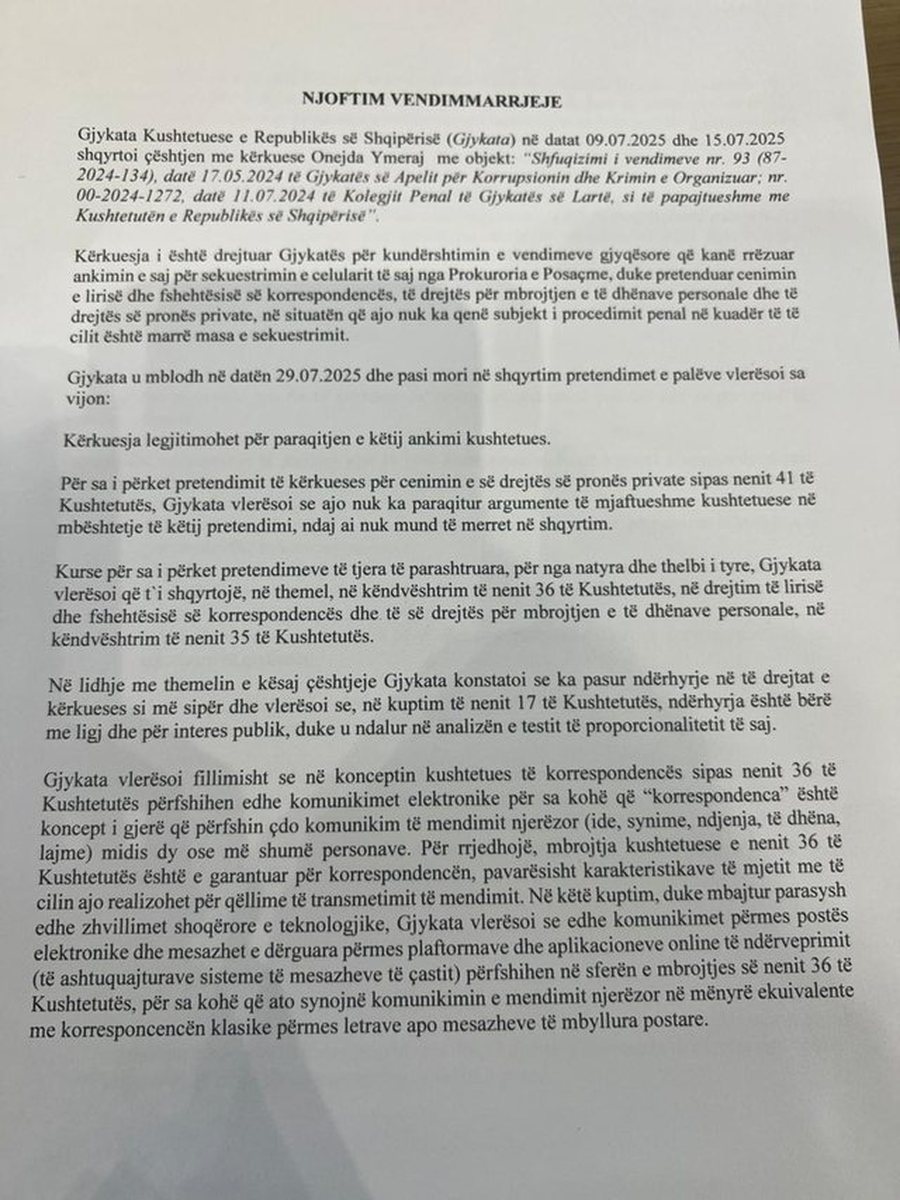
The court has accepted the request made by citizen Onejda Ymeraj, whose cell phone was seized as part of the investigation against Arben Ahmetaj. A few months ago, the BKH seized her cell phone, without a court decision. Ymeraj herself complained, describing it as a violation of her rights because she was not the subject of the investigation.
The Constitutional Court has partially accepted the request, arguing that the freedom and confidentiality of communication were violated, making it clear that a court decision is required for any seizure. Even in cases of flagrante delicto, it will be the court that will decide whether or not to open the cell phone. Also, according to the decision, private data, be it photos, conversations, etc., should not be taken from the cell phone.
" With regard to the merits of this case, the Court found that there was an interference with the applicant's rights as above and assessed that, within the meaning of Article 17 of the Constitution, the interference was made by law and in the public interest, focusing on the analysis of its proportionality test.
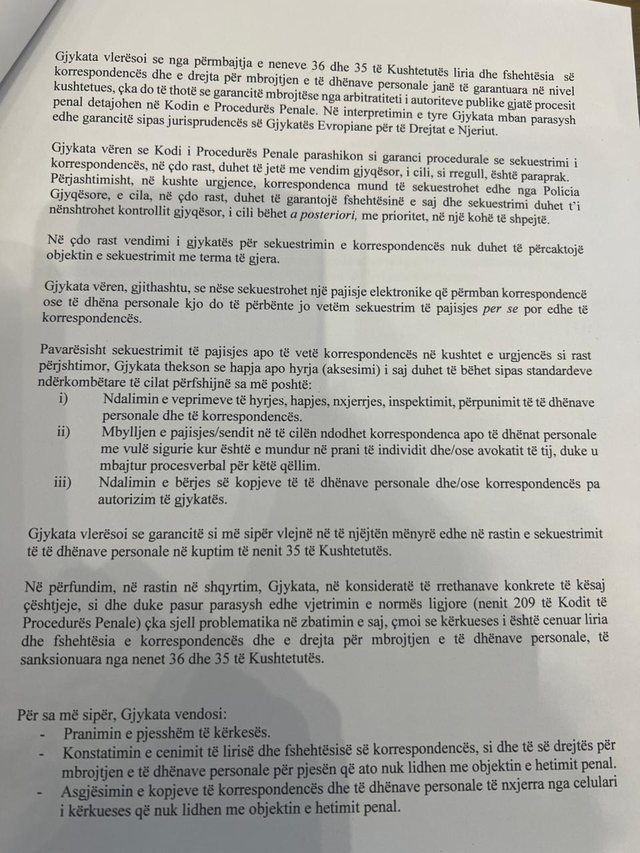
The Court initially assessed that the constitutional concept of correspondence under Article 36 of the Constitution also includes electronic communications via the Internet and that “correspondence” in this sense is communication between two or more individuals (messages, phone calls, emails, etc.) that are individual and personal in nature. Consequently, constitutional protection also applies to their content, not only to the communication address. In accordance with this understanding, the Court emphasized that the seizure of a mobile phone, electronic devices, or access to their content constitutes an interference with this right, activating the protection of Article 36 and Article 35 of the Constitution , ”the Constitutional Court states.
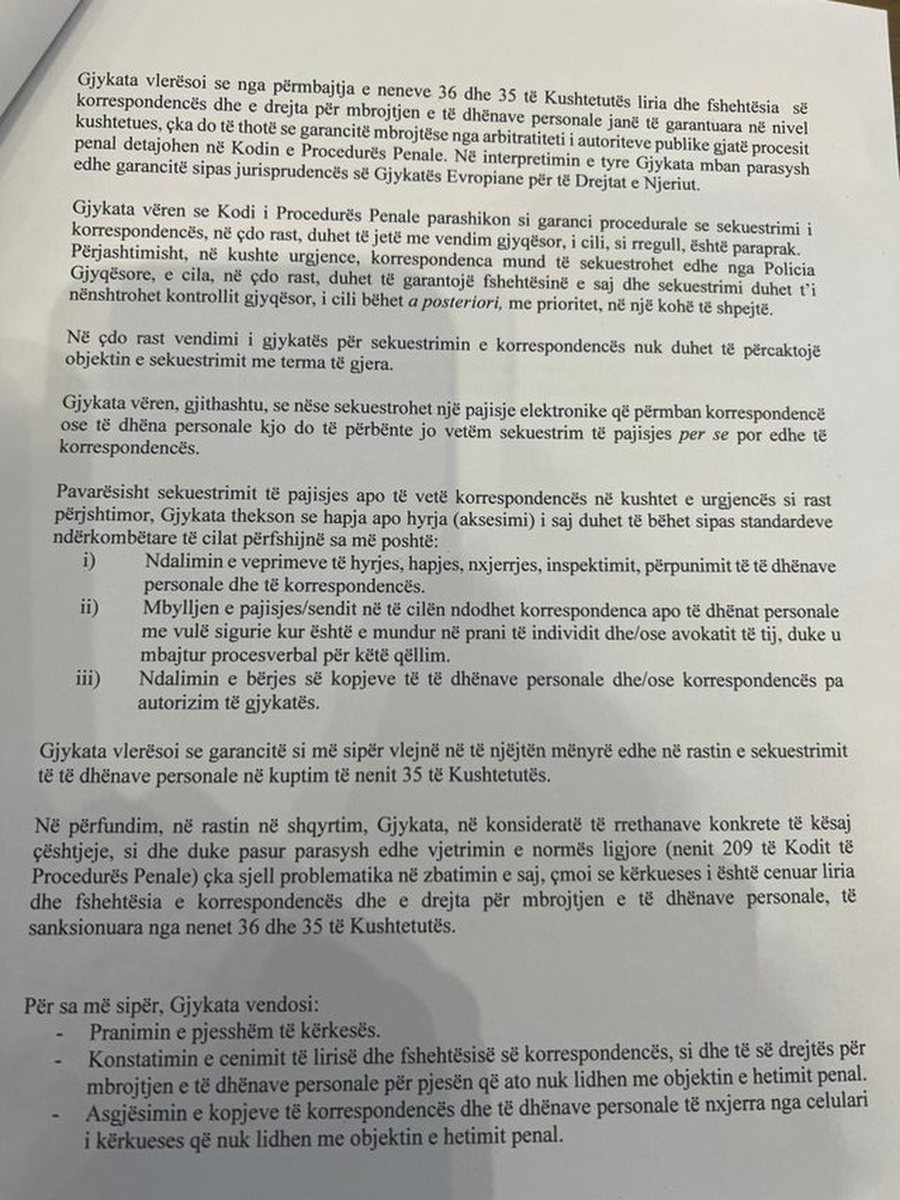
The Court assessed that from the content of Articles 36 and 35 of the Constitution, freedom and confidentiality of correspondence and the right to protection of personal data are guaranteed at the constitutional level, which means that the protective guarantees against arbitrariness of public authorities during criminal proceedings are detailed in the Code of Criminal Procedure. In their interpretation, the Court also takes into account the guarantees according to the jurisprudence of the European Court of Human Rights.
The Court notes that the Code of Criminal Procedure provides as a procedural guarantee that the seizure of correspondence, in any case, must be by judicial decision, which, as a rule, is preliminary. Exceptionally, in emergency conditions, correspondence may be seized by the Judicial Police, which, in any case, must guarantee confidentiality and the seizure must be subject to judicial control, which is made a posteriori, by a reasoned decision within the time limit set by law.
The Court emphasizes that in any case the court's decision to seize correspondence should not define the object of the seizure in broad terms.
Regardless of the seizure of the device or the correspondence itself in emergency conditions as a general case, the Court emphasizes that its opening or entry (access) must be done according to international standards which include:
i) Prohibition of acts of entry, opening, extraction, inspection, processing of personal data and correspondence;
ii) Sealing the device/sender containing the correspondence or personal data with a security seal when possible in the presence of the individual and/or his/her lawyer, with a record being kept for this purpose;
iii) Prohibition of making copies of personal data and/or correspondence without court authorization.
The Court assessed that the above guarantees apply equally to the case of seizure of personal data within the meaning of Article 35 of the Constitution.
In the end she decided:
-Partial acceptance of the request.
-The finding of a violation of the freedom and confidentiality of correspondence and the right to protection of personal data as a result of decisions to seize electronic devices.
-Destruction of correspondence data obtained from the seizure, which are not related to the object of the criminal investigation.
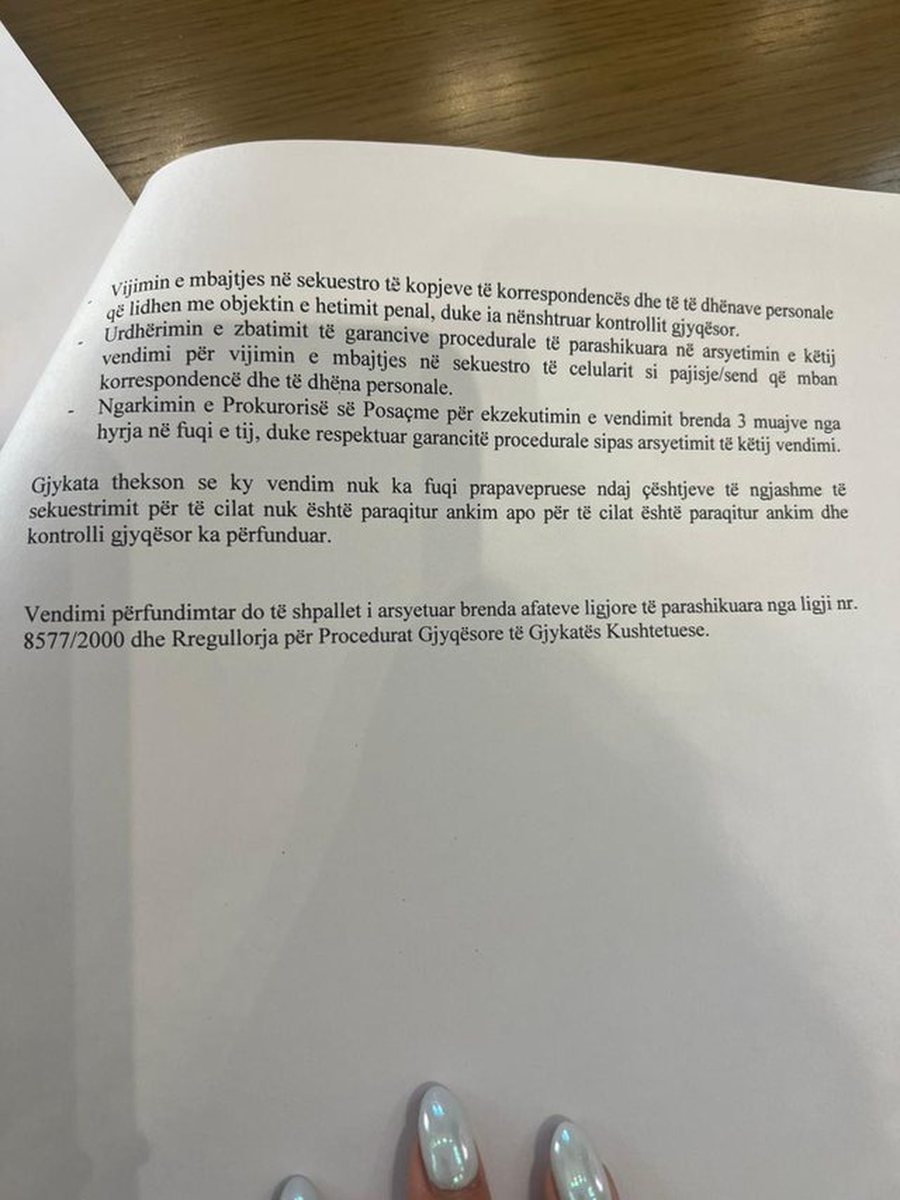
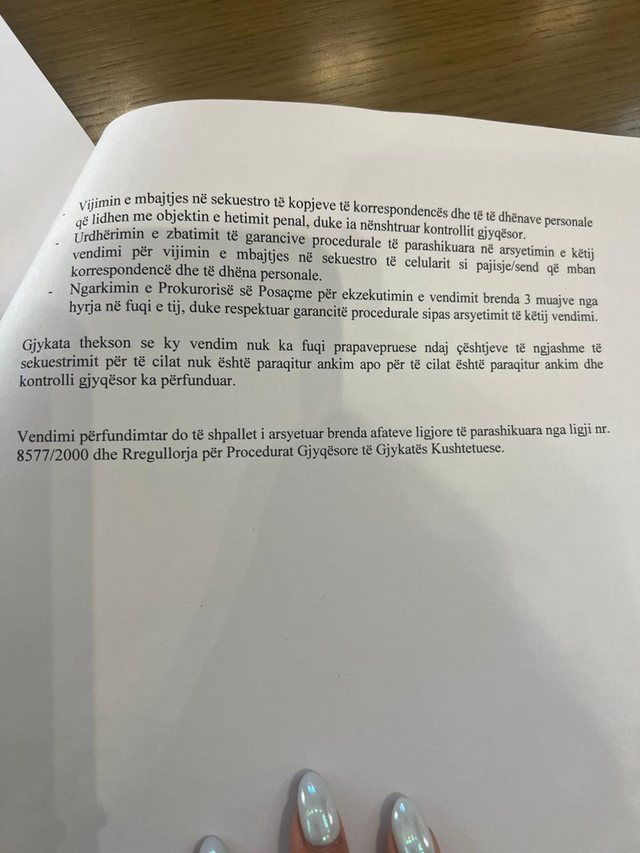
-Continuing the seizure of copies of correspondence and personal data related to the subject of the criminal investigation, subjecting them to judicial control.
-Ordering the implementation of the procedural guarantees provided for in the reasoning of this decision for the continued seizure of the mobile phone as a device/item that holds correspondence and personal data.
-Charging the Special Prosecution Office to execute the decision within 3 months from its entry into force, respecting the procedural guarantees according to the reasoning of this decision.
The court emphasizes that this decision does not have retroactive effect on similar seizure cases for which no appeal has been filed or for which an appeal has been filed and judicial review has been completed./ Pamphlet








Lini një Përgjigje