


 Shkruar nga Pamfleti
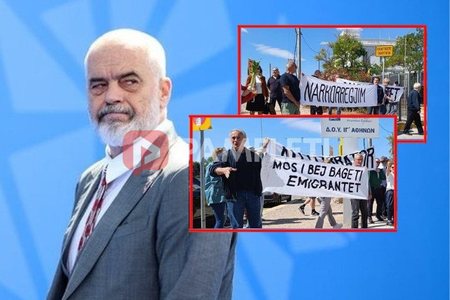
The Greek media newsbomb.gr, after echoing a news that some supporters of Berisha led by Kacifas's sister clashed with the supporters of Rama, reacted after the end of the meeting with the Albanians of Athens.
"The Albanian Prime Minister gave a recital of nationalism, as he shamelessly did not hesitate to say that Laskarina Boubulina was... Albanian!
Rama, with an incredible fury, did not hesitate to falsify history and write it as he wished, proving that it is both anti-historical and dangerous.
He said that Bubulina grew up in a family that spoke Albanian! And all this in Greece", writes the Greek media.
But who is Laskarina Bubulina, the National Heroine of Greece
Dhaskarina Pinoçi, later known as Laskarina Bouboulina (or Bubulina), was born in Constantinople, where her mother Skevo Pinoçi visited her imprisoned father, the Albanian captain Stavro Pinoçi.
Her father was in Constantinople, where as a clandestine participant in the Orlof Revolution (1769-1770) against the Ottoman Empire, he was arrested by the Turks.
Bubulina's family was from the Arvanite (Albanian) communities of the island of Hydra in the Peloponnese and Laskarina had inherited all the physical characteristics, such as: olive skin, sharp features, brown eyes and the fact that she was very proud.
When her father died, Laskarina's mother, Skeva, returned to Hidra, and then moved to Specie where Skeva married Dhimitri Lazaru-Orlof who lived there. At that time, the Peloponnese islands were distinguished by the flourishing of commercial activities, and Dhimitri himself was the owner and captain of a small fleet of ships.
This was more or less the environment in which Laskarina would grow up: a world of professions, trade, fishing... full of stories and stories of seas and pirates... but at the same time a very strong desire for freedom.
Greece had been under the long rule of the Ottoman Empire for nearly 400 years, and the Greek porters, sailors, shipowners, and soldiers who were in the service of the Turkish generals hatched a conspiracy that gave vent to that people's fantasy of freedom and rebellion. printed. Laskarina not only heard all this, but also the first words she had learned as a child were: "revolution" and "freedom". Perhaps this happened at the time when she began to wish that one day the Arvanites would also live in a free Greece.
She married for the first time at the age of 17. Later, after the death of her husband, she became the wife of Dhimitri Bubuli, owner and captain of the fleet, from a noble family, but also a very rich man. All this wealth passed to Laskarina after his death in a battle against pirates.
Bubulina, tashmë nënë e shtatë fëmijëve, dy herë grua e ve, në moshën 40-vjeçare mund ta kishte mbyllur jetën e saj. Por, ajo nuk u ligështua shpirtërisht. Mendja e mprehtë dhe shkathtësia e rrallë bënë që ajo shpejt ta fitojë krejt pasurinë e të shoqit, duke krijuar marrëveshje dhe aleanca me pronarët e anijeve dhe duke u bërë partnere me flotat e tjera, e duke e rritur dukshëm numrin e anijeve të saj. Në një kohë të shkurtër arriti të krijojë një pasuri të konsiderueshme.
Një nismë e tillë s’mund të kalonte pa u vënë re. Perandoria Osmane e deklaron fajtore për tradhti, për shkak të së kaluarës së burrit të saj që kishte kaluar në anën e Rusisë cariste gjatë luftës ruso-turke për kontrollin e Detit të Zi, dhe u përpoq t’i konfiskojë gjithë asetet e saj. Bubulina kërkoi mbrojtje prej ambasadorit rus Strogonoff, i njohur për tendencat pro-helene, dhe zbarkoi në kishat e Kostandinopojës duke kërkuar të bisedojë me nënën e Sulltan Mahmudit të II-të. Ne nuk e dimë se çfarë i tha e çfarë i kërkoi Laskarina, apo cili qe qëndrimi i saj; ndoshta ajo bisedë kokë më kokë midis një gruaje me një grua, apo mes një nëne me një nëne për jetën e saj të deriatëhershme, o ndoshta i ka rrëfyer për fëmijët e saj duke kërkuar ndihmë si të ishte vajza e saj! Dihet vetëm se nëna e Sulltanit, e prekur shumë nga guximi dhe kurajoja e asaj gruaje, e bindi djalin e vet që të hiqte dorë nga konfiskimi i pasurisë së saj.
Pas një qëndrimi të shkurtër në Krime, Bubulina u kthye në Specie, dhe jo vetëm për t’iu përveshur punëve, por tashmë duke sjellë me vete edhe erërat e revolucionit. Gjatë qëndrimit në Konstandinopojë, Laskarina në fakt i qe bashkuar, si e vetmja grua, shoqërisë së fshehtë “Filiki Eteria”, një konspiracion për lirinë e Greqisë. Prandaj, kthimi në shtëpi i saj përkoi me përgatitjen e përpiktë të kryengritjes kundra sundimit turk: blerja e paligjshme e armëve dhe municioneve, transferimi i fshehtë i tyre me anije në ishullin e Speces, shndërrimi i tyre në luftanije, dhe ndërtimi i të famshmit “Agamemnon” – një anije lufte e armatosur me 18 topa, balli i anijeve luftarake të flotës gjë që bëri që ajo të mbledhë rreth vetes një ushtri të vogël me “djemtë më trima” (palikari) siç i quante ajo vetë: një organizim ku ajo paguante, ushqente dhe mbështeste krejt anijet dhe ekuipazhet. E gjithë pasuria e saj u sakrifikua për çështjen e çlirimit të Greqisë.
On the 13th of March, 1821, with the roar of the cannon of the "Agamemnon", the command of which was in the hands of Bubulina, the Greek separatist flag was raised on the mast of a warship. This was the "Beginning of the Revolution" - on May 3, 1821, the fleet of the islands of Species, Hydra and Psaras attacked Nafplio to organize the naval blockade. The official iconography shows Laskarina Bubulina standing at the foot of "Agamemnon" facing forward, with her head covered in traditional clothing, with her arm pointing towards the conquest of the castle, now protected by 300 cannons. The battle was fierce and Kapedania, as she is called, landed on the ground with her men and participated in the first battle with all her energies. And then followed the battles of Monemvasia, Pylos and Argos, where she also lost her first son, Janus.
But Bubulina did not remain famous for her fighting spirit. It also deserves to be remembered for the act of forgiveness sought by the Greek separatists ready for the massacre of the besieged population in the fortress of Tripolis, in the heart of Lakonia. With her intercession, the Greeks spared the lives of the women and children of the Pasha's family, the ruler of the city, in respect for the former act of Sultan Mahmud's mother when she came down to Constantinople for the first time. Then 1825 happened: the borders of Greece were again in danger, after the Turkish-Egyptian fleet had arrived on the coast of the Peloponnese, in the city of Pylos. Laskarina, although now in poverty, having spent all her wealth on the revolution, appears again ready to fight, to prepare and organize the people.
Suddenly she receives a slanderous accusation from the family of her son's girlfriend. This incident made Laskarina forget about Greece, the homeland and the revolution. It happened that she abandoned political ideals and put the war aside. Thus, Kapedania loses her public role and becomes simply a mother. She confronts the relatives of the girl's family, defending her son. Suddenly the atmosphere ignites and a firearm, fired by a hand that remained forever anonymous, hits him between the forehead, leaving him dead. And that's how her life ends...
This is how Laskarina Bubulina died, the National Heroine of Free Greece, the only woman admiral of the Russian Imperial Navy, born in prison, but with one word in her heart and on her lips: Freedom!





Lini një Përgjigje