


 Shkruar nga Giansandro Merli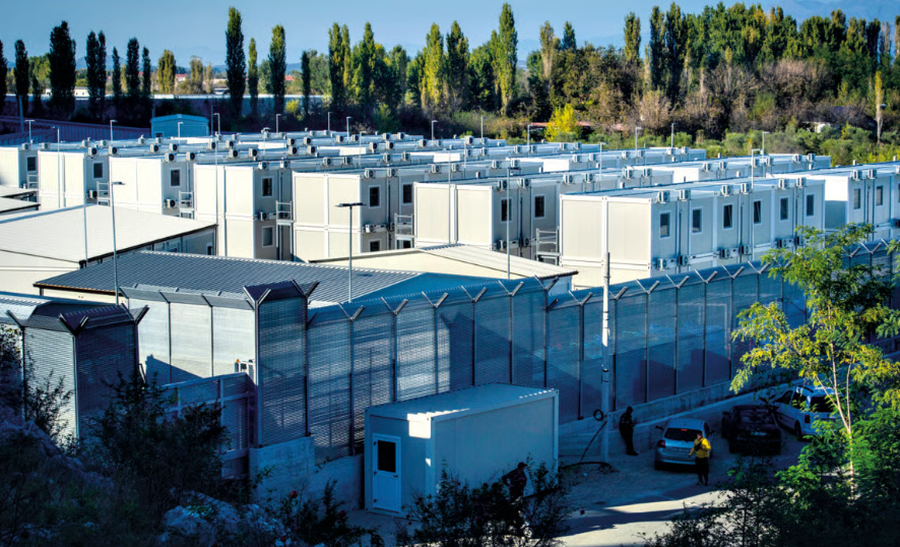
A new director, an educator, an official and 22 agents. Some legal doubts remain about the first extraterritorial prison.
There is one prison where the problems of overcrowding, lack of staff, and lack of beds do not exist: it is located in Gjadra, near the reception and detention center for asylum seekers.
The first Italian prison opened outside the country has opened in Albania. Inaugurated in mid-October 2024, as part of the migrant protocol between Rome and Tirana, the prison has never seen a prisoner. However, a director, an educator and an administrator were appointed last month.
Teresa Mascolo has been transferred from the head of the Rebibbia Nuovo Complesso prison to that of the structure on the other side of the Adriatic. She has replaced Silvana Salani Sergi, former director of Regina Coeli and then manager of the Lazio prison administration office, who in the first months had carried out the necessary administrative functions of the structure.
The usual management of an empty prison is another matter. The Italian authorities could have appointed a regency from another prison. This has already happened for the small ones, this one is very small: six cells with four places. After all, the judiciary and the prefecture of the capital are competent for the Albanian centers.
"I call the prison in Gjadra a self-contained ghost prison. There are no prisoners and 22 prison police units. More than those of the prison on the island of Gorgona, where there are 90 prisoners," says Gennarino De Fazio. The general secretary of Uilpa Polizia denounces "an unprecedented obscurantism: they do not give us news when we ask for it and they try to convince us not to communicate with the staff."
Among the hypotheses that Justice Minister Carlo Nordio is examining to deal with prison overcrowding, denounced by the President of the Republic Sergio Mattarella, is the transfer of foreigners to their countries of origin.
Twice, at the end of visits in December 2024 and March 2025, Senator Matteo Renzi proposed the use of the centers across the Adriatic, in their entirety, for the approximately two thousand Albanian prisoners in Italian prisons. "Faced with a crazy waste of money, it is the only solution to avoid the intervention of the Court of Auditors," he said.
Several complaints have been filed with the Court of Accounts regarding the facilities in Albania. This is a fact that worries the government: the project, albeit for other reasons, has already faced decisions from several courts, from first to third instance. However, the Ministries of Justice and Interior deny that the idea of transferring prisoners has ever been considered. At least until now.
As part of the agreement with Tirana, the prison was intended for migrants accused of possible crimes committed in the other two facilities. Crimes that must necessarily be committed in connection with them, because under the European Convention on Human Rights (ECHR) solitary confinement is prohibited. Authorities in Ankara have also been forced to lock up other people, including Kurdish leader Abdullah Ocalan, on the prison island of Imrali.
Luca Masera, full professor of criminal law at the University of Brescia, raises legal doubts about the 24-bed prison in Gjadra.
"The only regulatory reference is found in the law ratifying the protocol, with the definition of "appropriate structures" for the implementation of precautionary measures," he states, adding that "it is true that for a new prison in Italy a designation by the Minister of Justice is sufficient, but this is the first prison opened abroad, and such a low level of precision by the legislator is unacceptable."
Meanwhile, the rulings of the European Court of Justice weigh heavily on Albania's entire project. The one on safe countries has already been drafted, but, unusually, is not due to be published until after the summer.
The latest referral from the Court of Cassation regarding the second phase of the protocol, on "irregular" migrants already present in Italy, has not yet been assigned a procedure.
To decide whether to apply it, Luxembourg judges have requested more information: in particular, they want to know whether the two migrants who filed the complaints are currently free or detained (a condition that would increase the need for speed).
"Both are free," says lawyer Cristina Durigon, who defends foreign nationals. / Adapted from Pamphlet by Il Manifesto/




Lini një Përgjigje