


 Shkruar nga Pamfleti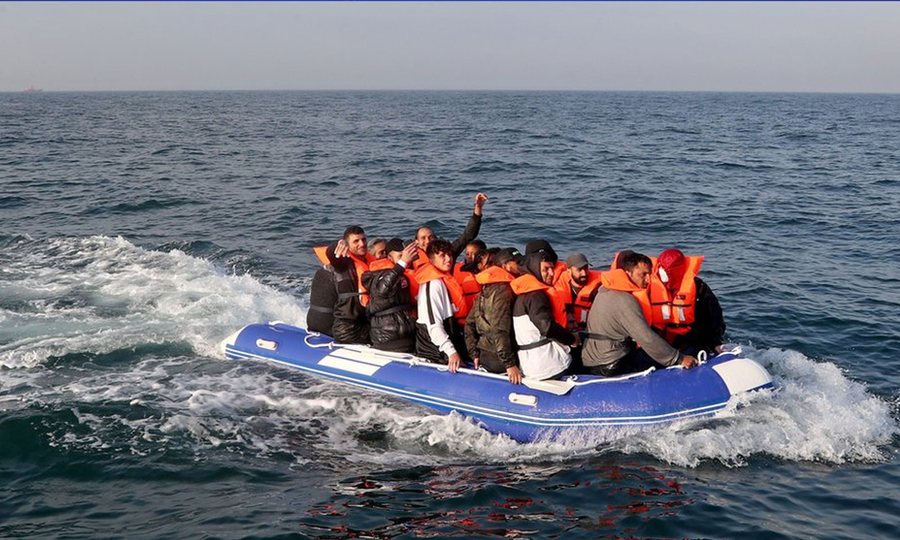
The agreement on migrants, signed on November 6 by the Prime Minister of Albania, Edi Rama and the Prime Minister of Italy, Giorgia Meloni, is viewed with concern by experts on migration and security issues in Tirana.
The opposition there also opposes it and demands an urgent interpellation with Rama.
Moreover, the Democratic Party warns that after the entry into force of the agreement, it will turn to the Constitutional Court of the country regarding it.
"This news comes as a surprise in Albania, as there has been no political or public debate on such a sensitive issue for the citizens and for the whole country", says the DP communiqué.
With the agreement signed in Shengjin, migrants who will be rescued in the Mediterranean Sea will be sheltered in Albania, while Italy will finance the establishment of centers for their reception.
Its implementation is expected to start next spring.
According to the protocol published by the Albanian Government, Italy will deposit 16.5 million euros in a special account of the Treasury of Albania, as an advance for the housing of migrants.
Ambiguity about the protocol
The head of the European Movement in Albania, Gladis Gjipali, says that there is a lot of uncertainty about how this protocol will be implemented.
"The protocol between the two countries is the first of its kind, so there are no similar practices that have been approved and implemented and there is a lot of uncertainty about how it will be implemented," Gjipali told Radio Free Europe.
He appreciates the fact that Albania has been cooperative, but says he believes that the benefits from this agreement will go to Italy.
As for Albania, says Gjipali, it confirms with this agreement its good relationship with Italy.
"From reading the protocol it is clear that the Italian legislation will be applied and therefore the European one, but, in practice, it will be seen how it will be applied, do they have more or less guarantees than those given to asylum seekers in the territory Italian", says Gjipali.
Security expert in Albania, Redion Qiriazi, expresses some reservations about this agreement.
He says that if it was in Albania's interest, it would be publicly discussed in the Assembly.
According to him, there is a contradiction between international law and what is signed in the agreement.
"If the Italian law is applied in the camps, the asylum seekers have the rights that the asylum seekers have in Italy, so they have the right to leave... The biggest problem is what happens if Italy withdraws and you have 3,000 migrants who do not have skills and capacities to keep them", says Qiriazi.
According to him, Albania's interest in this agreement is unclear and meaningless.
"We are not as smart as Turkey. When she made deals and took in migrants in 2016, she benefited 6 billion euros a year and was promised visa waivers. And, when there were restrictions on visas, Turkey opened the borders, put some pressure", says Qiriazi.
"I don't think that Albania has shown itself to be smart enough in drafting this agreement to have it as a lever to use against Italy in negotiations or to ask for something in return. I do not understand Albania's interest. Institutionalism has been violated. The fact that the deputies did not know is unacceptable," he adds.
He emphasizes that he is not against agreements that strengthen common interests between the two countries, but says that there should be more study and reflection. According to him, the threat to security may be real.
The European Commission, which oversees the implementation of European Union laws, said the deal could prove problematic if Italy sends migrants found in EU territorial waters to a non-EU country.
The international human rights organization, Amnesty International, said that "individuals rescued by Italian authorities at sea, including those seeking safety in Europe, are under Italian jurisdiction and cannot be sent to another country before the requests of for asylum and individual circumstances".
What do the citizens think?
"It doesn't seem reasonable to me as an agreement. I see a very big contrast with the situation where many young people are fleeing and leaving Albania for various reasons, while we receive migrants", says Kamela Cuka, a student in Tirana.
Peter Roci, journalist, says that he would understand this attitude of Albania only if it were a condition from the European Union.
"If it is a condition from the EU - I agree, but if not, I don't understand why it had to be signed. On the other hand, there should have been discussion, public consultation and passage to the Parliament", he says.
"I am against it. Italy should keep them... no matter how much income they bring, we have no use, they will bring chaos", says Isuf Shkurti, a pensioner.
What else does the agreement provide?
The Italian Prime Minister, Giorgia Meloni, and the Prime Minister of Albania, Edi Rama, said that they have agreed to temporarily shelter in Albania thousands of migrants seeking asylum in Italy.
Under the agreement, if Italy rejects asylum requests, Albania will then deport the migrants.
Children and pregnant women will be excluded from the agreement.
Italy will finance the construction of two centers in Albania, which can hold up to 3,000 migrants at a time, or up to 36,000 a year.
Albania will provide security measures in the relevant centers under Italian jurisdiction.
Rama said that Albania is indebted to Italy and that such an agreement would not have been signed with any other country./REL





Lini një Përgjigje