


 Shkruar nga Pamfleti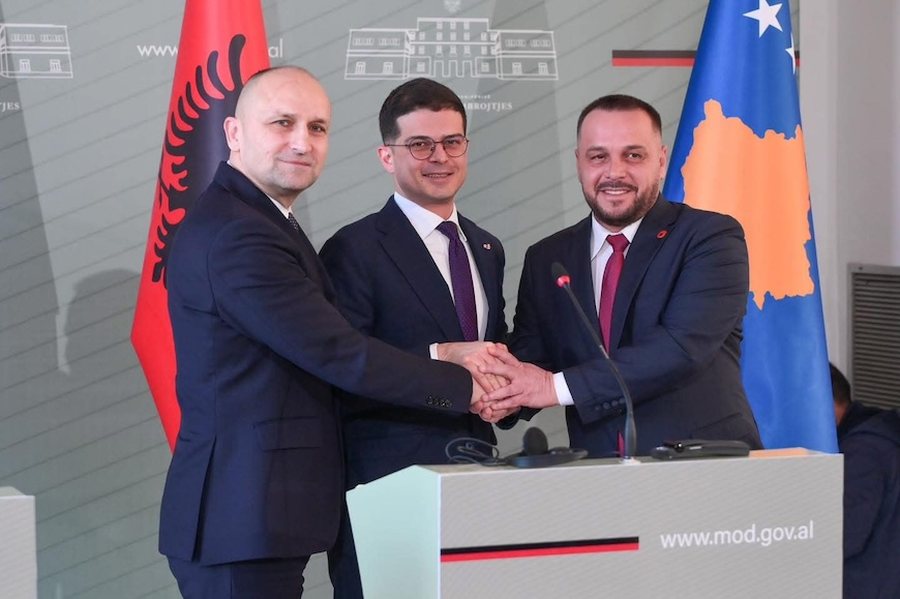
The initiative of Kosovo, Albania and Croatia for cooperation in the field of security and defense, "is also open to allies and partners of the European Union and NATO", who "want to contribute to building stability, security and sustainability in the Southeast European region".
This is how the Croatian Government comments on the Declaration signed by the three countries on March 18. According to it, the initiative can be joined by all countries that also want to offer support to Kosovo and Albania on their European and Euro-Atlantic path. Its goal "is not to create any military alliance."
"Such an alliance - apart from NATO membership - is not even necessary," the Croatian Government's written response to Radio Free Europe/Radio Liberty states.
Unlike Albania and Croatia, Kosovo is not a member of NATO. In his first reactions to the initiative, Serbian President Aleksandar Vučić said that by signing the document, Croatia, Albania and Kosovo “have opened an arms race in the region” and “have violated the 1996 subregional agreement.”
This agreement, which concerns the quotas allowed in armaments, was signed at the time by the two entities of Bosnia and Herzegovina - the Federation of Bosnia and Herzegovina and Republika Srpska, as well as by Croatia and the Federal Republic of Yugoslavia, which consisted of Serbia and Montenegro. In a statement to Radio Free Europe, the Croatian government says that this agreement has been implemented continuously for 29 years. It also recalls that neither Albania nor Kosovo are parties to that agreement.
"In this context, it is completely pointless to link it to the Joint Declaration, recently signed between Albania, Croatia and Kosovo, the main purpose of which is to strengthen cooperation between the defense ministries of friendly countries, partners and allies," the Croatian Government's response states.
The Serbian government and the country's Defense Ministry did not respond to Radio Free Europe's question about why they see the initiative of the three Balkan countries as a threat. But Daniel Serwer, a professor at Johns Hopkins University in the US, says that official Belgrade "knows very well" that NATO allies cannot act unilaterally against Serbia.
"Furthermore, the three countries mentioned do not pose any threat to Serbia," Serwer tells Radio Free Europe.
He says he sees the three-state declaration as “a move that contributes to stability, not destabilization.” He believes that Kosovo has acted “wisely” in establishing a partnership with Albania and Croatia, which are NATO members. NATO also commented on the declaration, describing it as a tripartite agreement between the three countries.
"NATO, as an organization, is not part of the initiative and, therefore, did not have any role in the consultation process," the response given to Radio Free Europe/Radio Liberty states.
Why are you hindering Belgrade?
Vuk Vuksanovic, a researcher at the non-governmental Belgrade Center for Security Policy, says officials in Belgrade are using the Declaration “to divert attention” from domestic problems.
He is referring to the mass protests that have gripped Serbia for more than four months. The protesters, led by students, are demanding political and criminal responsibility for the deaths of 16 people in the collapse of a shelter at Novi Sad’s railway station last November. Vuksanovic says Belgrade views Zagreb’s participation as particularly “provocative.”
"I don't think it has much to do with Albania, considering that Vučić has, or at least has had, a very cooperative relationship with Prime Minister Edi Rama," he says.
However, for Serbian Defense Minister Bratislav Gasic, the trilateral memorandum is "a provocative initiative by neighboring countries, which runs counter to efforts to strengthen regional security."
"Kosovo and Metohija is an autonomous province within the Republic of Serbia, regardless of the fact that several countries, including Albania and Croatia, have recognized its illegal and self-proclaimed independence," Gasic said.
Kosovo declared independence in 2008, but it remains unrecognized by Serbia. According to Gashiç, Zagreb and Tirana have long been trying to bring Kosovo into NATO “through the back door.” According to him, these two countries are also helping to develop the Kosovo Army, which Serbia considers illegal.
"Clearly, such a scenario is not acceptable for our country," said Gasic.
What is the legal force of the Declaration?
Vuksanović says this is not a typical interstate agreement, according to the rules of public international law.
"Memorandums of cooperation are not legally binding in nature," according to him.
He emphasizes that this is a subregional agreement between two NATO members with a third party - Kosovo. He sees Croatia's participation as an attempt to score political points on the regional level.
Who do Zagreb, Tirana and Pristina see as a threat?
In its response to REL, the Croatian Government emphasizes that defense cooperation between Zagreb, Tirana, and Pristina is "of high quality" and that the Declaration only aims to improve it.
"The Southeastern European area is exposed to security threats, especially those from the hybrid and cyber fields, whose aim is to destabilize the region," the Declaration states.
It does not specify where the threats come from.
Who is the "factor of peace and stability" in the region?
In addition to opposing the Declaration, Serbian officials have repeatedly reiterated that Belgrade remains committed to preserving regional peace and stability. Thus, the Serbian Ministry of Defense has said that, in this interest, it will continue to cooperate with NATO member states.
But Professor Serwer says that the "only" arms race in the region is the one that Serbia has been leading for years.
"Serbia is not a factor of peace and stability in the region. Vučić is simply deceiving naive diplomats," he says.
Serwer adds that Belgrade continues to refuse to implement the agreements with Kosovo, as well as to provide support to the secessionist policy in Republika Srpska, led by Milorad Dodik. According to him, the government in Belgrade, which has not severed ties with the Kremlin even after the Russian invasion of Ukraine, encourages pro-Russian policies in both Serbia and Montenegro.
"None of this contributes to peace and stability," concludes Serwer./ REL







Lini një Përgjigje