


 Shkruar nga Pamfleti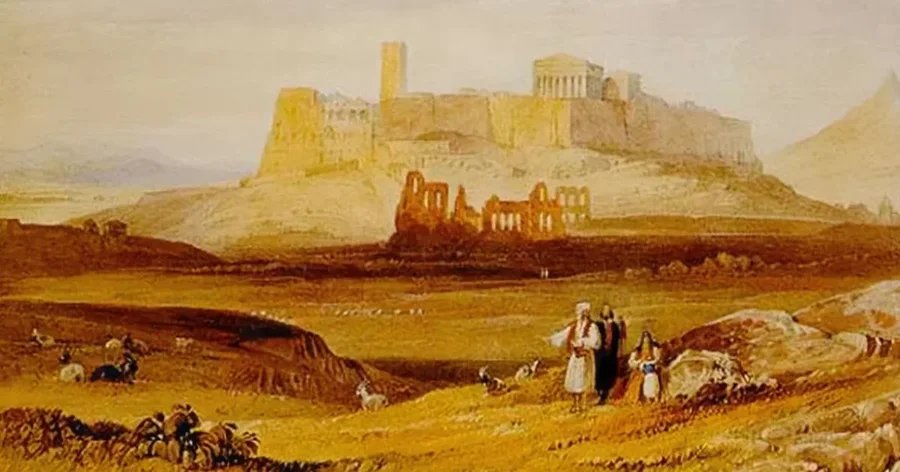
The French journalist Edmon Abou, has published in the Greek newspaper 'Protothema.gr', an article about the composition of the country's population many, many years ago, where he finds out that a part were Sikhs.
In the article entitled "Athens in 1850: Albanians, Poles, Maltese, arsonists and others...", Abou writes that Athens in the middle of the 19th century was partly inhabited by Albanians.
One of the foreigners who visited Greece a few years after its liberation was the French writer, academic and journalist Edmond Abou (Edmond Francois Valentin About, 1828–1885) . He came to our country as a scholarship holder of the French School and settled in Athens. He stayed in Greece until 1854. He traveled all over our small country at that time, and returning to Paris, published in 1855 his work 'Otto's Greece', provoking a storm of reaction.
In 1856 he published his novel "The King of the Mountains", which also caused a stir. At the same time he started writing articles for the newspaper "Le Figaro". Then he took the direction of the newspaper "Sek.
1/4 of the population of Greece in the middle of the 19th century were Albanians, writes Abu!
In chapter 2 of his book, Abu writes that Albanians make up about a quarter of the country's population. They are found, in most of them, in Attica, in Arkadi (I mention the village of Pavlica) and in Hidra.
They are a hardy and hardy race, as well fitted for agriculture as the Greeks are for commerce. The Albanians are a settled population, while the Vlachs are nomads and breeders, working and feeding the Greeks.
They are not looking for work and have no ambition to sit in an office. Every evening at sunset you meet around Athens caravans of entire Albanians returning with their wives from work in the fields. Almost all of them live on the slopes (slopes, but the plural of the word is slopes, not slopes...) of the Acropolis, in the same area where the Pelasgians once lived.
Vlachs sleep in the open sky in the mountains, among their flocks... In Greek, Vlach and shepherd are denoted by the same word. Albanians speak a special language that is not to be confused with any of the other Slavic idioms. The Vlachs speak a vaguely corrupted kind of Latin.'
Of course, reading this particular passage from Abu's book got us thinking. So we asked for more data on the population of Greece at that time, writes Protothema.
According to the official census data of 1853, the population of our country at that time was 1,042,527 inhabitants. For those who don't know, the Greek state consisted of the Peloponnese, Central Greece (the borders in the north were defined by the Pagasitikos - Amvrakikos Line, from the Gulf of Sourpi in Thessaly, to Menides in Etoloakarnania and a little further north), the Northern Sporades, the Oinousses of Messinia, Elafonissos and the Cyclades, with Eschati, south of Thira, which is the last Greek island in the south).
Is it possible that Abu traveled to all these countries within two years, 1852-1854, with the means and conditions of the time, and made a count of "Albanians"? Maybe it was impossible. Therefore his reference that ¼ of the population are "Albanians" is wrong. But who were the "Albanians" of Ebu? Obviously these are the Arvanites since the areas where they lived, according to Abu, were Attica (see Mesogeia etc.), Hydra and Arcadia. We have referred to Arvanitas of the Peloponnese at length in our various articles. / Protothema.gr




Lini një Përgjigje