


 Shkruar nga Pamfleti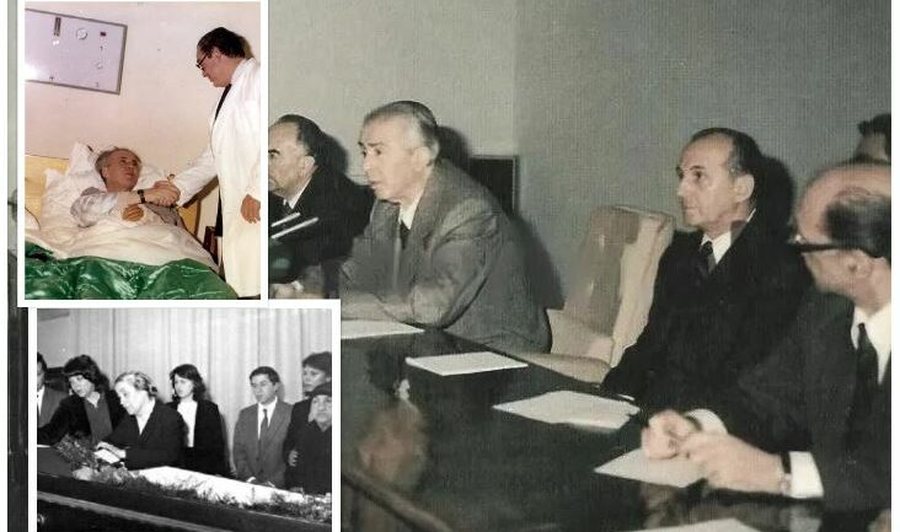
"In Albania, they are watching the soap opera 'Dinastia' from Belgrade television and it seems that the change has begun, as Ramiz Alia, as a gay Muslim, is appointing his people to the top leadership..."! –
Perhaps in no country has the death of Albanian leader Enver Hoxha, three months ago, been analyzed more carefully than it has been done in Yugoslavia, a country whose stability is directly influenced by the policies of the most secretive country in Europe. Stalinist Albania has figured in many of the "worst case scenarios" dreamed up by people whose job it is to analyze the future of the Balkans, the hottest region of Europe.
If the small mountainous country on the Mediterranean Sea were to return under Soviet tutelage, this could bring serious problems for their Yugoslav neighbors, due to the ethnic Albanian minority, which is politically tense. Therefore, an analyst of the bilateral relationship between Albania and Yugoslavia listened very carefully to an Albanian official who described the plot of the "Dynasty" series of the American television as a complicated detail.
It turned out from all the Marxist-Leninist rhetoric of this official, that he was a fan of the capitalist telenovela, which is broadcast in English, by Yugoslav television, whose frequency also goes to the Albanian capital, Tirana. A small incident at first glance, but which is a very clear indicator of how Albania is gradually - very gradually - emerging from four decades of self-isolation.
Just a few years ago, watching foreign television stations was strictly forbidden, as were other symbols of the "decadent" West, long hair, reading the Bible or driving a private car. From the point of view of the Yugoslavs, the new leaders of Albania are already at a historical crossroads.
An ever-increasing economic crisis and the desire to ease the difficulties of daily life, makes the 2.5 million inhabitants of Albania, to be in favor of an opening of the country to the outside world. But the political legacy of Enver Hoxha, a harsh sign of nationalism and factions within the leadership, make an immediate change dangerous and impossible.
In Yugoslavia, both Western diplomats and Yugoslav analysts agree that Hoxha's chosen successor, Ramiz Alia, 59, is still consolidating his political power after being appointed First Secretary of the Albanian Labor Party in April passed. As a Muslim Albanian from the North, i.e. a Geg, he must tread especially carefully, in a leadership dominated by Tosks, (southerners).
"If Alia, above all, feels insecure, he will continue to follow the current policies, even though the political situation is difficult", - says a Yugoslav official. "Once he stabilizes and puts his people in key positions, then maybe there can be some changes."
Last week, Albania published several statements of Hoxha's foreign policy, after the leader's death, expressing opposition to confusing political and commercial ties with countries with different ideologies. Western analysts appreciated this repeated statement and received confirmation that the change would not be immediate.
The current problems of the Albanian economy come as a result of the split with China in the late 1970s, leaving the country without a guardian for the first time in more than four decades. Hoxha, a French-educated teacher who led the uprising against Italian occupation during World War II, severed alliance relations with Yugoslavia in 1948 and the Soviet Union in 1962.
The few Western visitors allowed into Albania seem to harken back to the 19th century. Agricultural techniques are primitive, with the exception of the Steel Plant in the Central Albanian city of Elbasan, built with the help of the Chinese, while many other factories, in the eyes of the West, look like relics of the first stages of the Industrial Revolution.
Deprived of Chinese or Soviet aid, the only way to open up Albania and modernize its old assets is to increase foreign trade. Taking loans is prohibited by the Constitution, so all trade is done mainly through barter. According to Yugoslav statistics, the total turnover of commercial exchanges with foreign countries, now captures the small figure of 800 million US dollars, annually.
Albania exports chrome (it is the fourth producing country in the world for this mineral), electricity and oil, which it exchanges to get machinery, which it cannot produce itself. "Their economic difficulties seem to be increasing," says a Yugoslav official. "Every day in the official media, there is talk of fewer cuts. It is clear that the Albanian leadership is concerned with internal problems".
Like the United States of America, Yugoslavia has a clear strategic interest in stopping the Soviet Union from gaining access to Albanian warm water ports in the Adriatic. At this point, they are encouraged by Ali's harsh rejection, after a consoling message from the Russian leadership after the death of Hoxha, a clear sign that requires the start of a new era of relations between the Kremlin and Albania.
Yugoslav leaders are also concerned about what they see as Tirana's efforts to stoke tensions among the 1 million ethnic Kosovo Albanians in the Yugoslav province on the northern border with Albania. The political climate in Kosovo is still tense, after the serious rebellion in 1981, when Albanian demonstrators demanded the status of a federal republic for the province.
In the view of many politicians in Belgrade, this would be the first step in the disintegration of Yugoslavia into a multinational state. The delicate ethnic balances are threatened by the massive exodus of Serbs from Kosovo, due to Albanian threats and population pressure. Ironically, Albanian economic backwardness and the harsh nature of its regime can be seen as serving short-term Yugoslav interests, from the point of view of some analysts.
Although many of the Albanian-Yugoslavs see Albania as their homeland, they are also aware that the standard of living on the other side of the border is lower than theirs. After encouraging cultural ties between Albania and Kosovo in 1970, Yugoslav officials are very sensitive to what they refer to as Tirana's "interference" in the region.
Talks on a new cultural exchange agreement broke down last November, with Yugoslavia accusing Albania of refusing to recognize the rights of Yugoslavia's minorities. The first railway network between Albania and the rest of Europe will be inaugurated later this year, after work is completed on the line connecting Yugoslavia's Titograd with Shkodra in Northern Albania.
But the Albanians have given a clear signal that this is not an immediate opening with the outside world. When the Yugoslav side recently suggested regular passenger rail service between the two countries, the idea was rejected by Albania. At least, for now, the trains of the Shkodër-Titograd line will transport loads of chrome - not people./ Memorie.al




Lini një Përgjigje