


 Shkruar nga Pamfleti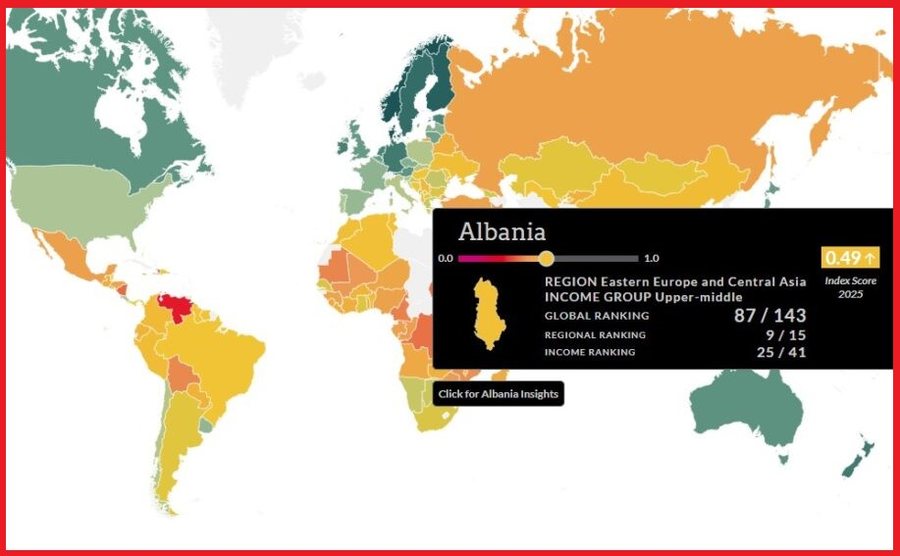
In the overall ranking of the Rule of Law Index 2025 (World Justice Project), Albania ranks 87th out of 143 countries, moving up two positions compared to last year, when it ranked 89th.
However, the country remains among the last in the Balkans, behind only Serbia (ranked 96). In the region, Montenegro performs better, ranking 55th, followed by Kosovo (ranked 59th) and North Macedonia (ranked 64th).
The index is built on eight main factors, which measure the functioning of institutions, respect for rights, and the strength of the rule of law in practice.
Constraints on Government Power – 105th place (up from 106th in 2024): This factor measures the extent to which executive power — that is, the government and political leaders — is limited by law, independent institutions, and democratic oversight mechanisms. On this indicator, Albania ranks 105th out of 143 countries.
Absence of Corruption – 105th place (out of 107): This indicator measures the extent to which public power is exercised without abuse for private gain. Albania ranks 105th, marking a slight improvement compared to the previous year.
Open Government – 78th place (out of 79): This indicator measures how transparent, accountable and inclusive public institutions are in relation to citizens. Albania ranks 78th, maintaining a similar position to last year.
Fundamental Rights – 68th place (out of 68): This factor measures the extent to which the basic rights and freedoms of the individual are respected and protected by the state. Albania has maintained the same ranking, in 68th place.
Order and Security – 55th place (out of 54): This indicator measures the extent to which society is safe, secure, and functions without violence or crime. Albania has dropped one place, ranking 55th.
Enforcement of Regulations – 111th place (out of 114): This indicator measures how well laws and regulations are implemented in practice, whether authorities follow, control and enforce the rules in a fair, consistent manner and without political or corrupt influences. Albania has moved up three places, to 111th place.
Civil Justice – 99th place (out of 101): This indicator measures the extent to which people have fair, equal and effective access to resolving civil disputes through the judicial system. Albania improved by two places, ranking 99th.
Criminal Justice – 82nd place (out of 92): This is one of the most important dimensions of the index, measuring the extent to which the criminal justice system is fair, effective, impartial and independent, ensuring that crimes are investigated and punished according to the law, without abuses and without human rights violations. Albania has moved up 10 places, to 82nd place.
Rise of authoritarianism deepens global rule of law recession
The global rule of law recession accelerated during 2025. 68% of countries experienced a decline in their rule of law levels in 2025, compared to 57% a year earlier.
“The steady deterioration of the rule of law had slowed in recent years. This year, however, we are seeing a strong reversal: more countries are getting worse and fewer are getting better,” said Alejandro Ponce, Executive Director of WJP.
The gap between rule of law improvements and declines is widening. Over the past year, countries that have improved have seen an average score increase of 0.52%; while those that have deteriorated have seen an average decline of twice as much: 1.07%. This shift highlights that building sustainable rule of law institutions is a long and iterative process, while their collapse can happen quickly.
The expansion of authoritarian tendencies – mainly through the reduction of civil space and the weakening of checks and balances – has been the main driver behind this deterioration, with deep declines in factors measuring Limits on Government Power, Open Governance, and Fundamental Rights.
The index shows that judicial systems are losing ground to executive interference, with political influence on justice systems increasing. Indicators measuring whether the judiciary limits executive power and whether civil and criminal justice are free from undue government influence fell to 61%, 67% and 62% of countries, respectively.
More broadly, civil justice has weakened in 68% of countries. This decline reflects longer delays, less effective alternatives to the courts (such as mediation), and greater government interference.
At the top of the global ranking are Denmark, Norway, Finland and Sweden, which maintain their traditional positions as the countries with the highest level of rule of law in the world. /Monitor








Lini një Përgjigje