


 Shkruar nga Pamfleti
According to Artificial Intelligence, the Albanian government should act with a combined package...
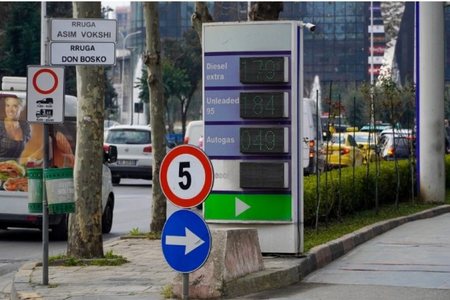
While the Albanian government's response to the oil price hike is very slow and has almost no effect, we asked Rama's minister's "brother", 'Diella', to tell us about the steps the government should actually take to ease the burden on citizens' pockets.
According to Artificial Intelligence, the Albanian government should act with a combined package: temporary fiscal relief on fuel, targeted support for families in need, stronger control over the functioning of the market, limited assistance to sectors with a chain effect on inflation, and maintaining budgetary discipline.
The full answer of Artificial Intelligence:
The Albanian government should not treat the increase in fuel prices as a normal market episode. When a geopolitical conflict hits the global oil supply and increases the costs of transportation, production and supply, public intervention should be rapid, targeted and fiscally controlled. At this stage, the main objective is not to artificially reduce prices at all costs, but to cushion the blow to households and businesses without damaging budgetary stability.
The first measure that the government should consider is the temporary review of the fiscal burden on fuels. In Albania, the final price of oil and gasoline includes not only the cost of import, but also a high burden of taxes and fees. When the international price increases sharply, the entire burden is transferred to the domestic consumer. In this situation, the government should use part of the fiscal space to temporarily reduce the external impact, through a partial reduction of excise duty or other elements that burden the final price. This measure should be neither general nor unconditional. It should have a deadline, be periodically reassessed and be directly linked to the behavior of prices in international markets. Otherwise, it becomes a permanent burden on the budget.
At the same time, the government should not follow the universal subsidy model. The same support for all consumers has high costs and also benefits the groups that do not really need assistance. The most efficient approach is to target assistance to low-income families, pensioners and categories that spend the largest part of their budget on energy, transport and food. This can be achieved through direct transfers, partial compensation of bills or expansion of existing social support schemes. The economic logic is clear: when budgetary resources are limited, the state should protect the basic consumption of the most exposed groups and not uniformly subsidize the entire market.
Another area where the government should act is the supervision of the fuel and energy market. In times of international crises, the increase in real costs is often mixed with an increase in trade margins. This is especially the case in markets where competition is weak or where the transparency of price formation is low. For this reason, the government should require clearer publication of the price structure, strengthen the role of the Competition Authority and monitor in real time the behavior of the main operators. The goal is not permanent price management, but the prevention of excessive profits in crisis conditions. If it is found that the growth in the domestic market goes beyond what is justified by imports and operating costs, the government should intervene with temporary margin-limiting mechanisms.
Beyond protecting families, the government should also think about businesses facing sudden increases in costs, especially for sectors that have a direct impact on consumer prices. Transport, agriculture, food processing and basic services immediately feel the rise in fuel and energy prices. If these sectors are left without support, the increase in costs is transferred to final prices and hits the consumer again. Therefore, the government should consider limited support packages for sectors with a knock-on effect on inflation, not in the form of general subsidies, but with targeted, conditional and time-bound instruments. Assistance should be provided where it preserves supply, prevents new price increases and avoids disruptions to activity.
An often overlooked dimension is the indexation of social policies to the new price reality. If energy and fuel prices increase, the impact does not stop at the pump or the electricity bill. It spreads to food, urban transport and basic living costs. This means that economic assistance schemes, minimum pensions and other forms of social protection lose real power if they are not adjusted to inflation. The government should reassess the level of social support not on the basis of average formal inflation, but on the basis of the increase in the basket of basic goods that affect low-income families. This approach is more economically fair, because inflation does not hit all families in the same way.
Equally important is that the government maintains fiscal discipline. In such a situation, the political temptation is great to intervene broadly, but any ill-calculated relief package could worsen the deficit and increase public debt. Albania does not have the luxury of pursuing costly and protracted policies without medium-term costs. For this reason, any measure must have three conditions: a clear source of financing, a defined deadline, and a measurable objective. The government should first redistribute existing spending, suspend less priority items, and only then commit additional funds. Good intervention is not measured by its size, but by its efficiency.
More strategically, the government should use the current crisis as an argument to accelerate the reduction of dependence on external energy shocks. Albania remains exposed not only because of fuel imports, but also because its response depends on developments beyond its control. This requires more serious investments in domestic energy sources, energy efficiency, reserve capacities, and infrastructure that reduces the cost of dependence on international markets. These measures do not provide immediate results for next month's bill, but without them, any new geopolitical crisis will put the government back under the same pressure.
Finally, the government needs to improve its economic communication with the public. In times of crisis, lack of clarity increases uncertainty and makes markets more nervous. The government needs to explain what is happening, what measures it is taking, how long they will last, and who benefits from them. This is not a formality. Transparency reduces panic, stabilizes expectations, and makes public intervention more credible./ Pamphlet



Tallje Trapi hiqni 50 % te taksave te naftes pezulloni PPP e karburanteve keto lek shkojne ne xhepat e hajduteve MOs dilni sa per show ku jane rezervat 90 dite qe kompanite e karburanteve e kane detyrim ligjor ?? Sot ministra e deputete aksionere ne kompanite e karburanteve prandaj nuk u hyn gjemb ne kembe . Vetem ne jemi Shtet pa Shtet ne raste krizash apo katastrofash Nese nuk merren masa Nuk do jete e larget dita kur nafta do kaloje 300 leke per liter
Bravo Tos!