


 Shkruar nga Pamfleti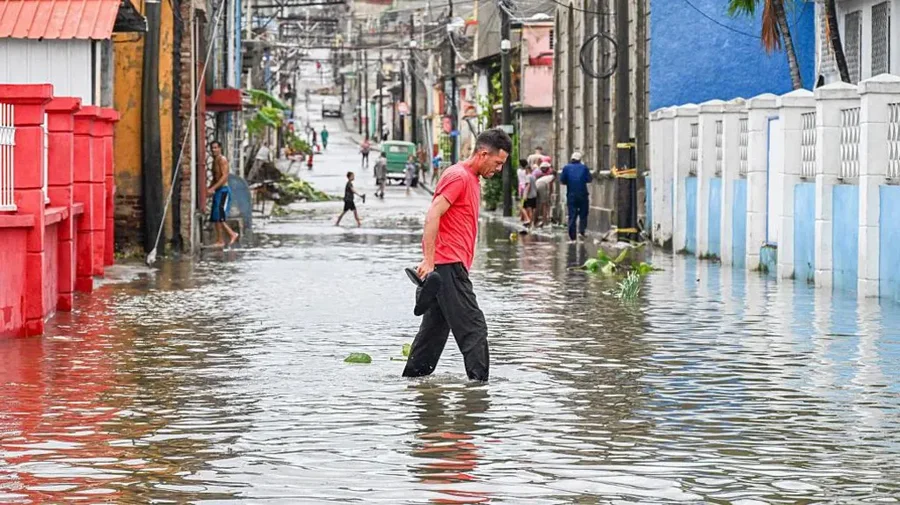
Hurricane Melissa has destroyed homes and infrastructure across the Caribbean, flooding neighborhoods and leaving dozens dead.
The impact on Jamaica was most evident on Wednesday, as the island nation took a direct hit from the Category 5 monster, one of the most powerful hurricanes ever measured in the region. At least 5 people have been confirmed dead there.
At least 20 more died during flooding in Haiti as Hurricane Melissa, now weakened to a Category 2 storm, swept through the region.
In Jamaica, people remain stranded on rooftops and without power. Prime Minister Andrew Holness noted "total devastation" across the island.
He added that "80-90% of the roofs were destroyed," along with hospitals, libraries, police stations, port houses and other urban infrastructure.
King Charles, who is the head of state in Jamaica, said in a statement that he is "deeply concerned" and "deeply saddened" by the damage caused by Melissa in Jamaica and across the Caribbean.
"This storm, the most terrifying of the record-breaking storms, reminds us of the increasingly urgent need to restore the balance and harmony of Nature for the sake of all those whose lives and livelihoods may have been destroyed by this heartbreaking catastrophe," he said.
From Jamaica, where the storm also caused mudslides and palm trees that were uprooted like toothpicks, Melissa moved north toward Cuba as a Category 3 storm, bringing 115 mph winds and torrential rains, and hitting the southeast of the island.
Rovier Mesa Rodríguez, a video maker living in Santiago de Cuba, called the storm "terrible" and described it as sounding "like a tornado."
Cuba's President Miguel Díaz-Canel urged residents to "not lower their vigilance" and said the country was prepared for the worst-case scenario, which helped its response.
As of Wednesday night, the storm was 105 miles (170 km) from the central Bahamas and was expected to make landfall in the Bahamas overnight. Hurricane Melissa was moving northeast with maximum sustained winds of 96 mph (155 km/h). A dangerous storm surge is expected there before moving further north toward Bermuda.
A tropical storm warning is in effect for the Turks and Caicos Islands and the slow-moving hurricane's speed is expected to increase in the coming days.
In Jamaica, three men and a woman were confirmed dead. They were discovered after being swept away by floodwaters during the storm, said Desmond McKenzie, Jamaica's minister of Local Government and Community Development.
About 3/4 of the country lost electricity overnight.
Richard Vernon, the mayor of Montego Bay, told the BBC that half of the city had been cut off from the other half due to flooding. He said the priority was to "check if everyone is alive".
A resident of St Elizabeth, who was sheltering in her four-bedroom home, described the moment her roof collapsed.
Gordon Swaby, a businessman in Kingston, told the BBC that his first cousin's house was completely destroyed. His cousin, who had recently moved from the United States to her "dream" seaside home in the upscale Crane Road area, lost the entire concrete structure and everything in it.
"She wanted a different kind of life," Gordon said. "She chose the area because she loves the ocean, so this is really devastating."
Destruction was visible across central Jamaica on Wednesday. The town of Mandeville was flattened and the main road through the town was littered with debris.
Pieces of construction materials were scattered along the road. The cleanup is expected to take months.
In Haiti, at least 20 people, including 10 children, died in river floods, local authorities told the AFP news agency.
The island, which the country shares with the Dominican Republic, was hit by catastrophic flooding and landslides, which forced 3,000 people to take shelter.
"Many houses have been flooded on the coast," said Pascal Bimenyimana of the Christian NGO, World Relief, in Port au Prince. Structures also lost their roofs and people were cleaning up the debris with their bare hands, he said.
Gusty winds, torrential rains, and flooding destroyed crops throughout the south of the country.
The U.S. is sending a disaster response team to Jamaica to assess the extent of the need after the hurricane. Formal requests for assistance have come from Haiti and the Bahamas, according to senior State Department officials.
The aid comes after the Trump administration closed the United States Agency for International Development (USAID), which was the world's largest aid agency, due to cuts in foreign aid by billions of dollars.
Melissa is not expected to reach North America, but will still be a formidable extratropical cyclone when it approaches St Johns, Newfoundland, in Canada on Friday evening. / Adapted from BBC /





Lini një Përgjigje