


 Shkruar nga Pamfleti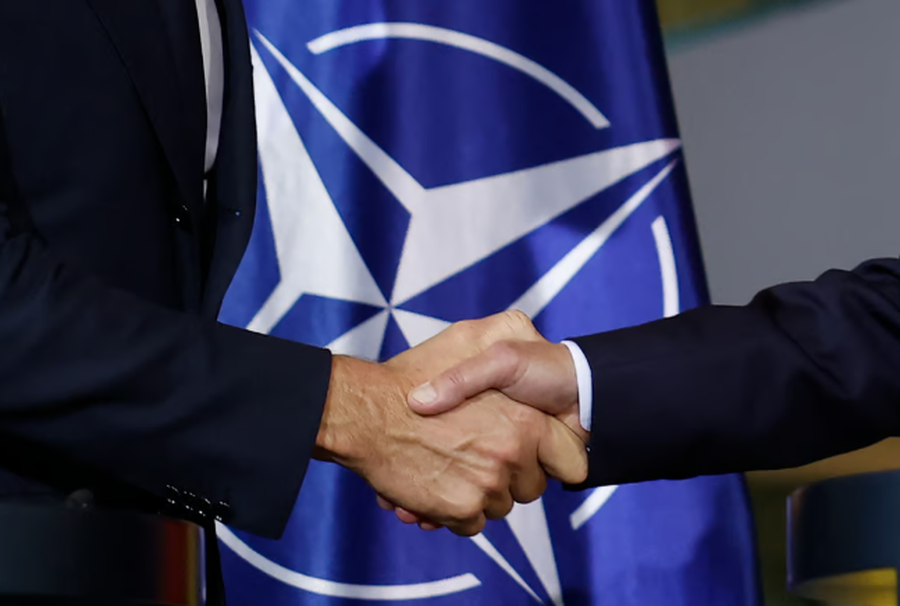
Gilberto Teodoro, the Philippines' defense secretary, dismissed the idea of an Asian NATO at a recent security forum.
No one believes that NATO will expand to Asia - least of all the Asian countries. But there is still talk of the possibility. In reality, Indo-Pacific governments tend to prefer individual partnerships with Western defense giants, and opening the door to a Western alliance would be wildly out of character. Meanwhile, European allies are reluctant to stretch further, and the US believes it is "premature" to talk about an Asian NATO.
However, the biggest reason behind all the rift and internal rivalry within the Indo-Pacific is that the biggest enemy of an Asian state is often another Asian state. And yet, paradoxically, the nations of the region still tend to have a general preference for resolving disputes among themselves.
Along these lines, Gilberto Teodoro, the Philippines' defense secretary, dismissed the idea of an Asian NATO at a recent security forum, saying that "dichotomies and divergences in country interests" within the region dimmed the prospect of an alliance of unified military.
According to two EU diplomats, who spoke on condition of anonymity, there are no plans to offer dangerous guarantees, such as an Article Five-type mutual protection guarantee, to their Asian allies and partners either.
So, it seems that neither NATO expansion in Asia nor an Asian NATO are true on paper. But this does not mean that further cooperation is not inevitable or that prevention is impossible.
When the Russian tanks entered Kiev, the echoes were felt not only across the Atlantic, but also across the Pacific. And since then, NATO and its four Asian partners (AP4) - Japan, South Korea, Australia and New Zealand - have met more frequently. They have mainly discussed how to respond to the hybrid war of China and Russia. In 2022, they participated for the first time in a NATO summit. And last month their defense ministers attended a NATO defense ministerial in Brussels.
This increased commitment is intended to dissuade Beijing from occupying Taiwan, to discourage it from bullying other Western allies in the region, and to counter its "borderless" partnership with Moscow. According to NATO, Beijing is a "crucial enabler" in the ongoing conflict in Ukraine, and allies believe that China is not only keeping the Russian economy afloat, but also supplying the country with weapons and technology.
However, while security in the Euro-Atlantic and Indo-Pacific regions seems to be growing more and more connected, all the noise about NATO expansion in Asia is actually being fueled by China – not European capitals.
Division is the norm in the region, and there is still no consensus on how to respond to China's hostility. For example, various Southeast Asian countries, such as Indonesia, Vietnam, and Malaysia, have competing claims over islands in the South China Sea. And although Beijing has raised the Chinese flag and built military posts on small islands in the middle of this disputed sea, others have preferred a peaceful, non-combatant solution, but have failed to adopt a unified approach.
Moreover, Seoul and Tokyo despise each other over a number of historical issues. Imperial Japan's exploitation of South Korea during and before World War II, and South Korea's control of the resource-rich Liancourt Rocks islands are a continuing source of mistrust and hostility. In fact, South Korea views Japan along with China as one of the main security threats.
Ying-Yu Lin, a military expert at Taiwan's Tamkang University, believes the division among the Asian allies will never allow them to unite under a common defense umbrella.
Then there are the precious trade links with Beijing to consider – links neither Asia nor Europe want to disrupt too much. Because even though the anti-China rhetoric may become sharper with the second term of US President-elect Donald Trump, Beijing remains the main trading partner of both.
But despite the lack of a full entry into NATO, cooperation continues to grow. Factoring in Asia's rift, US President Joe Biden and his team have created smaller groups to contain China.
First, Biden revived the Quadrilateral Security Dialogue, or Quad, involving Australia, India, Japan and the US. Subsequently, India's sensitivity to being seen as part of a security alliance against China gave rise to the Squad, which excludes India but includes the Philippines. The US has also encouraged confidence-building measures between Seoul and Tokyo, supported Japanese defense investments and identified new bases for joint use in the Philippines.
European allies, for their part, began building a cooperative framework with the goal of containing China. And according to experts, just as the EU supports Ukraine without being a NATO member, the bloc can also help its partners in Asia by providing intelligence and material support.
Recently, NATO Secretary General Mark Rutte also revealed that it was South Korean intelligence that informed NATO of the "deployment of thousands of North Korean troops in Russia's Kursk region." And defense-industrial cooperation with Seoul has become essential since South Korea supplied Ukraine with more ammunition than Europe.
Meanwhile, others believe that as Japan gradually breaks away from its pacifist constitution and continues to increase defense spending, mistrust between Seoul and Tokyo may show signs of abating. Just last month, the EU and Japan signed a Security and Defense Partnership to promote "concrete maritime cooperation" and discuss "defense initiatives including the exchange of information on issues related to the defense industry."
Moreover, it was Japan's new prime minister, Shigeru Ishiba, who said it was time to set up an "Asian NATO," as if to turn China's rhetoric into a call for unity./ Adapted "Pamphlet" from "Politico"





Lini një Përgjigje