


 Shkruar nga Federico Rampini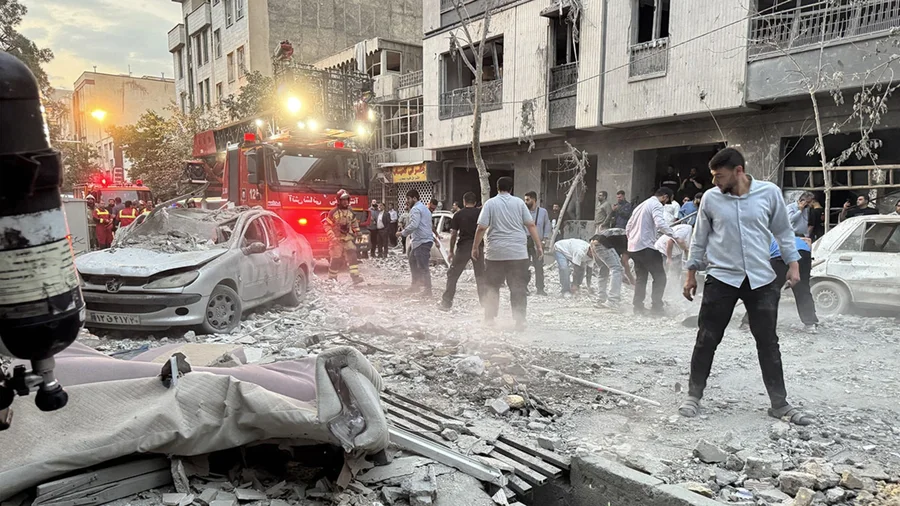
Behind the precision of Israeli airstrikes and missiles lies this reality: the Mossad secret service continues to have a network of infiltrators and collaborators within the Tehran regime. This is not only because the Mossad does its job well, but also because anger has grown in Iranian society...
Could Iran end up like Syria? The Israeli military offensive, in addition to the main objective of blocking Tehran's nuclear plans, now openly evokes an operation for "regime change", the overthrow of the theocracy of the ayatollahs.
Netanyahu has spoken about this, and besides words, facts matter: the selection of military targets struck by the Israelis so far has been quite coherent with the statement that "this is a war against the Islamic Republic, not against Iran."
At least in the early stages of the offensive, the Tel Aviv armed forces seem to have mainly targeted military installations and military leaders. Even in the comments of very progressive and anti-Netanyahu American observers (I will cite one in particular), there is a hope that the Syrian case will be repeated: an overthrow of Khamenei after that of Assad, who, moreover, had long been protected by the ayatollahs themselves. A crucial element generating this belief is the recent success of the Mossad.
Behind the precision of Israeli airstrikes and missiles lies this reality: the Mossad secret service continues to have a network of infiltrators and collaborators within the Tehran regime. This is not only because the Mossad does its job well, but also because anger, exasperation and rejection of a despotic, bloody, corrupt and incompetent regime has grown in Iranian society. The Mossad finds it “easy” – a way of saying it – to recruit spies in Tehran because many, even at the highest levels, are betting on the end of the regime. This is one of the signals that also strikes the Americans and could make them more inclined to support the ongoing offensive.
Trump is generally wary of those who would drag him into “regime change” and “nation-building” operations abroad, given his radical criticism of the Bush wars. But Netanyahu offers him the chance for a historic breakthrough – no American president has managed to resolve the Persian question since 1979 – and with a relatively limited American military commitment, as the bulk of the operations fall on Israel’s shoulders.
To witness this climate change in the United States, I suggest you read a highly respected journalist, and known as anti-Netanyahu: Thomas Friedman of the New York Times.
For decades, Thomas Friedman has been considered one of the most well-informed reporters on the Middle East, where he has long been a correspondent and envoy. He has always waged a relentless campaign of criticism against Netanyahu, whom he deeply opposes. Just as he opposes Trump. That is why the much more neutral tone of this latest comment of his stands out, the overtures he makes to the Israeli prime minister – with the important exception of Gaza – and the credibility he gives to a scenario of overthrowing the fundamentalist regime in Tehran. Even in Trump's Middle East policy, this latest intervention is less negative than usual. However, he warns that a regime change does not necessarily bring a peaceful scenario.
Here is the full translation of his latest analysis, titled "How to Judge What's Going on Between Iran and Israel," from the New York Times website:
“Friday’s large-scale attack by Israel on Iranian nuclear infrastructure should be added to the list of decisive and transformative wars that have reshaped the Middle East since World War II, known simply by their dates – 1956, 1967, 1973, 1982, 2023 – and now 2025. It is still too early to say how the Middle East ‘great game’ will be changed by the 2025 Israeli-Iranian conflict, and the possible outcomes are numerous. All I can say for now is that both the more optimistic hypothesis (that the attack triggers a domino effect that ends with the fall of the Iranian regime and its replacement by a more honest, secular, and consensual one) and the more catastrophic one (that the entire region goes up in flames, drawing the United States in) are both on the table. Between these two extremes there remains an intermediate possibility – a negotiated solution – but not for long. President Trump has cleverly used the Israeli attack to say, in essence, to the Iranians: 'I'm still willing to negotiate a peaceful end to your nuclear program, and you should probably do it quickly – because my friend Bibi is CRAZY. I'm expecting a call from you.'
Given the wide range of possible scenarios, the best I can offer is a list of key variables that I will monitor to understand which of these outcomes – or another yet unforeseen one – will be the most likely.” /Adapted from “Corriere Della Sera”


Lini një Përgjigje