


 Shkruar nga Pamfleti
Vevçan, from folk carnival to geopolitical signal on the Albanian border...
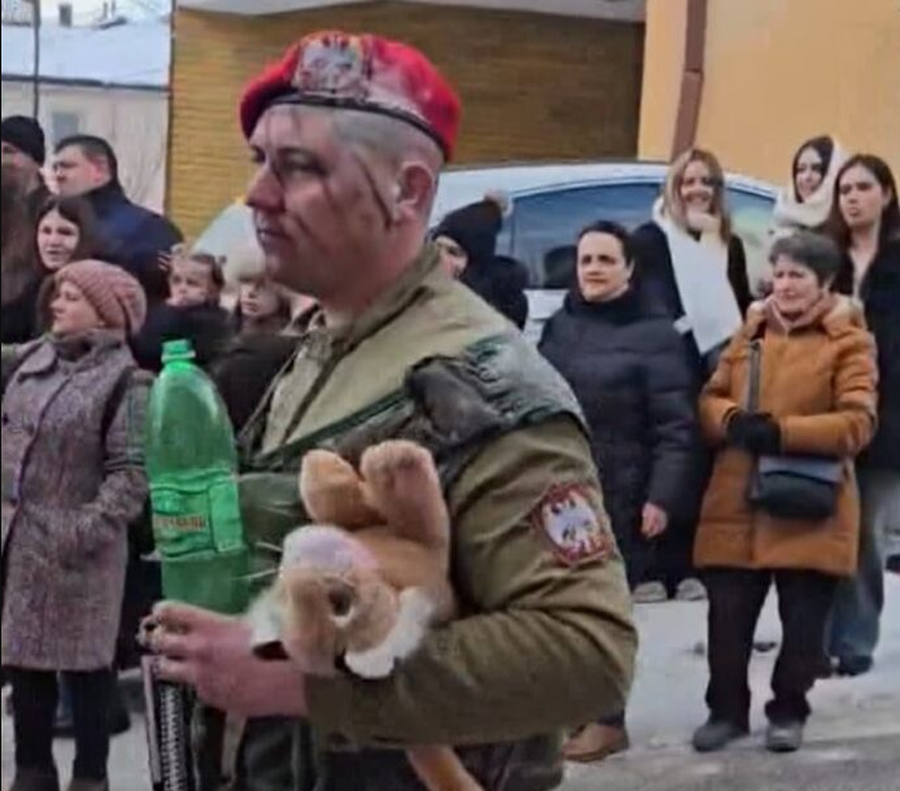
The parade of Serbian paramilitary symbols and chauvinistic songs at the Vevcani carnival places a peripheral municipality in North Macedonia in the focus of Russian-Serbian influence in the Balkans.
The Vevcani carnivals, promoted as a local satirical tradition, have become a politically and geopolitically charged scene after the appearance of Serbian paramilitary symbols and songs used during the wars of the 1990s. The event takes place in a strategic area near the border with Albania and the Balkans, at a time when international reports speak of the return of the Balkans to the agenda of Russian-American negotiations. Without being proof of a Macedonian state strategy, Vevcani appears as an indicator of the penetration of expansionist narratives and as a potential hotbed of influence in a geopolitically sensitive region.
The Vevcani Carnival is a provincial performance in the village of Vevcani, North Macedonia, an area inhabited by fewer than 2,500 inhabitants, lying between Struga and Dibra, near the border with Albania.
It is a not very frequented border, but one that is of strategic importance for North Macedonia, as it is connected to the Golloborda area, where an old Bulgarian dialect is widely used and where some of the residents have Bulgarian or Macedonian citizenship.
Vevcan is located near the Jablanica highlands, a territory where for centuries, during Bulgarian rule in the early Middle Ages, monasteries and Orthodox churches with historical ties to Sofia were built.
During the 19th and 20th centuries, during the period of displacement of Albanians from their lands in the Balkans, Serbia used this territory to create an island with “old Slavic roots.” This island still exists today, although economically and demographically it has no particular weight.
In Vevcani, there is a carnival tradition that has become a springboard for national identity for Macedonian circles uncertain about their linguistic and ethnic roots. This is how the narrative of a supposedly 1,400-year-old tradition of satirical carnivals, where political figures are parodied, is built.
It's incredible to think that for 1,400 years, the inhabitants of the Jablanica highlands have been engaged in “Saturday Night Live”-style parodies. However, a few days ago, the annual carnival took place there, which received widespread media coverage.
This happened because, in addition to mocking Edi Rama's "Diella" surrounded by police, in parody of the investigations into the ANA in Albania; the carnival also featured people dressed as the infamous paramilitaries of Željko Ražnatović, known as Arkan, perpetrators of massacres in Bosnia and Kosovo during the wars of the '90s.
One of the carnival participants also carried a stuffed tiger, as Arkan did in public appearances, with the difference that in his case the tiger was real.
Albanian media and politics in North Macedonia, with few exceptions, did not take this case seriously, treating it as a manifestation of nationalist and chauvinist mindsets.
But two days later, international documents and reports brought to attention rumors of a possible pact between Donald Trump and Vladimir Putin, where the so-called "New World Order" would include the Balkans.
Radio Free Europe reported that Sergey Lavrov has a negotiation plan ready for the Balkans, which has worried countries that have problematic relations with Moscow.
A long-standing German report sees North Macedonia as a potentially dangerous area for reopening discussions on the division of territories. This was also the reason why Angela Merkel strongly opposed the land swap plan during Trump's first term.
Vevcan is a municipality with a Macedonian Orthodox majority, administratively separated from Struga in 2004, and is located about 8–10 km from the border with Albania, with direct connections to Pogradec and Tirana.
In September 1991, less than two weeks after Macedonia declared independence from Yugoslavia, Vevcani symbolically declared independence through a local referendum. This act was not recognized, but remains indicative of a local tradition of symbolic rebellion.
Recent developments place Vevcani in a new context. During January 13th and 14th, as part of the St. Basil's Carnival, a ritual associated with the New Year according to the Julian calendar, the Serbian national-chauvinist song "Ko to kaže, ko to laže, Srbija je mala" was heard.
During the 1990s, this song was used by the Serbian army, police and paramilitary formations in Kosovo, Croatia and Bosnia and Herzegovina. Its presence at a traditional festival does not prove a Macedonian state strategy, but rather shows the penetration of expansionist narratives into uncontrolled areas.
In this area, where there is almost no Albanian population, Russian influence is visible through banners and graffiti. Although it is a small territory, it is considered a potential hotbed of influence, usable by Russia as a buffer zone in a geopolitical reconfiguration.
Not coincidentally, in 1991 Vevcani symbolically declared independence, presenting itself as a Russian-Serbian space near Albania, specifically with the Golloborda region, where joint "folklore" activities are often held, and where, in addition to residents, the presence of officials and secret service officers is also noticeable./ Pamphlet


Kte idiotin qe eshte vesh si Arkani do e vrasin te tijet e do thone e vrane shqiptaret. Idiot i dobishem.
Nuk ka nevoj per perdredhje fjalësh. Rregulloni Shqiperine, dilni ndalni megahajdutet qe bëjnë vjedhje monstruoze te parave te buxhetit te shtetit ditën per diell. Nuk ecet me hajni, droge, tendera ku stervjedhet, qe nga kryetari, kryeministri, ministri, deçiteti, kryebashkiaku e deri te me i vogli.
Po perkatite lufta midis serbise shqiperise ne veri shqiperi dhe Macedonia midis shqiperise vovojdina shqiperise greqia midis shqiperise malicious Serbia cenike Romania bosnja hungaria bullgaria dhe qipro
Ndokush që e ka IQ më të lartë se Ajshtajni, të na ndihmoi duke dhënë një përgjigje; Pse Tramp nuk ftojë në Davos, as Malin e zi dhe as Maqedoninë e Veriut?