


 Shkruar nga Jack Watling
Other measures that could significantly improve morale would be increasing payments and compensation for families and providing every means to defeat the glide bomb threat. This should be a priority for Ukraine's partners.
After 3 years of Russian attempts to invade and annex Ukraine, the country continues to put up fierce resistance.
Russia is suffering more than 1,500 casualties a day and is slowly gaining ground. But the Ukrainian military is also coming under immense pressure.
As steps are taken toward a negotiated settlement, it is vital that military support is maintained. If Vladimir Putin believes he can achieve his objectives by force, he will talk, but he will not stop fighting.
The Russian approach today has three essential components: infantry, glide bombs, and FPV drones. Russian infantry constantly advances in small groups to threaten Ukrainian positions.
The Ukrainians focus on trying to kill the aggressors 10 km or more in front of their positions, aiming to minimize the size of the Russian units.
The Russians have struggled to gain ground, largely due to the continuing decline in the quality of their infantry, driven by a high rate of attrition over the course of 2024. But this tactic puts Ukrainian troops at the forefront of Russia's other capabilities.
The deadliest weapon in Russia’s arsenal today is the glide bomb. The Russians use precision-guided glide bombs, dropped by Russian aircraft between 40-70 km behind the front line, with enough explosive power to collapse trenches or level buildings. To avoid being killed in their trenches, Ukrainians must spread out, so that a squad of 8 soldiers is tasked with defending between 70-200 meters of ground. With so few defenders at any point along the front, it becomes difficult for soldiers in positions to rest and they must resupply.
Resupply is threatened by Russian drones and artillery. Russia has caught up with Ukraine in the use of FPV drones and has innovated with the use of fiber-optic FPVs that are impervious to electronic warfare to shoot down Ukrainian troops and vehicles behind the front lines, where Ukraine now suffers about 50% of its casualties. Combined with Russian artillery, this makes it extremely dangerous to resupply combat positions or evacuate the wounded. Ukrainian medics have to talk to soldiers through procedures over the radio, because it is too dangerous to try to reach the trenches.
This combination of systems is slowly forcing Ukraine back. Although Russia is taking more casualties, it has the wherewithal to continue this weak exchange for another year. The Russian force attacking Ukraine now consists of 580,000 troops. The Russians have contracted 400,000 soldiers by 2024, while the Ukrainian Armed Forces are holding a 1,200 km front with fewer than 200,000 troops. On this basis, Putin believes that he can simply fight for more than Ukraine can hold.
Although Russia currently has the military advantage, the margin of this advantage is small. The Russian military is extremely weak, largely due to the poor quality of its infantry and the lack of lower-level command and control. While Russia is steadily destroying Ukraine’s defense lines, it is failing to exploit them. The current paths to a military victory for Russia are that Ukraine finds itself with so few troops that it cannot adequately defend the entire front, allowing Russia to simply bypass Ukrainian units, or that Ukraine’s partners stop supplying the country with enough weapons to continue fighting.
The biggest threats to Ukraine today are force generation and morale. Ukraine has enough men to continue the war, but its training system is broken. Most tactical training is done at the combat unit level, but the good combat units are all stuck at the front. This has led Ukraine to try to create new brigades, but the result has been inexperienced new units, while the experienced force has been depleted. If recruits are simply sent to existing units, however, they will find themselves in combat with inadequate training.
President Zelensky has begun to address this problem by halting the creation of new units and forming military corps, which are intended to command several brigades so that experienced units can be taken off the front lines, recruit new recruits, and train them before returning to fight. Another vital function of this reform is to give Ukraine’s veterans a chance to rest.
Other measures that could significantly improve morale would be increasing payments and compensation for families and providing every means to defeat the glide bomb threat. This should be a priority for Ukraine's partners.
If Ukraine can regulate its force generation process, then the timeline for a Russian military victory could be significantly extended. Under these circumstances, the leverage would shift away from Moscow, and it is possible that Russia would change course. Rather than slowing down talks to buy time to break the Ukrainian military, the Russians could very well push for a ceasefire.
But Ukraine would then be in grave danger. It would have to hold elections - which would be controversial. The troops would want to demobilize and see their families. But Russia would not demobilize, and once it stopped taking heavy losses, its industries would rearm its military forces. The danger then becomes that Moscow would destabilize Ukraine from within, cripple its economy by threatening to resume hostilities, and then attack when Ukraine is much weaker.
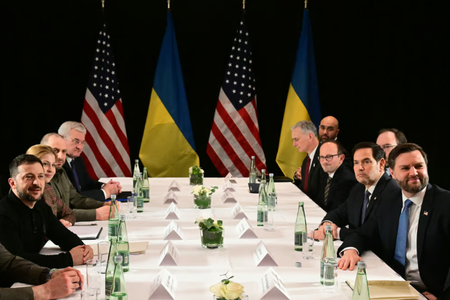
Because of this persistent threat, even in the event of a ceasefire, President Zelensky has emphasized that security guarantees are essential for a lasting peace.
The United States has now made it clear that it will not be a guarantor. Therefore, European policymakers now face a clear choice. If they want peace, they must invest in their militaries to maintain it. If Ukraine is defeated, the threat to Europe will be acute.
Ukraine needs investment in industrial capacity. Europe has the money, but it is not yet clear whether Britain and Ukraine's other European partners have the will to spend it. /Adapted from The Guardian Pamphlet/


Lini një Përgjigje