


 Shkruar nga Pamfleti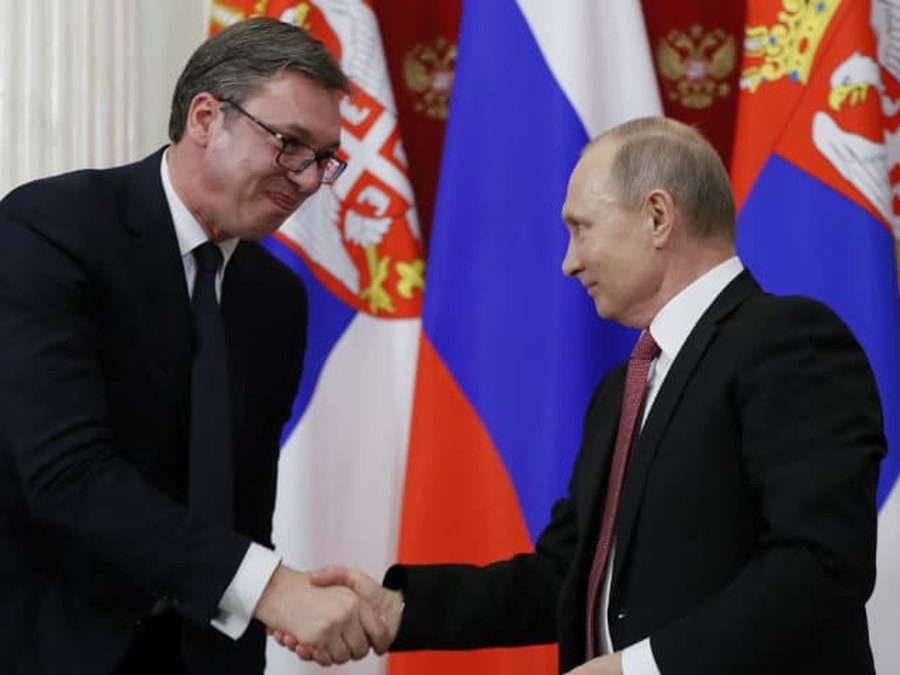
Serbia is distancing itself not only politically but also strategically, further deteriorating relations and paving the way for a harsher Russian response.
It remains an open question whether Russian President Vladimir Putin has crossed the "red line" set by Donald Trump and whether Washington is ready to impose more painful sanctions against Russia, says former US diplomat John B. Craig, a senior fellow at the Transatlantic Leadership Network in Washington and a member of the advisory board of the Institute for Politics and Economics of Southeast Europe in an article.
He writes that Moscow is waking up the US President's administration with its continued defiance and irresponsible activities. Putin is preparing for a long political battle for influence with Washington, Craig argues. The new target now appears to be Serbia, another Western Balkan country friendly to Russia.
Although Serbia is considered a traditional ally of Russia, it has been revealed that it has been supplying weapons to Ukraine, including multi-barrel rocket launchers and mortar shells, reportedly via Bulgaria and the Czech Republic. This provoked a strong reaction from Moscow, which called the move a “stab in the back” and a “betrayal.”
On May 29 of this year, the Russian Foreign Intelligence Service publicly condemned Serbia, Moscow's second official warning to Belgrade in a month. Such public statements are rare and indicate a shift from quiet diplomacy to open pressure.
There is also the accusation from Alexander Dugin, the right-wing ideologue often called “Putin’s brain,” who recently said that Serbian President Aleksandar Vučić “no longer has legitimacy.” He has also supported the protests in Serbia that have erupted over corruption, negligence, and shoddy construction and that have continued since the deadly collapse of the Novi Sad railway station canopy (November 1, 2024). In response to the revelations and mounting domestic pressure, Vučić has announced a suspension of all military exports, perhaps in an attempt to ease tensions with both Moscow and domestic public opinion.
Geopolitical implications
A possible “breakthrough” in relations between Russia and Serbia could be a turning point. While Belgrade has tried to balance East and West for years, the indirect arming of Ukraine could be a red line for Moscow.
Serbia is also a key player in the region. Any internal turmoil or external pressure (whether from Russia or the EU) could have wider implications for the entire Western Balkans. The reference to “long-term political struggles for influence,” which is Putin’s broader strategy, shows that Russia still sees the Balkans as part of its sphere of interest and will react harshly to any rapprochement with the West.
What is Dugin's role? Although he does not have an official position, Dugin's statements often reflect the Kremlin's tone. His outspoken criticism of Vučić suggests that Russia could support the opposition or destabilize the government if Vučić were to move even closer to the West.
The American diplomat believes that Putin, in addition to arming Ukraine, also disliked Serbia’s significant agreements with the West. Last July, Serbia, the EU and Germany signed a battery supply chain agreement, which gave the EU access to raw materials sourced in Serbia. With significant lithium deposits, especially in the Jadar Valley, Serbia has the potential to become a major supplier of the key battery metal to Europe. The agreement was hailed by then-German Chancellor Olaf Scholz as a megaproject that could reduce Europe’s dependence on China. If implemented, the $2.4 billion (€2 billion) Jadar lithium project could meet 90% of Europe’s current lithium needs. What does the agreement entail and why is it geopolitically important?
Serbia is committed to developing infrastructure for the extraction, processing and export of lithium, cobalt and other raw materials needed for batteries in electric vehicles. The agreement aims to reduce the EU's dependence on China for rare metals and critical minerals, which puts Serbia in an important position within Europe's green industry. German companies, including perhaps Volkswagen and BASF, are working together to transfer technology, develop the mining industry and improve environmental standards.
Why does this anger Putin?
This agreement ties Serbia more closely to the EU economic sphere and distances it from Russia's sphere of influence. Serbia is positioning itself as a supplier of Western green industries, in direct contrast to Russia's fossil fuel-based economic model.
For years, Russia has used its energy exports and infrastructure projects (e.g. gas pipelines) for political influence in Serbia and the Balkans. Serbia's involvement in Western green technology supply chains weakens Russia's economic and energy influence.
Lithium is thus the “new oil” and control of its supply and processing is becoming a matter of national security for major powers. Serbia has one of the largest lithium deposits in Europe (the Jadran Valley), which has been the subject of fierce protests on environmental issues and is now becoming part of the EU’s strategic plan for raw materials.
Putin's broader concerns
Russia sees such agreements as a loss of control over key territories in the region that were once strongly linked to Moscow. In the Kremlin's eyes, Serbia is distancing itself not only politically but also strategically, further worsening relations and paving the way for a harsher Russian response.
In Belgrade, tens of thousands of demonstrators took to the streets, fearing irreversible pollution in the Jadran Valley, despite warnings from officials that it was all part of an alleged plot to overthrow President Vučić and his government. Many carried flags in the colors of the combined Russian and Serbian tricolor.
While Putin may have hoped to find large lithium reserves in Serbia, Craig points out, just last week Russian troops took control of one of the most valuable lithium deposits in Ukraine, near the village of Shevchenko in the Donetsk region. That leaves only two of the four lithium deposits in central Ukraine under government control.
Serbia, as we recall, also signed a 2.7 billion euro deal in late August last year to purchase Rafale fighter jets from the French company Dassault Aviation, a significant shift in the country's political and security orientation, away from Russia, its traditional ally and arms supplier.
Recently, the Board of Directors of the American company EXIM has approved a preliminary commitment of $50 million (42.8 million euros) to the Serbian Telecom Group to support the preparation and launch of their 5G telecommunications network. This transaction further strengthens EXIM's China Transformative Export and Countermeasures Program (CTEP), as the security of 5G networks is a high priority for the American government and one of the top ten areas of transformative exports that EXIM supports. All this could be enough for Moscow to decide to try to destabilize the government in Belgrade. / Adapted "Pamphlet" from "TheGeopost"


Lini një Përgjigje