


 Shkruar nga Federico Giuliani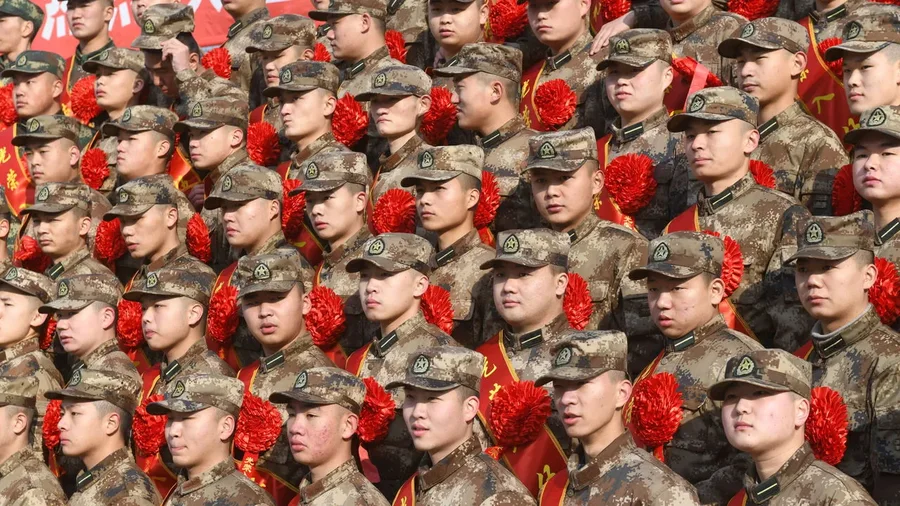
The People's Liberation Army (PLA) is the largest army in the world. Here are China's main military assets...
In anticipation of the massive military parade that China will organize on September 3 to commemorate the 80th anniversary of the end of World War II, which Beijing will apparently use to unveil some new weapons to the world, the Chinese army continues to strengthen with each passing month.
Not a week goes by without state media reporting on developments, new technologies, and prototypes of advanced vehicles from the People's Liberation Army (PLA).
Of course, the war on the ground is dictated by many factors that do not only include high technology, but in the meantime, the Asian giant has begun to intimidate the United States. And this was not at all a given until a few decades ago.
First, at least in quantitative terms, the People’s Liberation Army (PLA) is the largest military in the world. It has undertaken a radical modernization program since Xi Jinping took power in 2013. With aspirations to make it a “world-class military” by 2049, Xi wants the PLA to soon be on par with the US military. But what are Beijing’s key advanced weapons systems that could play a key role in the Taiwan Strait, the South China Sea, and other geopolitical flashpoints?
There are many, as the South China Morning Post summarized in a very long report. The Air Force can rely on high-quality drones, such as the Wing Loong-2, effectively Dragon’s answer to the American MQ-9; its six strong points under the wings can carry up to 12 missiles or bombs. Speaking of missiles, the PL-15 is a long-range, radar-guided, beyond-visual-range air-to-air missile developed for the Air Force and Navy; its BVR capabilities could be crucial in an emergency situation in Taiwan to deny Taiwan air superiority and deter or limit US intervention.

China can also rely on the HQ-19, an anti-ballistic missile system that rivals the United States' Terminal High Altitude Area Defense anti-missile system, essential for protecting China from ballistic missiles that could be armed with nuclear warheads. It is also impossible not to mention the J-20, China's first fifth-generation fighter jet, important for guarding the East China Sea and countering the more than 100 F-35s stationed at US air bases in Japan and South Korea, and the J-35.
Beijing has also produced the KJ-3000, an early warning and control aircraft equipped, among other things, with two sets of sequential radars to detect and track smaller objects at greater distances, improving its ability to counter stealth fighters and drones.
The latest class of electronic surveillance ships in service with the People's Liberation Army Navy is the Dongdiao-class Type 815A spy ship; it can use China's space satellite system to track all nearby warships during military exercises and also provides real-time target acquisition and mid-course guidance for ASBMs, such as the DF-26 and YJ-21. Also worth mentioning is the Type 076 amphibious assault ship, capable of carrying drones and equipped with an electromagnetic launch system for aircraft, and of course the three aircraft carriers, including Fujian, the latest and most advanced of the trio.
On the missile front, maximum attention is being paid to the DF-31, China's first road-tolerable solid-fuel intercontinental ballistic missile, with a range of between 8,000 and 11,000 kilometers, and the DF-41, China's most advanced fourth-generation surface-to-surface intercontinental ballistic missile, essential for the strategic deterrence of the Dragon nuclear forces and designed for a counterattack against a nuclear attack.
Finally, we mention the PHL-16, Beijing's most advanced long-range multiple launch rocket system, and the Type 99A, China's first mass-produced third-generation main battle tank. /Adapted from Il Giornale/






Lini një Përgjigje