


 Shkruar nga Richard Wood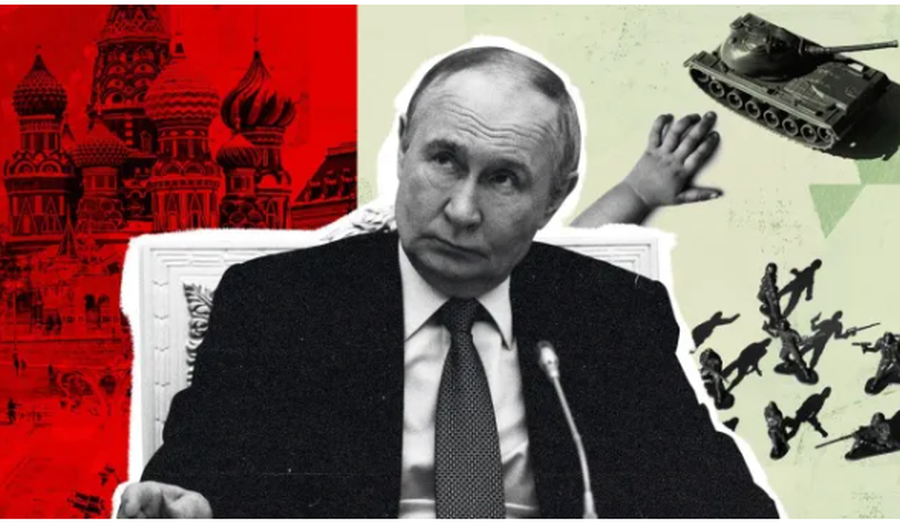
The trauma of a violent childhood has transformed Vladimir Putin into a leader who knows no compromise, only ruthless escalation as a means of political survival...
Vladimir Putin grew up in a particularly brutal and threatening environment, even by the standards of post-World War II Russia. While there is much we don't know about the first 10 years of his life, what we do know suggests that during his teenage years he was raised in a very harsh environment.
The courtyard of the building where he lived in St. Petersburg was the center of daily life.
That place could be terrifying, especially for a short boy. As his biographers, such as Philip Short, have documented, many of the residents of this courtyard later became part of the criminal underworld.
It's not hard to imagine that their childhood must have been filled with the despair caused by the poverty of post-war Russia. According to Short's account, alcohol and drugs were ubiquitous in that courtyard.
More likely, they were used to assuage despair, but one can imagine that this only increased the uncertainty and threat in their daily encounters. The reality of being physically small must have impressed Putin, underscoring the extreme disadvantage and vulnerability with which he had to adapt.
As a psychoanalytic author and therapist, I believe there is enough evidence from his childhood, plus ample evidence from his adult life, to conclude that he is a malignant narcissist. What do I mean by that?
I am describing a personality that is organized around the need to protect itself from severe early traumas. This means closing off from community and human connections. Instead of openness and vulnerability, the malignant narcissist presents himself as a powerful and dominant figure.
The need for others is replaced by grandiose claims and behavior aimed at intimidating and subjugating others. The malignant narcissist imagines that the world around him is as heartless, brutal, and greedy as he is.
He is alarmed by petty insults, trivial acts of defiance, and assertions of individuality, prompting merciless and often disproportionate counterattacks.
His life is very lonely; the attention of servile followers can never satisfy his need for enriching human experiences.
As a result, he is perpetually “hungry.” An unbridled appetite for power, money, fame, and cruelty distorts the choices he makes, as does his growing paranoia. Over time, Putin becomes increasingly prone to blatant errors of judgment.
He compensates for these failures with increased repression and intimidation. These are traits that Putin clearly displays and that were perhaps instilled in his early years. Another biographer, Steven Lee Myers, suggests that as a child he may have been the target of bullying, although Putin has never confirmed this.
Being tough and displaying an unwavering hyper-masculine attitude is a popular strategy in such situations. It is a means of finding a place in the ruthless hierarchy of that world.
As an adult, Putin became famous with photos of himself riding topless.
Putin not only survived, but thrived in the environment of his youth, becoming the “Invincible King of the Court,” known for his physical ferocity, tenacity, and courage. Short quotes his schoolmate, Victor Borisenko, as saying: “Vladimir was fearless… If a big boy insulted him, he would immediately attack him… He would scratch him, hit him, pull out tufts of his hair… He wasn’t the strongest in the class, but in a physical fight he could beat anyone because he would get into a rage and fight to the end.”
From Putin himself we learn even more about his approach to physical combat. In his autobiography “In the First Person,” he writes: “I started the sport around the age of 10 or 11. As soon as it became clear that my fighting nature would not keep me ‘King of the Court,’ I decided to take up boxing. But I didn’t continue for long. I quickly broke my nose… Then I decided to take up Sambo… Martial arts were popular at that time… Judo is not just a sport, it is a philosophy. It is respect for elders and the opponent. It is not for the weak.”
Putin’s expertise in judo, a sport that allows a smaller person to use their size to defeat a larger person, undoubtedly solidified his reputation as a “tough guy.” This fits exactly the profile of the malignant narcissist who wants to appear as a dominant figure that I mentioned.
His adult life confirms that he never felt confident enough to abandon this attitude. He continued to pick fights, seizing on minor provocations to engage in physical combat, even though it jeopardized his career as a KGB agent.
Putin was indifferent to danger, partly because his service in the KGB offered him protection from the regular police. As a politician, his personality is defined by a number of qualities: a lack of mercy, a complete lack of empathy, a capacity to project menace and cruelty, the ability to wear different masks according to the audience, and an unquenchable thirst for power.
There is also a need to suppress the individuality of others. In his Russia, justice has been destroyed, as has freedom of the press and free elections. In their place, there is only one man left to mediate the “truth”: Vladimir Putin.
Opposing voices have been suppressed, exiled, beaten, poisoned, or thrown out of windows. Looking ahead, Putin knows that he does not have the military means to defeat Western Europe. This reality has shaped his strategic vision.
His ultimate goal is to destabilize democratic governments that stand in his way. This is not about ideology or empire building; it is about a ruthless, empathetic personality driven by the need to aggrandize himself, regardless of the cost to human society.
The conclusions of this analysis are grim. First, Putin is unlikely to abandon the war in Ukraine unless forced to. Second, he is likely to use migration, food, and energy as weapons to boost the popularity of the far right in Europe.
Recent violations in European airspace suggest that he hopes to force European democracies to spend more on weapons and less on the social programs that maintain the stability of governments.
The goals that Putin pursues so relentlessly grow out of the malignant narcissism that defines him as a man. And it stems from the intimidation and brutal violence that characterized his childhood. / Adapted from "Pamphlet", from "The Intelligent Papers"
Note: Dr. Richard Wood, clinical psychologist and editor of the book “Psychoanalytic Reflections on Vladimir Putin: The Cost of Evil Leadership” (Routledge, 2024).


Lini një Përgjigje