


 Shkruar nga Pamfleti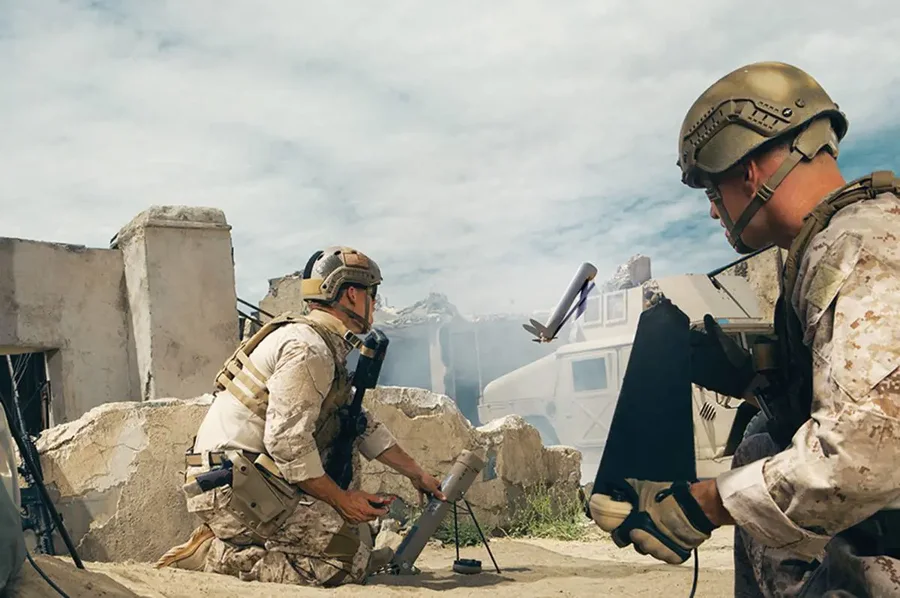
“Switchblade,” from 300 mini-drones to 600 long-range Block 2s, integrates autonomy, artificial intelligence, and anti-armor penetration. Powerful in Ukraine, they advance doctrines of production and engagement, but increase risks of proliferation and abuse.
In recent years, unmanned aerial vehicles, or so-called "kamikaze" drones, have become essential tools in modern combat scenarios, redefining the relationship between lethality, maneuverability, and tactical advantage. Among the key players in this transformation is AeroVironment, which recently evolved the "Switchblade" with three versions designed to meet the complexities of contemporary operational theaters: the Switchblade 600 Block 2, 400, and 300 Block 20.
These platforms represent more than a simple technological improvement: they mark a redefinition of the Western approach to warfare, especially in environments with a high density of countermeasures. Their combination of autonomous precision, penetration capabilities against armored targets, modularity, and rapid deployment meets the strategic need to maintain an asymmetric advantage even where air supremacy is uncertain or contested.
At the heart of the family is the Switchblade 600 Block 2, a long-range platform designed for multi-domain operations. The aircraft integrates advanced systems, artificial intelligence-based target recognition, military-grade M-Code GPS reception and resilient tactical communications, designed to operate in environments characterized by deliberate jamming or signal denial. Compared to the previous configuration, Block 2 represents a significant increase in operational autonomy, approximately 20%, and the ability to operate beyond 100 km via relay link. The platform is also dimensioned to withstand extreme environmental conditions, including deployment in a maritime environment.
The Switchblade 400 model is designed as a portable solution for light infantry and rapid engagement missions against armored vehicles.
With a total mass of less than 18 kg and a push-assisted launch system, it is designed to allow a single operator to engage an armored target with high precision in a very short operational time. Compatibility with existing launchers facilitates its integration into units and reduces training requirements.
The Switchblade 300 Block 20, the lighter variant, carries a shaped charge warhead designed using the Explosively Formed Penetrator (EFP) principle, optimized for penetrating light and medium armor.
Weighing just over 3 kg, it is designed for beyond-line-of-sight missions with autonomous target identification capabilities and configurable operational interfaces for different trajectories and engagement modes.
The expansion of the Switchblade line is accompanied by a significant increase in production: AeroVironment has increased production by 600 units in the past year alone, with plans to further scale up production capacity through the opening of new facilities. This growth is supported by growing demand from the US military and NATO partners and is part of programs aimed at increasing rapid and distributed engagement capabilities in operational depth.
The Ukrainian theater has been an important testing ground for the Switchblade family. Widely used by Kiev forces, these effectors have proven effective in an environment where electronic warfare and long-range firepower complicate the use of conventional systems. The ability to neutralize high-value tactical targets, sensitive positions, armored vehicles, and logistical points has shown how swinging munitions can compensate for numerical limitations and increase operational flexibility.
From a doctrinal perspective, these systems are becoming central elements of an operational vision based on precision, distribution, and targeted lethality. They are no longer simply cost-effective tools for limited operations, but integrated components of an architecture that combines direct fire, information superiority, and sustained engagement capabilities.
Interaction with open architectures, centralized control software, and advanced vision systems allow for a reduction in cycle time between target acquisition and neutralization, increasing overall effectiveness while maintaining human control over critical decisions.
The widespread use of mobile munitions raises important international security issues. Technological accessibility, combined with ease of use and increased autonomy, poses risks of proliferation and unregulated use. Western democracies are being urged to establish stricter export criteria, common rules of engagement, and oversight mechanisms to prevent irresponsible deployment.
At the same time, the integration of autonomous effectors changes the nature of deterrence: the ability to selectively neutralize strategic assets behind enemy lines changes the traditional concept of operational depth.
In a multipolar environment characterized by hybrid threats and fluid front lines, platforms like Switchblade will not only influence the outcome of conflicts, but will help rewrite the principles and practices of the military art of the future. /Adapted from Il Giornale/







Lini një Përgjigje