


 Shkruar nga Stewart Prest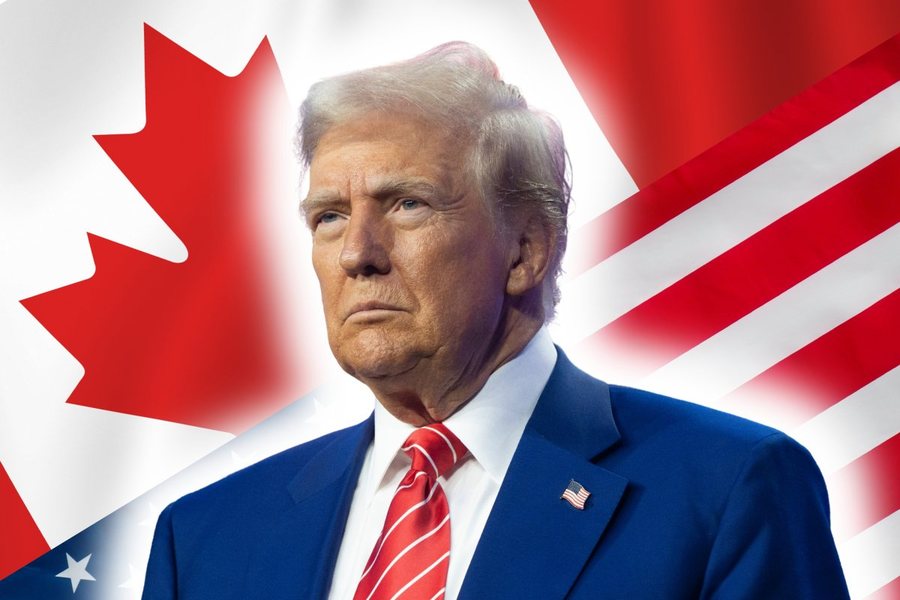
The world is watching carefully to see how Canada will respond to Trump. If it hopes to enjoy the respect of other states, it must show a willingness to fight for itself, its prosperity and its values.
President-elect Donald Trump has reiterated his apparent desire to make Canada the 51st state of the United States. Trump has been severely criticized for such statements towards a respected neighboring country. But his fixation is dangerous at a time when the country's long-weakened liberal government is in chaos.
In fact, in her resignation letter in December, Finance Minister Chrystia Freeland made the country's response to Trump central to her criticism of Prime Minister Justin Trudeau. Among the many arguments in the resignation letter was that Canada is unprepared for the new threat of Trump's second term.
Trump did not hesitate to meddle in Canada's internal affairs, calling Freeland a "toxic" politician and labeling Trudeau as the governor of an American state rather than a leader of a sovereign nation. Attacks on Canada are becoming commonplace.
In another post, Trump stated that as the 51st country, Canadians would "save a lot on taxes and military defense." Whoever becomes prime minister in the coming weeks or months must know how to deal with Trump — and the existential threat he poses to Canada — far more effectively than the Liberals under Justin Trudeau.
Trump is blatantly disregarding Canada's independence and with it Canadian identity. So Canada must respond accordingly. It can be difficult to fully understand the nature and extent of the threats posed by someone who is willing to flout respected political and diplomatic conventions.
His threats to annex our country create an ongoing set of multiple challenges to Canada's economic development, democratic norms and sovereignty. The economic dimension of his threat to Canada is already well known.
Trump's proposed tariffs of 25 per cent on all Canadian exports to the US would be too costly for both countries, given the integration of their economies. But based on the size disparity between the two countries, the negative impact will be greater for Canada.
The threat to democracy is clear. Trump has shown that he regards democracy not as an important set of rules and norms, but as a set of obstacles to be overcome. He is unable to accept defeat or even humbly accept victory.
His revenge has only just begun, with lawsuits against the media and even a polling company whose data suggested Democrat Kamala Harris was ahead of him during the final days of the US election campaign.
After returning to the White House on January 20, Trump has promised to use public institutions to punish his opponents. Trump's lack of respect for democratic institutions is corrosive and contagious.
During his first term, experts warned alarmedly about how he was linked to the decline of democracy around the world. After all, if the American president can openly challenge democratic norms, then what is to stop other demagogues from doing the same?
A second Trump administration is likely to continue such trends, and his willingness to meddle in Canadian politics has already caused quite a bit of concern. Trump's actions repeatedly show that he has no respect for those he sees as powerless.
And now it seems to be Canada's turn. Trump has joked that Canada is not a real country, but just another American state. Laughing in the face of a threat does not diminish the seriousness of the situation. So far, Canada has acted in a way that makes it look like Trump has some right.
Rather than distance himself from such statements, defending Canada's strong record in managing its part of the border relationship, the government promptly pledged over $1 billion in new spending on border control. Canadian leaders have failed to dismiss Trump's threats as the derogatory statements of a well-known bully.
In the face of Trump's tariff threats, Trudeau made a surprise trip to Florida to honor the president-elect and plead Canada's case, instead of following normal protocol and waiting to make an official state visit after the inauguration.
This made Trudeau look more like a supplicant than a visiting head of government. Protecting borders is a core function of every state and a responsibility of every American president. Trump’s demand that others do it for him is both a sign of weakness and an attempt to have a “scapegoat” if his own efforts fail.
As with any bully, promising to do their jobs will only prompt additional demands. So when Trudeau promised to do more in return for ending bullying, he took a shot below the belt as Trump began mocking him for being the governor of America's 51st state.
The world is watching carefully to see how Canada will respond to Trump. If it hopes to enjoy the respect of other states, it must show a willingness to fight for itself, its prosperity and its values.
Canada must defend its sovereignty from those who refuse to respect it, and act decisively to preserve its development. This could mean a trade war. For more than a century, Canada and the US have found ways to cooperate and prosper side by side.
This despite the fact that the USA is a much more powerful nation. They have built alliances and agreements based on shared norms, values and customs as part of a deep and multifaceted relationship. None of that history seems to matter to Trump.
And apparently, now American power matters more than Canadian sovereignty.
This power imbalance is strong, given Canada's dependence on American economic and military power. But Canada is not powerless. Dependency works both ways, and the deep integration of the two countries' economies makes the US vulnerable as well. Cutting off energy exports to the US, as recently suggested by the Premier of Ontario, Doug Ford, is one course of action that would have an immediate and not a little damaging effect on the US economy.
Likewise for oil. Energy is a power in many ways. The US consumes several million barrels of Canadian oil every day, and a tax on that fuel would produce inflation, so it would be unpopular with American voters.
Meanwhile, other countries will lose a lot if the US does not continue to respect Canada's sovereignty. If Trump refuses to respect Canadian sovereignty, no country is safe. Even Panama and Denmark can prove this now.
Finding ways to counter such demands should be a vital mission for any country that values its independence, and Canada should work with such allies. Trump will be president of the USA again in a few days.
But he is not and should not be treated as the president of Canada. Whoever leads Canada in the coming months has tools available to protect Canadian sovereignty, and must be prepared to use them.
Note: Stewart Perst, lecturer in political science at the University of British Columbia, Canada. / Adapted "Pamphlet" from "Vancouver Sun"





Lini një Përgjigje