


 Shkruar nga Pamfleti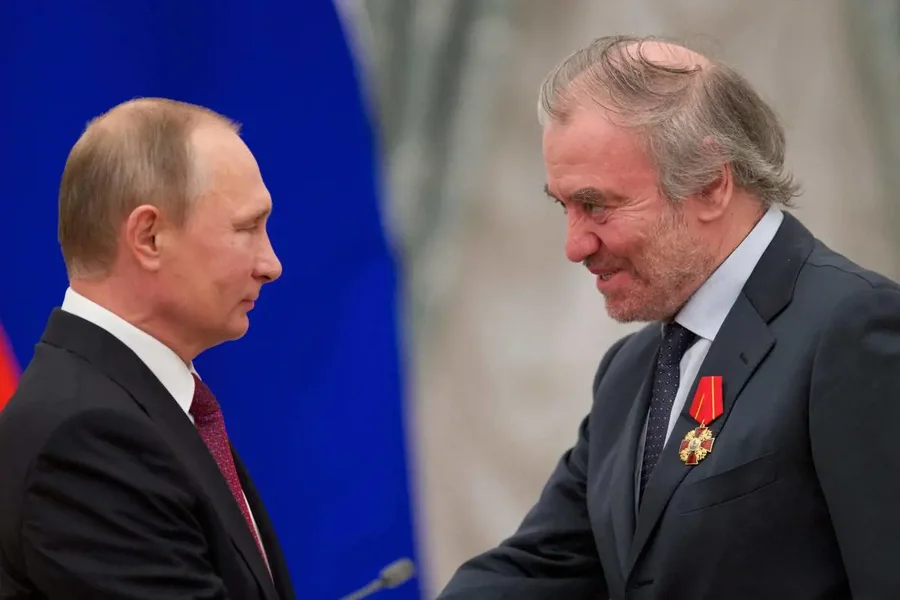
Gergiev knows how to manage the rest of the money. The international press writes that his net worth reaches 1 billion euros, and a significant part of it is in Italy, where the Russian director received an inheritance from a pharmaceutical industrialist, Renzo Ceschina, and his wife, a Japanese musician, Yoko Nagae...
There is a Faustian pact in the career of Valery Abisalovich Gergiev. And according to his critics, namely the Kremlin's opponents, the pact was realized on December 1, 2023, when Vladimir Putin appointed Gergiev as director of the Bolshoi Theater in Moscow.
It was what the brilliant conductor had always dreamed of: combining the leadership of Moscow's main stage with the direction of St. Petersburg's Mariinsky Theater, which he had held for decades. From that moment on, Gergiev, the first in history to simultaneously hold the leadership of the country's two greatest theatrical institutions, became the absolute master of music, more powerful than a minister, the undisputed Tsar of Russian culture.
Along with director Nikita Mikhalkov (his most internationally famous film is Black Eyes with Marcello Mastroianni), he is the most prominent intellectual in Putin's power, willing to collaborate with Vladimir Medinsky, the former Minister of Culture, the man who rewrote school textbooks until a single authorized version of history was adopted.
This is thanks to a talent unmatched in the world and an absolute commitment to the values and actions of the current Kremlin president.
In 2008, Russia invaded Georgia; a few days after the fighting ended, Gergiev conducted a celebratory concert in Tskhinvali, the capital of “liberated” Ossetia (his family, incidentally, is of Ossetian origin). Among the pieces performed was the Leningrad Symphony, written by Shostakovich to commemorate the resistance to the Nazi siege of the Soviet Union’s second-largest city. This sealed the equation between the “Great Patriotic War” and the wars desired by the current Tsar, a key element of Putin’s propaganda.
In 2014, Gergiev again signed, in the front row, the document celebrating the return of Crimea to Mother Russia. And in 2016, he conducted another concert: the one in Palmyra, where the former Soviet army, in front of 100 journalists from around the world who had arrived on an official plane from Moscow, celebrated the Kremlin's new role in Assad's Syria and the entire Middle East.
When the invasion of Ukraine began, Gergiev had no doubts. Theaters around the world asked him to distance himself so that they could continue to organize his concerts, but he continued to express unconditional admiration for the Kremlin's decisions. Tens of thousands of intellectuals and artists saw no other choice but to leave the country, but he was not afraid. On the contrary.
Financially, he didn't seem to be suffering from the situation either. That's why he was targeted by Alexey Navalny's team: with documents and documents, investigative journalists led by the dissident who died in prison demonstrated that the conductor was using the assets of the international philanthropic foundation (which also holds Dutch nationality) that bears his name for personal gain.
Gergiev knows how to manage the rest of the money. The international press writes that his net worth reaches 1 billion euros, and a significant part of it is in Italy, where the Russian director received an inheritance from a pharmaceutical industrialist, Renzo Ceschina, and his wife, a Japanese musician, Yoko Nagae.
Among his assets on the peninsula are valuable and extremely profitable properties: a magnificent villa on the Amalfi Coast; a 20,000-square-meter residence and offices in Milan; Palazzo Barbarigo on the Grand Canal and Caffè Quadri in Piazza San Marco in Venice. Perhaps this is also why Putin's musician is so interested in performing in Italy.

Gergiev, a political sensation in Italy
A wine for a king or a tsar? The concert of the Russian conductor Valery Gergiev at the festival held at the Royal Palace of Caserta is already inappropriate before the music starts. All because of Gergiev's relationship with Russian President Vladimir Putin. A dangerous relationship, highlighted by Europa Radicale, which last Thursday called for the cancellation of the event, calling it a "pro-Putin disgrace". The friendship between Gergiev and Putin was also highlighted in the pages of La Repubblica by Yulia Navalnaya, the wife of Alexei Navalny, who died in February last year. For the dissident's widow, the musician's invitation to Caserta is "a gift to the dictator", since Gergiev himself has not only never criticized Putin's foreign policy choices, but is even considered a "collaborator and supporter" of the Russian president.
And after the stance of Navalny's widow and the support of Radical Europe's appeal, including that of the head of Azione, Carlo Calenda, and the senator of the Democratic Party, Filippo Sensi, political reactions are multiplying, often with different positions. Among those criticizing is the Minister of Culture, Alessandro Giuli. After noting that the event was "desired, promoted and paid for by the Campania Region" and that the Royal Palace of Caserta is "autonomous in choosing the events it will organize, like all autonomous institutions of the Ministry of Culture", Giuli countered that "the concert by Putin's friend and advisor, Valery Gergiev, risks sending the wrong message". The event, even if "high-profile", could ultimately become "a reference point for Russian propaganda", and this, Giuli concludes, "would be deplorable in my opinion".
"We do not intend to accept a logic of exclusion or interruption of dialogue, because this does not help peace. This only serves to feed the rivers of hatred and distances us from peace", objects the Governor of Campania, Vincenzo De Luca, who, as "host" of the contested event, tries to act as a firefighter, albeit with his usual incendiary enthusiasm. / Adapted Pamphlet from Il Giornale /




Lini një Përgjigje