


 Shkruar nga Pamfleti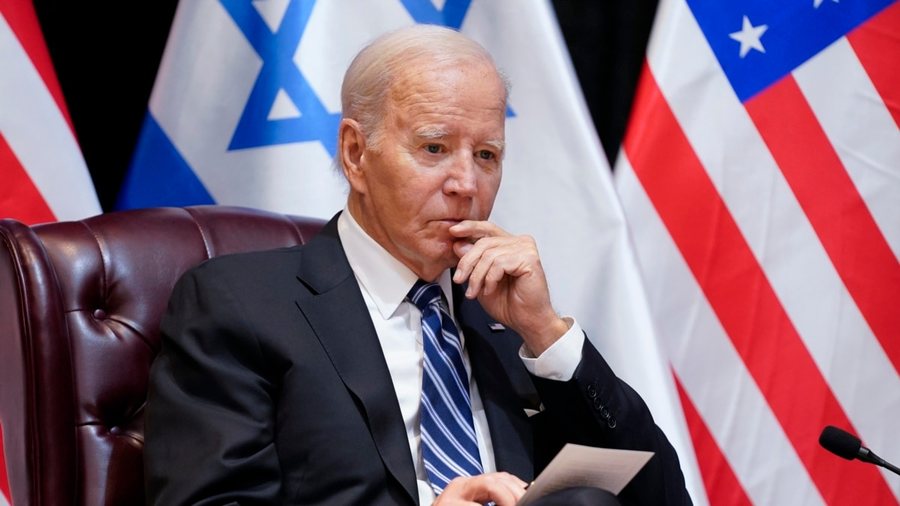
Before the Israel-Hamas war began, President Joe Biden's foreign policy goals in the Middle East were to further integrate Israel with its Arab neighbors and curb Iran's efforts to develop nuclear weapons. Those goals may now be in jeopardy as he focuses on efforts to contain the spread of the Israel-Hamas conflict to other Iranian-backed countries in the region, such as Lebanon, Yemen and Syria.
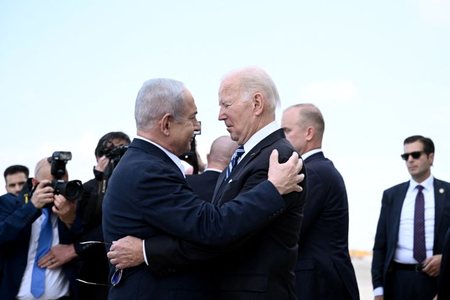
President Biden has spoken nine times with Israeli Prime Minister Benjamin Netanyahu since the beginning of the conflict, a senior US government official said during a conference call with reporters. The American official said that President Biden has also spoken with the leaders of Egypt, Jordan and Saudi Arabia, while national security adviser Jake Sullivan has engaged "almost every day" with the United States' partners in the region.
As Arab capitals are engulfed in anti-Israel protests, US officials believe that supplying Palestinian civilians in the Gaza Strip with humanitarian aid is a key factor in efforts to stem the spread of the war.
On Friday and Saturday, Secretary of State Antony Blinken was in the region for the second time in less than a month to reach an agreement on a temporary cessation of hostilities to make way for the delivery of humanitarian aid and the evacuation of civilians to The Gaza Strip.
"We must do more to protect Palestinian civilians," Secretary Blinken said in Tel Aviv.
However, Israeli Prime Minister Benjamin Netanyahu said he has ordered thousands of Palestinian workers working in Israel to return to the Gaza Strip. He also said that Israel will not allow fuel to be sent to the Gaza Strip and will not accept a temporary cessation of hostilities without the release of the hostages. More than 200 people were kidnapped by Hamas during the group's October 7 attack on Israel, and at least 1,400 others were killed.
The US Secretary of State opposed the request of the Arab countries for a complete ceasefire between Israel and Hamas, repeating the position that this would only help the Palestinian militant group that Washington considers a terrorist organization. Mr. Blinken faced pressure from his Arab counterparts in Jordan, who are insisting on a ceasefire in the Gaza Strip, where according to the health ministry, which is run by Hamas, more than 9,000 Palestinians have been killed by Israeli attacks.
Analysts say that even if the United States is successful in its diplomatic efforts on short-term issues, Washington should focus on laying the groundwork for long-term issues, such as governing the Gaza Strip after the war and achieving a two-state solution.
Efforts to prevent the spread of conflict
The United States is "determined not to open a second or third front in this conflict," Mr. Blinken said. For this purpose, the US has strengthened its military presence in the region.
On Israel's northern border with Lebanon, Hezbollah, a powerful militia allied to Hamas, has been engaged in cross-border fighting with Israeli soldiers. On Friday, Hezbollah Secretary-General Hassan Nasrallah stopped short of saying his militia would fully engage in the conflict, but warned the US that if Israel did not stop attacks on Gaza, the conflict could widen.
Yemen's Houthi rebels on Tuesday claimed responsibility for missile and drone attacks targeting Israel, after several strikes by the group last month were intercepted by US ships in the Red Sea.
US troops in Iraq and Syria have also been targeted by Iran-allied groups, raising concerns about possible attacks on other US bases across the region.
Violence is also escalating in the West Bank, where more than 100 Palestinians have been killed in clashes with Israeli soldiers and armed Israeli settlers.
Barbara Slavin, a researcher at the Stimson Center, says that the longer Israel's offensive in Gaza continues, the more the sense of militancy in the region grows, the more difficult it will be to make accurate predictions and contain the war.
"Arab public opinion is inflamed by these horrific scenes [in Gaza]," she tells VOA.
Even countries that have recently normalized relations with Israel, including the United Arab Emirates, Bahrain and Morocco, are under increasing public pressure to sever those ties.
President Biden has repeatedly warned Iran and groups supported by it not to escalate the conflict. Tehran officials have also declared that they do not want the war to spread.
Iran has a tendency "to go to the brink of conflict, but not over it," says Elisheva Machlis, lecturer in Middle East Studies at Bar-Ilan University.
She tells VOA that it is likely that Iran has instructed the groups it supports in the region not to create another war front, but to cause enough trouble to distract the Israeli military from Gaza.
Given the possibility of miscalculations, this strategy could fail even though Tehran is reluctant to get directly involved.
What happens next?
Both Israel and the United States have ruled out an Israeli return to Hamas-controlled Gaza and generally agree that Israel will not govern the territory after the war.
Allies have different views on what happens next: Washington insists that the goal of the war should not only be to defeat Hamas, but also to push for a two-state solution.
Mr. Netanyahu's office has said that the goal of the war is to eliminate Hamas and that there have been no talks about possible decisions to hand the Gaza Strip over to the Palestinian Authority or any other party.
Unlike Hamas, the Palestinian Authority recognizes Israel and supports a two-state solution.
Kristian Coates Ulrichsen, Middle East fellow at the Baker Institute, says there is also a need to ensure there is no further radicalization and empowerment of extremists across the region.
"Arab states will need to be at the forefront of efforts for a political response that addresses the underlying issues as well as the more immediate ones," he told VOA.
A pause in the fighting is the first challenge to both the administration's short-term goal of protecting Palestinian civilians and its long-term goal of working toward a lasting peace in the region.
So far this challenge has not been solved. Following Secretary of State Blinken's request for such a pause for humanitarian purposes, Prime Minister Netanyahu said there will be no temporary ceasefire until all hostages are returned from Hamas. /VOA






Lini një Përgjigje