


 Shkruar nga Pamfleti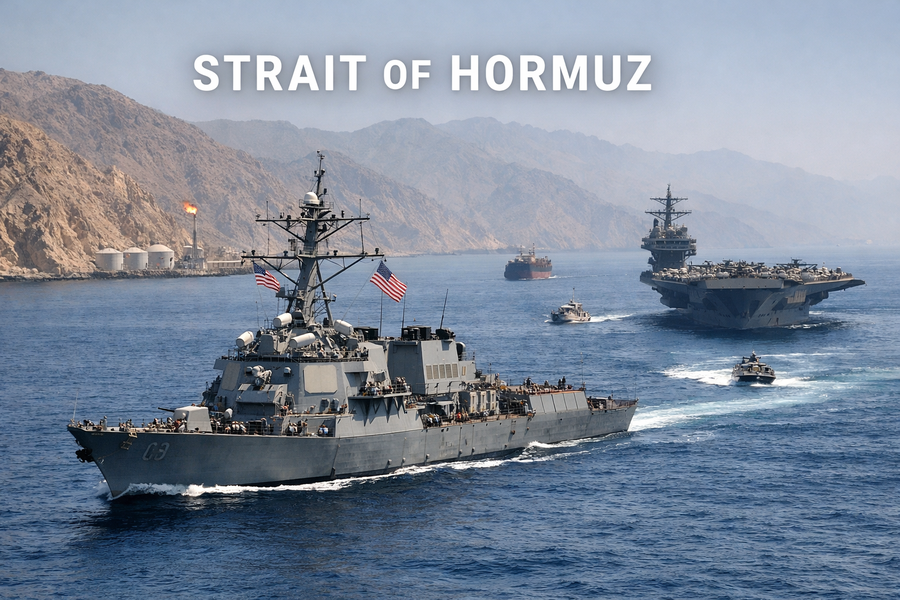
The United States imposes maritime restrictions, while several states and organizations call for de-escalation and respect for freedom of navigation...
The naval blockade announced by US President Donald Trump in the Strait of Hormuz area has come into effect, after the deadline set for its implementation at 16:00 Albanian time passed.
Although the US armed forces have not officially confirmed the start of the operation, the US Central Command (Centcom) had earlier announced that the measure would be implemented on this schedule, in accordance with the presidential decision.
According to Centcom, the blockade will be applied impartially to all vessels entering or leaving Iranian ports and coastal areas, including ports in the Arabian Gulf and the Gulf of Oman. The US authorities aim to limit maritime access to Iran's port and energy infrastructure.
The British maritime security agency, UKMTO, confirms that the restrictions cover the entire Iranian coastline, from the Arabian Gulf to the Arabian Sea east of the Strait of Hormuz. In an official statement, the agency emphasizes that transit through the strait to non-Iranian destinations will not be impeded, but warns of an increased military presence in the area. Neutral ships currently in Iranian ports have been given a limited deadline to leave.
After the blockade was launched, US President Donald Trump reacted harshly, threatening to attack any ship that approaches the blockade.
“ The Iranian Navy is at the bottom of the sea, completely destroyed – 158 ships. What we have not hit are some of their smaller vessels, what they call ‘fast attack craft’, because we have not considered them to be a major threat. Warning: if any of these vessels come anywhere near our BLOCKADE, they will be eliminated immediately, using the same elimination system we use against drug traffickers at sea. It is fast and brutal. PS 98.2% of drugs entering the US by ocean or sea are BANISHED! Thank you for your attention to this issue ,” he writes.
The US decision has prompted immediate reactions from international actors. Qatar has called for the sea lanes not to be used as a tool for pressure or negotiation. In a phone call with Iranian Foreign Minister Abbas Araghchi, Qatar's top diplomat Mohammed bin Abdulrahman Al Thani called for maintaining open sea lanes and guaranteeing freedom of navigation, calling on all parties to support mediation efforts.
China has also expressed concern about the developments. Foreign Minister Wang Yi stated that the blockade of the Strait of Hormuz is not in the interest of the international community and that a solution to the crisis should be achieved through political and diplomatic means. He underlined that Beijing supports the security and sovereignty of the Gulf countries, while seeking a more active role in reducing tensions.
On the other hand, the UN International Maritime Organization emphasizes that, under international law, no state has the right to restrict free passage in international straits used for global transit. Secretary-General Arsenio Dominguez recalls the importance of respecting freedom of navigation, referring directly to the situation in the Strait of Hormuz, a strategic hub for global oil transport.
Developments in this area increase tensions in the Middle East and add uncertainty to international energy markets, while the international community continues to seek paths for de-escalation and dialogue. / Pamphlet



Lini një Përgjigje