


 Shkruar nga Pamfleti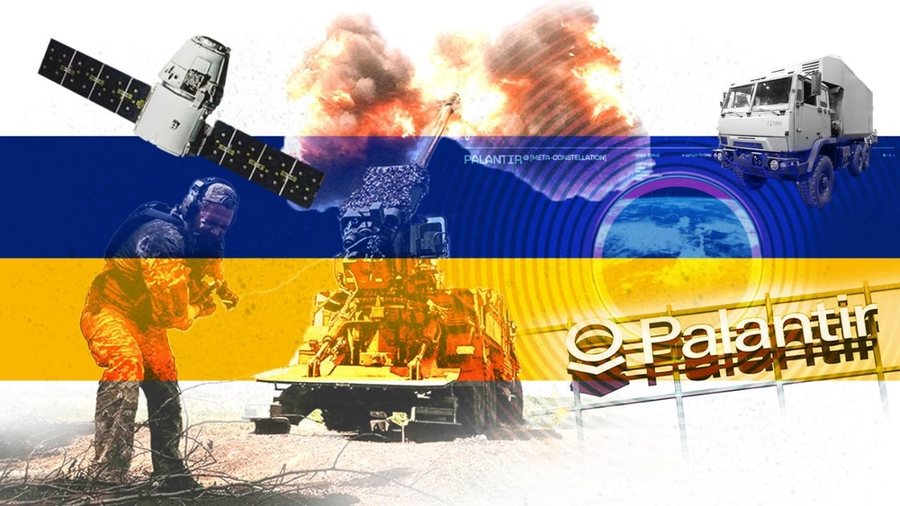
"In the early summer of 2022, when the roads to Kiev were still littered with charred tank corpses, President Zelensky invited the executives of a CIA-linked data mining company to his bunker in the Ukrainian capital." this is how The New York Times begins its article.
The executive vice president of Palantir, the company that has helped Ukraine with defense, Louis Mosley said that Zelensky proposed a relationship that would define how his country would fight, which he finds compelling.
"He made a very convincing pitch. Ukraine desperately needed support from the West. They had identified us as the best 'miltech' company in the world and were very eager to access our technology" , said Mosley, on his 16th visit to Kiev.
After a long journey from the Polish border, the Palantir team arrived in Kiev at a time when the curfew was still strictly enforced and war debris, including dragon's teeth anti-tank defenses, littered the streets.
" People in Kiev looked like they had a close shave, a near-death experience. When you spoke to government officials, they seemed traumatized. They were hours away, frankly, from losing everything: their lives, their families ," Mosley said.
Conceived after 9/11 and launched in 2003, Palantir is now valued at about $54 billion, or $42.8 billion. It was co-founded by a group of entrepreneurs. Palantir was named after the crystal balls that appear in The Lord of the Rings. Its first clients included the NSA, the FBI and the CIA, the latter investing through its venture fund In-Q-Tel.
Adopting a staunchly pro-Western stance, Palantir caught the world's attention when its technology was rumored to have been used to track down Osama bin Laden. But it is in Ukraine, where it has been used alongside Elon Musk's Starlink, whose satellites have kept Ukrainian soldiers connected to the Internet, that it has had perhaps the biggest impact, helping a much smaller army hold its own against a world power. , prompting broader questions about the use of AI in warfare.
" Are these things dangerous? Yes! or we're going to control them or our adversaries are going to control them ," Karp, Palantir's chief executive, said last year.
Collecting vast amounts of data, the firm provides Ukrainian commanders with a complete picture of the battlefield, from warships cruising the Black Sea to tanks rolling through the Donbas to warplanes launching cruise missiles from the air.
The New York Times writes that the goal is for Kiev to make quick decisions, allowing it to bypass Russia's Soviet-era military bureaucracy from top to bottom. Despite some initial nervousness about sharing such powerful algorithms, Palantir appears to have found an ideal partner in Ukraine, a country known for its thriving tech scene.
"Before the war, Ukraine had become an outdoor shop for Western technology companies. "When Russia invaded, not only did you have this very technical population with amazing engineers, but they were also widely familiar with Western software ," Mosley said.
More than a thousand members of Ukraine's armed forces, stationed at brigade headquarters across the country, are using Palantir's software.
More targets than ammo:
Palantir's software uses AI to speed up traditional military decision-making. At the heart of this is MetaConstellation, a program that allows Ukraine to create a detailed picture of what the Russians are doing.
Hundreds of commercial satellites orbiting the Earth each day take pictures of Russian forces, but MetaConstellation selects the most useful and detailed images, often using synthetic aperture radar (SAR) to look through clouds to pick up troop concentrations or the movements of ships.
The New York Times writes that based on these calculations, each unit of the Ukrainian army can then be directed to its most effective contribution to that day's war. Due to the proliferation of satellites and smartphones, the war in Ukraine is believed to be the most documented conflict in history. Using Palantir's artificial intelligence to find a series of photos, videos and witness statements, Ukraine's chief prosecutor has recorded details of 124,000 possible crimes.
Global reach from Kiev to Tel Aviv:
Outside of Ukraine, Palantir's control over multiple areas of government has been criticized by privacy activists worried about the implications of a multibillion-dollar private company managing public data. The company has also come under fire recently, not least from its own staff, over a deal struck with the Israel Defense Forces to supply technology for the war in Gaza.
But in Ukraine, the American company is seen as a close partner, whose value grows even as Republicans stall on a new $60 billion aid package. As Kiev runs out of ammunition, it becomes increasingly essential that every remaining projectile, rocket and missile finds its target.






Lini një Përgjigje