


 Shkruar nga Can Dündar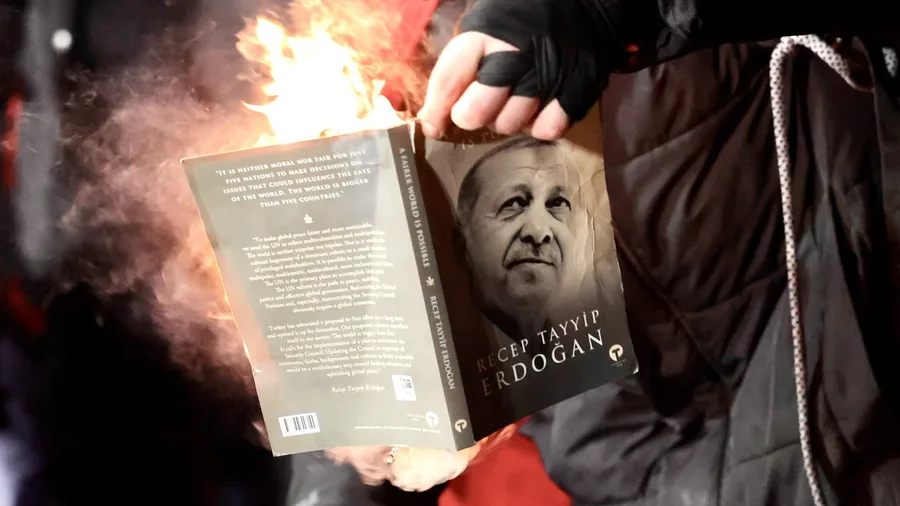
If there were a step-by-step guide for autocrats, Erdogan is following it in writing. He seems to be taking a page from Vladimir Putin's playbook: imprison your opponents, silence the media, ban political parties, spread fear - secure your throne at all costs.
These days, Bertolt Brecht is enjoying immense popularity in Turkey, as the opposition has rallied around two lines from one of his poems: " Alone, his fate cannot be better. Either guns or shackles. Everything or nothing. All of us or none."
The truth of this slogan became painfully apparent when President Recep Tayyip Erdogan arrested Istanbul Mayor Ekrem İmamoğlu, his biggest political rival, who had managed to defeat him four times in local elections.
Now, every critic of the government in the country is asking himself: If Imamoglu can be taken away at dawn by the police and labeled as the "leader of a criminal organization," could I be next?
This fear is exactly what Erdogan wants to instill in the nation. If there were a step-by-step guide for autocrats, Erdogan is following it to the letter. He seems to be taking a page from Vladimir Putin's playbook: imprison your opponents, silence the media, ban political parties, spread fear, secure your throne at all costs.
-Global climate
There are several reasons why Erdogan executed what amounts to a civilian coup over the weekend. The most important is the global political climate: Yes, the rise of Donald Trump in the US emboldened him.
Moreover, as America retreats from its traditional role as a global protector, Europe has begun to prioritize security concerns over democratic values, viewing Turkey more as a strategic defense partner than as a country sliding into autocracy.
He was confident that there would be no significant resistance. This comes as domestic polls in Turkey paint a bleak picture for Erdogan. His popularity is falling, even among his once loyal base, while the economy is collapsing. He sees defeat imminent in the next election, and he knows it.
So Erdogan seems to have thought: if I can't defeat my opponent at the ballot box, I will use my control over the judiciary to overthrow him.
He is supporting Kurdish voters, a major dynamic force in the country, by remaining neutral as he is currently engaged in peace negotiations with them. He also calculated that any backlash would come only from Turkey’s social democrats – a challenge he believed he could meet. And if he went so far as to ban the main opposition party, the CHP, he was confident there would be no significant resistance.
-But he made the calculations wrong.
Erdogan may have decided to become the next Putin, but the people of Turkey have made it clear that they do not want to become the next Russia. The blow to İmamoğlu not only stirred Istanbul, but sparked protests across the country.
In the system that Erdogan has built, any voice of dissent must be suppressed.
Opposition groups, previously fragmented, united in an instant. Despite bans on public gatherings, roadblocks, media censorship, limited social networks and police intimidation, hundreds of thousands took to the streets, chanting together: "One alone, his fate cannot be bettered [...] / All of us or none ."
The palace's response was quick and clear: " None of you! "
In the system Erdogan has built, any voice of dissent must be suppressed. He is convinced that only through brutal repression can he prevent an uprising similar to the Gezi Park protests of 2013.
In a twist of fate, Erdogan knows where this path could lead. In 1999, under pressure from the military, a court ruling sent him to prison while he was mayor of Istanbul. At the time, newspapers declared: " Now he won't even be able to become a village headman! " But his time in prison only made him more popular. Four years after his release, he became prime minister and soon after president.
Now, history repeats itself: by imprisoning his most formidable opponent, Erdogan may unwittingly pave the way for İmamoğlu to the presidency.
-International community
Can Turkey resist Erdogan's march toward absolute autocracy, as opposition leaders are thrown behind bars and strongmen around the world wage war against democracy? Can the people achieve what the Serbian people may be on the verge of achieving?
This will depend on how far Erdogan is willing to go to cling to power, whether the opposition can stay together, and how much courage he can muster.
-Will Europe prioritize geopolitical security over fundamental democratic values?
But the role of the international community is just as critical. In a strategic move, Erdogan reminded Western leaders, just before arresting his rival, of Turkey’s crucial role in European security. His goal was clear: to deter European governments from speaking out against his crackdowns, both now and in the future.
Now, Europe faces a defining question: Will it prioritize geopolitical security over fundamental democratic values? Will it turn a blind eye to Erdogan's power grab, as it has done with other authoritarian leaders, because it thinks it needs Turkey's military might and strategic importance? Or will it stand with a people willing to risk their lives to defend democracy?
The answer will shape not only the future of Turkey, but also of Europe. Ultimately, Brecht's warning, written in the face of Nazi tyranny, rings just as true for today's Europe: " A single one, his fate cannot be better. Either guns or shackles. All or nothing. All of us or none. " / Adapted from "Pamphlet" by "WorldCrunch"
*Note: Bertolt Brecht was a German playwright and poet.


Lini një Përgjigje