


 Shkruar nga *Josep Borrell, Guy Verhofstadt, Domènec Devesa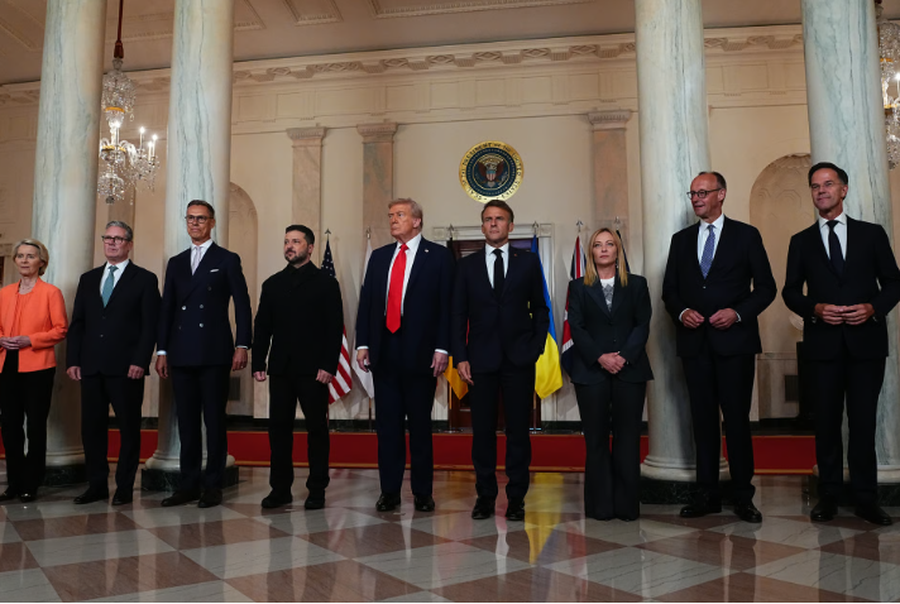
Becoming a US protectorate is not inevitable, especially given the increasingly outraged public opinion due to a series of concessions and humiliations…
It has become a tradition for pro-Europeans to chart their political course from Ventotene, where Altiero Spinelli wrote the manifesto “For a Europe Free and United.” This spirit has never been more urgent than now.
Our union looks dangerously fragmented and weak, trapped in a hostile internal and external environment. With only 5% of the global population and a widening economic gap with other great powers, Europe is not only facing a world of continental empires, but is in real danger of becoming America's vassal.
This became clear after unreciprocated concessions to US President Donald Trump on defence spending and trade, as well as Europe’s acceptance of a minor role in handling the war in Ukraine. Moreover, from Gaza to Nagorno-Karabakh, the EU’s involvement in conflicts abroad has become largely irrelevant, either due to a lack of a credible international stance or unity.
The second term of European Commission President Ursula von der Leyen has been marked by the dismantling of the Green Deal, the flagship project of her first term, as if climate change is not getting worse.
The Commission has also proposed a disappointing Multiannual Financial Framework without real growth, thus sacrificing cohesion policy for new priorities in products and defence research. Meanwhile, the Eurosceptic and Europhobic populist far right has never been stronger in the member states or EU institutions.
The current EU leaders suffer from a lack of long-term political vision, leadership and unity.
At the moment, an unexpected alliance of Trump sympathizers and nostalgic Atlanticists seems to be dominating both the European Council and the Commission. Thus, the prevailing line has been to flatter and appease the American president in the hope of damage control, while in turn fostering our political, strategic and even economic dependence on Washington, and this is hardly working.
For Trump, contracts only bind the other party, not him. And far from avoiding punitive tariffs or bolstering his support for Ukraine, accepting 5 percent of GDP spending on defense and buying more American weapons and natural gas has not even increased his commitment to collective security. Instead, from mineral deals to arms sales, it has become largely a purely transactional affair based on advancing U.S. economic interests and fortunes.
Paradoxically, the lack of serious commitment from Russian President Vladimir Putin to starting a negotiated solution is hindering Trump's attempt to reach an agreement on Moscow's terms.
It should be clear by now that Trump is not and will never be an ally. His America represents a major geopolitical, economic, and cultural shock to Europe. But becoming a US protectorate is not inevitable, especially given the increasingly outraged public opinion over the series of concessions and humiliations we are witnessing.
There is an alternative path. A resurgence of a pro-European majority in the bloc’s three institutions, especially the European Parliament, could yet lead to self-determination of our destiny. Parliament has the constitutional role of scrutinizing the Commission and could demand a new direction, as it retains the power to censure it. For starters, Parliament could block the lowering of tariffs on American products, a move that would surely be popular with voters and signal Europe’s willingness to stand up to blackmail.
Moreover, we must strengthen our political unity, overcome the veto that allows Hungarian Prime Minister Viktor Orbán to block EU military aid to Ukraine, and build our own defense system, one that does not depend on the US and that could instill fear in the Kremlin.
Once again, these decisions will be quite familiar to most EU citizens. As former European Central Bank President Mario Draghi said, we will not be a geopolitical power just by relaunching our internal market and competition agenda. We must become a federal union that is not constrained by unanimity requirements or by a lack of appropriate competences in foreign and security policy.
The main member states should immediately take the initiative to start activating the mutual defence clause and reform the Treaties in alliance with the Parliament, which has the right of veto over the budget. Alternatively, a coalition of the willing should launch a new "European Defence Community" with a parliamentary and fiscal dimension, and open to all member states interested in joining.
If no action is taken and we wait for the next crisis to improvise difficult decisions, Europe as a political project risks dying. /Adapted from Politico/
*Josep Borrell Fontelles is the former EU High Representative for Foreign Affairs and Security Policy.
Guy Verhofstadt is a former Prime Minister of Belgium and president of the European Movement International.
Domènec Ruiz Devesa is a former member of the European Parliament and president of the Union of European Federalists.





Lini një Përgjigje