


 Shkruar nga Pamfleti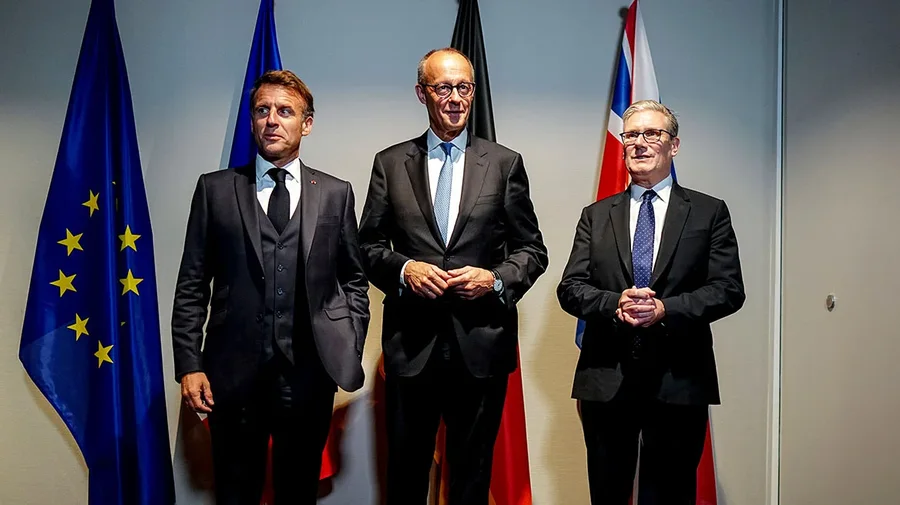
French President Emmanuel Macron is expected to consider expanding France's nuclear defense to other European countries after consulting with his advisers. He had left the option open last year after developments in Ukraine.
The temporary suspension of US military intelligence sharing with Ukraine in March 2025 had immediate consequences on the ground and reopened the debate on nuclear deterrence in Europe, a discussion that had not taken on such proportions since the end of the Cold War.
When Washington cut off the flow of information to Kiev for several days, Ukrainian forces faced operational difficulties, while European governments watched the development with concern. Although the measure was temporary, the political signal was strong: doubts grew in some European capitals about the reliability of the United States as a long-term military partner.
According to sources cited by Bloomberg, several European countries have begun bilateral and trilateral discussions, mainly at the military level, to strengthen or build a European nuclear deterrent mechanism. The talks are taking place discreetly, especially among states that host US military assets, are located near the Russian border and perceive a direct threat from Moscow.
Currently, Europe relies on the US “nuclear umbrella,” which includes American weapons deployed on the continent and the guarantee of NATO’s collective defense. If the credibility of this commitment is called into question, European countries face a Russia that possesses the world’s largest nuclear arsenal.
In Europe, only France and the United Kingdom possess nuclear weapons. French President Emmanuel Macron is expected to consider expanding French nuclear defense to other European countries after consulting with his advisers. He had left the option open last year after developments in Ukraine.
The UK relies on an American supply chain for its missiles, manufactured by Lockheed Martin, while submarines are built in Britain and London retains operational autonomy. France, on the other hand, produces its own nuclear warheads.
Theoretically, other European countries could also seek to acquire nuclear weapons, but such a step would entail high economic and political costs, and would require violating international agreements on the non-proliferation of nuclear weapons. At the same time, they would have to accept the risk involved in defending an ally in the event of escalation.
“Imagine Russia invading Estonia,” Pavel Podvig, a researcher at the United Nations Institute for Disarmament Affairs, told Bloomberg. “France could inflict huge damage on Russia, but Russia could inflict equivalent damage on France. Would Paris be willing to take that risk?”
The issue of nuclear deterrence is also expected to be at the center of discussions at the Munich Security Conference. However, experts estimate that completely replacing the American umbrella would be economically difficult. In 2025, the European Union and the United Kingdom spent over $530 billion on defense, a level that is already putting pressure on national budgets.
Daria Dolzhikova, a researcher at the Royal United Services Institute, says a single pan-European nuclear deterrence mechanism does not seem realistic. The challenge, she says, lies in how French and British strategies can contribute to strengthening overall European security.
France and the United Kingdom each have about 400 deployed nuclear warheads, compared with the United States's 1,670. Although smaller, this arsenal remains sufficient to cause widespread destruction. Russia, meanwhile, has a wider range of tactical weapons, including lower-yield nuclear weapons.
Both countries spend about $12 billion a year maintaining their arsenals. Any potential expansion of nuclear defense to other countries also faces domestic political challenges, including the debate in France, where figures such as Marine Le Pen and Jordan Bardella have opposed the idea of a “joint” nuclear deterrent.
On the other hand, NATO continues to emphasize the unity of the alliance. Secretary-General Mark Rutte has stated that the US remains committed to NATO, while a Pentagon official has affirmed that nuclear deterrence in support of allies continues unchanged. President Donald Trump has not publicly addressed the issue of the nuclear umbrella and, according to Bloomberg sources, the topic has not even been raised in private conversations.
However, according to the assessment included in the report, economic and political constraints could curb ambitions for a new European nuclear architecture. Belgian Prime Minister Bart De Wever stated that building a multi-layered nuclear umbrella would bring Europe closer to the status of a world power, adding that it remains debatable whether the continent should follow such a path. / Adapted from Bloomberg




Lini një Përgjigje