


 Shkruar nga Pamfleti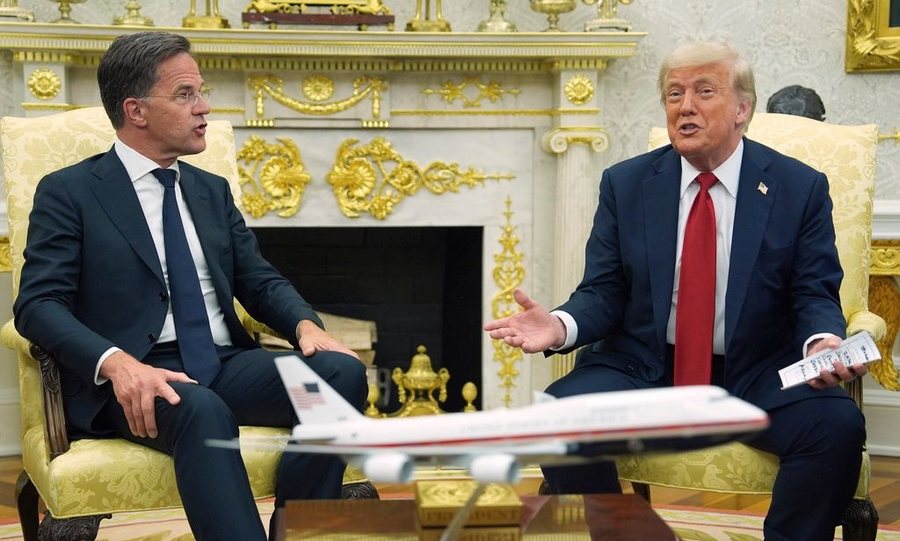
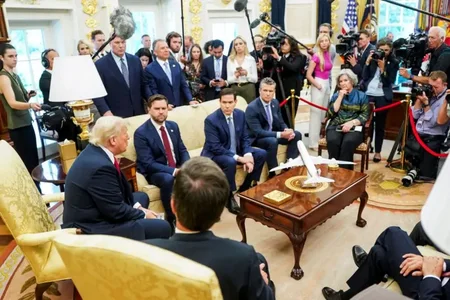
US President Donald Trump had announced for days that he would make a "major" statement on the war in Ukraine today, something he did side by side with NATO Secretary General Mark Rutte in the Oval Office of the White House.
Donald Trump's main announcement was the 50-day ultimatum he gave Moscow to reach an agreement with Kiev, otherwise the US would adopt secondary tariffs of 100% against Russia.
Trump also confirmed what had been said before: top-notch weapons would be sent to Ukraine in a NATO-coordinated operation.
During the meeting with NATO Secretary General Mark Rutte, Trump said he was "very unhappy" with Russia and "disappointed" with President Vladimir Putin, adding that he wants the war in Ukraine to end.
Rutte called the agreement a "really great deal", confirming that the weapons would be paid for by European nations, a decision the alliance leader called "absolutely logical".
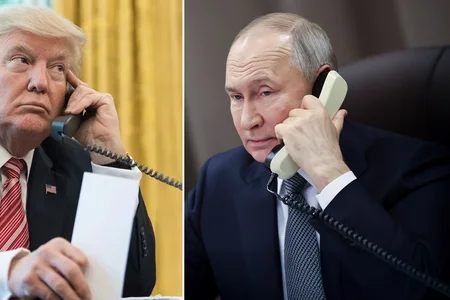
Trump claimed that he talks a lot with Putin, describing the conversations as very pleasant, but added that talks are of no value when missiles are hitting cities.
He also declined to comment on how far he was willing to go in response if Putin escalated the situation.
What are secondary fees?
The main lever of pressure against the Kremlin to achieve a ceasefire that the US president is using is the threat to adopt secondary tariffs of 100% against Russia.
The secondary tariffs mean that any country that continues to trade with Russia will face high levels of tariffs to sell its products to the US.
If, for example, India continues to buy oil from Russia, which it has continued to do since the start of the war in 2022, American companies that buy products from India will have to pay a 100% import tax, or duties, when the products reach American shores.
The idea is that this makes these goods so expensive that American businesses will choose to buy them cheaper elsewhere, resulting in lost revenue for India.
Targeting Russian oil and gas revenues
The goal is also to cripple Russia's economy. Theoretically, if it is unable to generate money by selling oil to other countries, it will have less revenue to finance the war in Ukraine.
Russia relies heavily on oil and gas revenues, which in 2021 accounted for 45% of the country's federal budget, according to the International Energy Agency.
The White House has said it will only impose secondary tariffs on countries if a deal to end the war with Russia is not reached within 50 days.
A significant change of course for the American president
At first glance, this is a significant change in Donald Trump's approach to the war between Ukraine and Russia. Until now, the arms shipments were "legacy" deals from the Biden administration.
But now Trump has given the green light to transfer new stockpiles not only of defensive weapons, such as Patriot missile batteries to protect Ukrainian airspace, but also of offensive weapons, including missiles and munitions with the ability to strike deep inside Russia.
However, there is a big condition as European governments will foot the bill, 100% of it.
Despite maintaining his tough stance on who should pay for the weapons, the president also struck an unusual tone of "warmth" toward his European allies, who often face harsh rhetoric from Washington.
Trump's rhetoric about Vladimir Putin has become increasingly harsh in recent weeks, with the president particularly furious after a recent phone call, which was followed by the heaviest bombing of the Ukrainian capital by Russia since the start of the war.
Will Trump's ultimatum differ from that of European leaders?
At first glance, today's White House announcements are extremely encouraging for Ukraine.
Kiev will be even bolder when it sees weapons arriving at its borders.
However, in relation to President Trump's 50-day ultimatum to Russia for a ceasefire, this is the second significant deadline set for Moscow, after the first by European leaders, when hopes were dashed by both Trump and Putin.
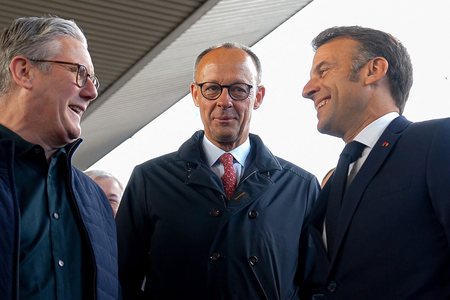
In May, the leaders of four major European states, France, Germany, the United Kingdom and Poland, came to Kiev and issued a ceasefire ultimatum to Moscow, or face harsh sanctions.
But President Putin quickly sidestepped this opportunity by offering “direct talks” with Ukraine in Istanbul, which Trump more or less ordered the Ukrainian leader to attend. He did as he was told, Putin didn’t show up, and Trump did nothing.
This time it may be different. Donald Trump is at least publicly declaring his disappointment with Vladimir Putin.
But 50 days gives the Kremlin plenty of room to maneuver. Time, in other words, in which it will be able to present a counteroffer that will avert the threatened sanctions. /Adapted from Pamphlet/




Lini një Përgjigje