


 Shkruar nga Peter Ricketts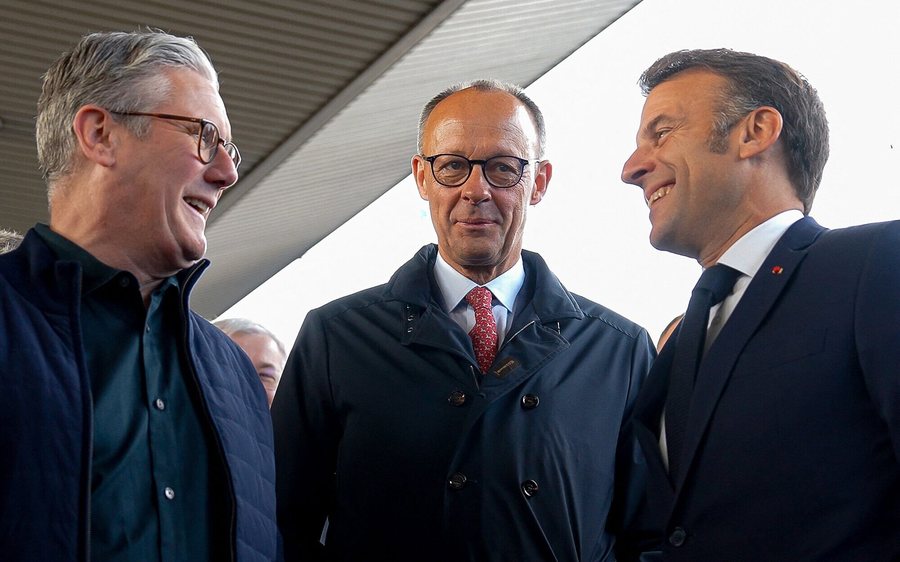
In the face of geopolitical instability, close trilateral relations are essential.
France and the United Kingdom agree that there is no extreme threat to Europe that would not trigger a response from our two nations.
That sentence in the Northwood statement issued by Prime Minister Sir Keir Starmer and President Emmanuel Macron at the Britain-France summit last week signaled a potentially far-reaching shift in the two countries' defense priorities as they confront Vladimir Putin's aggression in Ukraine and Donald Trump's lack of credibility as an ally.
The most productive UK-France summit since 2010 will be followed by German Chancellor Friedrich Merz's first visit to London this week. It will have none of the pomp and show of Macron's state visit, but it will still be a momentous occasion.
Merz and Starmer will sign a broad cooperation treaty, strengthening what has been the weakest part of the London-Paris-Berlin triangle, while the three countries take on more responsibility for European security. The agreements end a decade in which Brexit overshadowed relations between the United Kingdom and its neighbors.
British-French nuclear cooperation is at the heart of the debate over how Europeans should respond to the weakening of the US commitment to NATO. For 30 years, London and Paris have stuck to the formula that the vital interests of one cannot be threatened without also engaging the vital interests of the other. But what about the rest of Europe?
As Merz said shortly before becoming chancellor: " The division of nuclear weapons is a topic we need to talk about... We must be stronger together in nuclear deterrence ."
Northwood’s confirmation that the two countries will “coordinate on all nuclear policy, capabilities and operations” is a response to the concerns of Merz and others. There is, rightly, a lot of ambiguity in this careful wording. That’s how deterrence works. But the overall message is clear enough. The new wording is more innovative for France (which has always been Delphic about whether its nuclear deterrence extends to its European partners) than for the UK, whose nuclear weapons have long been declared to NATO for the protection of all allies. Nevertheless, it is a powerful sign of the growing strategic trust between London and Paris.
In another sign of the times, Macron and Starmer agreed that their armed forces should move away from expeditionary operations away from Europe and create a joint combined force on a “combat-sufficient scale”.
The proximate cause of this rapprochement is the combined effect of Putin and Trump. But the improvement in relations between the UK and the EU has also given Macron the political space to strike ambitious deals with the UK. The French president clearly wanted to help Starmer with his difficulties over irregular migration by agreeing to a pilot scheme allowing limited returns to France, balanced by family reunification cases coming to the UK.
It would have been much harder to sell this deal in Brussels if the UK and the EU were still at odds. It could still face legal challenges from both sides, and it may not reduce migrant flows unless it can be expanded into an EU-wide deal. But the fact that Macron has opened a door that had been firmly shut shows the value he places on strengthening the alliance with Starmer, which has grown from their shared leadership of European support for Ukraine.
Merz will visit London in a similar frame of mind. Since his first speech to the Bundestag as chancellor, he has called for deeper cooperation with the United Kingdom. He too is a strong advocate for greater European military and economic support for Ukraine. Germany has pledged to meet NATO’s new target of spending 5 percent of GDP on defense, including 3.5 percent on hard defense. It is one of the few European NATO members that can credibly commit to meeting that goal by 2032, given its low level of government debt.
Britain is a natural partner for Germany in this transformation. Both countries have traditionally purchased far more US military equipment than France and have a shared imperative to develop European alternatives. It helps that their defence industries are less competitive with each other than those of the UK and France. To enable real progress, a swift agreement is also needed to give the UK access to the EU’s new investment fund for secure defence.
The task of weaning Europe from its decades-long overdependence on American military power is so vast that close trilateral cooperation on defense, security, and foreign policy between London, Paris, and Berlin is essential. The foundations for this are being laid now./ Adapted from "Pamphlet" by "FinancialTimes"




Lini një Përgjigje