


 Shkruar nga Pamfleti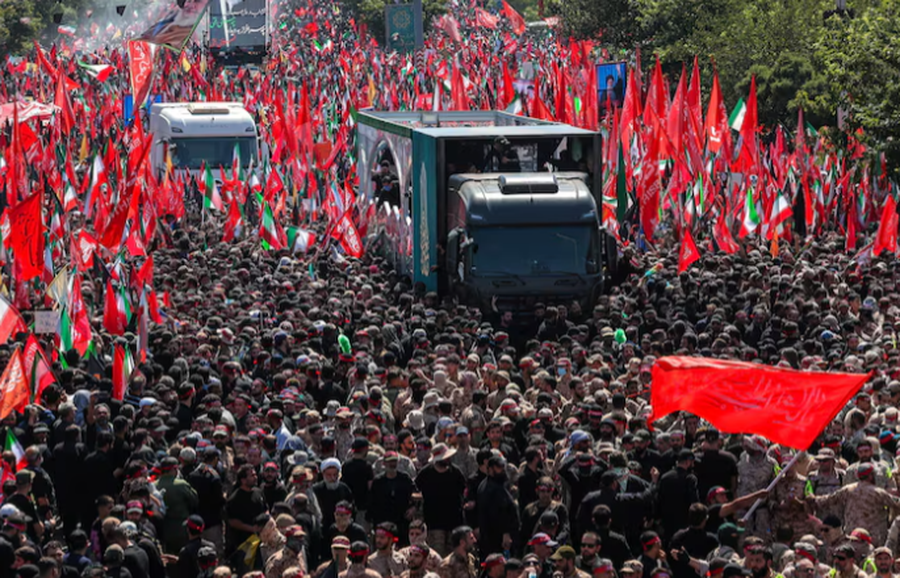
Iran believes that US President Donald Trump has a greater political interest in securing a deal than Tehran in making concessions.
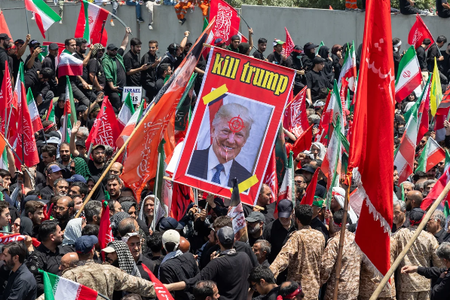
The funeral of Iran's late supreme leader, Ayatollah Ali Khamenei, turned into a political demonstration, through which Tehran aimed to convey the message that the Islamic Republic survived the war with the United States and Israel and remains an important regional actor.
According to a Reuters analysis, the massive turnout at the funeral ceremony was used by the Iranian leadership to present the country as united and determined, despite the conflict that began with the US and Israeli attacks on February 28.
Regional officials, diplomats and analysts quoted by Reuters assess that Tehran is trying to turn survival during the war into a diplomatic advantage.
Hormuz at the center of the strategy
Iran's main focus is no longer its nuclear program, but consolidating influence in the Strait of Hormuz, the maritime corridor through which about a fifth of global supplies of oil and liquefied natural gas pass.
Reuters quotes analysts as saying that Tehran intends for any future agreement with the West to recognize its role and influence at this strategic point.
The 60-day ceasefire, conceived by Washington to restore negotiations on the Iranian nuclear program, has, according to the analysis, created a new dynamic, where Iran's time and geographical position have become its main assets.
Iran's "Diamond"
Alex Vatanka, an analyst at the Middle East Institute in the US, told Reuters that for Tehran, the importance of Hormuz is more political than economic.
According to him, Iran seeks symbolic recognition of its dominant role in the strait and does not want to exchange this advantage for the easing of sanctions or the unblocking of frozen assets.
Referring to a Persian expression, Vatanka said: "Why give a diamond for a candy?" According to him, for Iran, the "diamond" is Hormuz, while economic benefits represent the "candy."
Even the speaker of the Iranian Parliament, Mohammad Bagher Qalibaf, declared that the Strait of Hormuz is Iran's "greatest tool of power" and that the country will not give up the rights it claims in that area.
Slow negotiations
Diplomatic sources and analysts cited by Reuters estimate that Iran is deliberately dragging out negotiations to consolidate the strategic gains gained during the war before returning to the nuclear file.
Alan Eyre, a former US diplomat with expertise on Iran, said Tehran feels no rush to reach a deal.
According to him, Iran believes that US President Donald Trump has a greater political interest in securing a deal than Tehran in making concessions.
Reuters also quotes Aaron David Miller, former US Middle East negotiator, who argues that the military campaign failed to weaken Iran's regional influence.
According to Miller, Tehran has no reason to seriously engage in nuclear negotiations until it is assured that its position on Hormuz is accepted and that progress has been made in unlocking billions of dollars in frozen assets.
Concerns in the Persian Gulf
Ebtesam Al-Ketbi, president of the Emirates Policy Center, told Reuters that ending the war without resolving its causes may have further strengthened Iran's influence in Hormuz.
According to her, the Gulf states are concerned that Tehran now considers this strategic advantage non-negotiable, even in exchange for sanctions relief or progress on the nuclear file.
Analysts quoted by Reuters estimate that the United States may face the need to accept a new reality in the Strait of Hormuz, where Iranian influence remains a key factor in any future agreement.


Lini një Përgjigje