


 Shkruar nga Pamfleti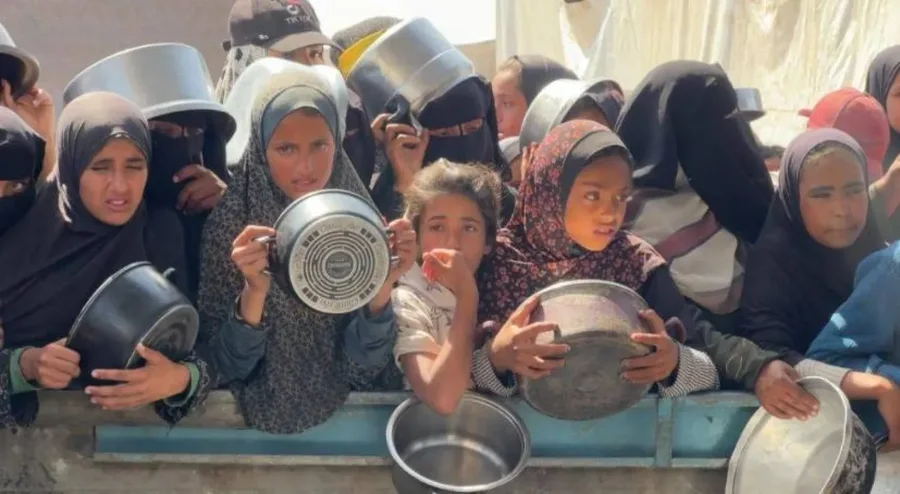
The daily ordeal of Gaza residents to survive. A 7-year-old girl stands in line for 1.5 hours every day for a small pot of food for her and 6 other family members. Humanitarian organizations are sounding the alarm that supplies are running out, and if the situation does not change, tens of thousands of Palestinians could die of hunger every week...
As noon approaches, Waheed Abu Sabeeh calls his 7-year-old daughter, Bisan. He hands her a small pot and tells her to hurry. Just a few dozen meters from their tent, a kitchen set up by a charity offers a kind of salvation for them: a single ration of food, cooked in the Al-Shati (Plazh) refugee camp in Gaza.
Abu Sabeeh, 47, was displaced from his home in Beit Lahia in northern Gaza. He now lives with his wife and five children in a makeshift tent, no larger than 4 square meters, erected next to an UNRWA school, which has been converted into a shelter in western Gaza City.
Like thousands of others driven from their homes by war and poverty, Abu Sabeeh has little way to feed his family. "We survive on what our donors give us. If it weren't for them, my children would go to bed hungry," he says in a voice that echoes with extreme fatigue.
Every day, Bisan, who should be in school like every other child in the world, joins a long line of women, children and men, all holding empty containers. The charity serves modest food rations of lentils, beans, peas or rice, about 400 grams per person, without any extras.
For nearly 90 minutes every day, sometimes longer, 7-year-old Bisan waits in line in the sun, a small pot in her hands, outside the charity's tent in the Al-Shati refugee camp in Gaza. Other days, she leaves earlier, hoping to escape the large crowds.
“I go there to get food to help my family feed themselves, because we have nothing at home,” she says in a soft, innocent voice. The food she brings rarely goes beyond a very modest meal.
On days when the organization's kitchen runs out of food, the family indulges in small amounts of za'atar (a mixture of dried oregano, thyme, basil, and sesame seeds), and sometimes goes without bread.
Her father ran a small children's clothing and toy shop in Beit Lahia, in northern Gaza. But Israeli airstrikes destroyed his shop and home nearly a year ago, leaving him and his family with only a tent and the daily uncertainty of survival.
"Bisan waits for hours, just to bring home a few spoons for each child," her father tells the Arab newspaper Asharq Al-Awsat. "Sometimes she comes back empty-handed. Other times she fights with other children in line, when they are pushing each other to get the food first," he adds.
According to Bisan's father, the little girl's behavior has changed. "Now she's noisier, more aggressive. She screams or pushes. She's learned along the way that if she doesn't fight for what she needs, she might not be able to eat!" - emphasizes the father.
Every day, 51-year-old Faten Al-Masri holds a pot in her hands, and joins a long line of people hoping to receive a small ration of lentils or rice from another charity kitchen in the bombed-out Al-Rimal neighborhood in Gaza.
Originally from Beit Hanoun in the north, Al-Masri and her family of 13 have been living in a tent for months, displaced by the war. With no flour available, they eat whatever the kitchen offers, and often sleep without bread or anything else edible.
"Some days, I wait more than 3 hours just to get some food," she tells Asharq Al-Awsat, her voice heavy with fatigue. "There is no flour, nothing else. We eat whatever they offer us. That's all we have!" the woman adds.
Despite chronic diabetes and pain from standing for long periods, Al-Masri says she has no choice but to endure the wait. "My children are busy. One bringing water, the other looking for something else. I go in line because I have to. I am sick, but I cannot let my family go hungry. We have nothing..." - the woman says.
Her words reflect the desperation currently felt across the Gaza Strip, where hunger, displacement and the collapse of basic services have forced even the elderly and the infirm to wait in line for survival.
Charity kitchens across Gaza - once a lifeline for displaced families - are struggling to cope with the growing burden. Once able to feed hundreds of people each day, some kitchens have begun to ration the limited supplies they receive.
Others have closed down altogether, unable to cope with growing demand and dwindling resources. These soup kitchens are run by a mix of international organisations, UN agencies, Arab charities and local youth-led initiatives.
But aid workers warn that the situation is deteriorating to what they describe as "beyond catastrophic", as war, displacement and an escalating blockade have left hundreds of thousands of people on the brink of starvation.
Ali Matar, who helps run a soup kitchen in West Gaza, an area already filled with families displaced from the north, says the food crisis is reaching a tipping point.
"There is a clear shortage of canned goods, rice, lentils and other basic products. Suppliers are running out of stocks, and this is greatly affecting our ability to cook and distribute food. Hunger has gripped Gaza in its grip," Matar told Asharq Al-Awsat.
The rising cost of what little food remains, such as beans, peas and rice, is making it increasingly difficult for donors to continue humanitarian operations. Matar said the situation is forcing some aid groups to close their kitchens entirely, as their storage shelves are empty.
"Some of the charities and Arab-funded organizations are now pooling resources just to keep cooking. But if this crisis is not addressed soon, the consequences will be catastrophic. We could see dozens of people die of hunger every week," he warns.
Under growing international pressure to halt its military campaign in Gaza and allow aid in, Israel recently announced that it would allow “essential” humanitarian supplies to enter. However, aid groups say the announcement is long overdue, as aid has been blocked since March 2, while the needs are dire. /Adapted from Pamphlet by “Asharq Al Awsat”/






Lini një Përgjigje