


 Shkruar nga Pamfleti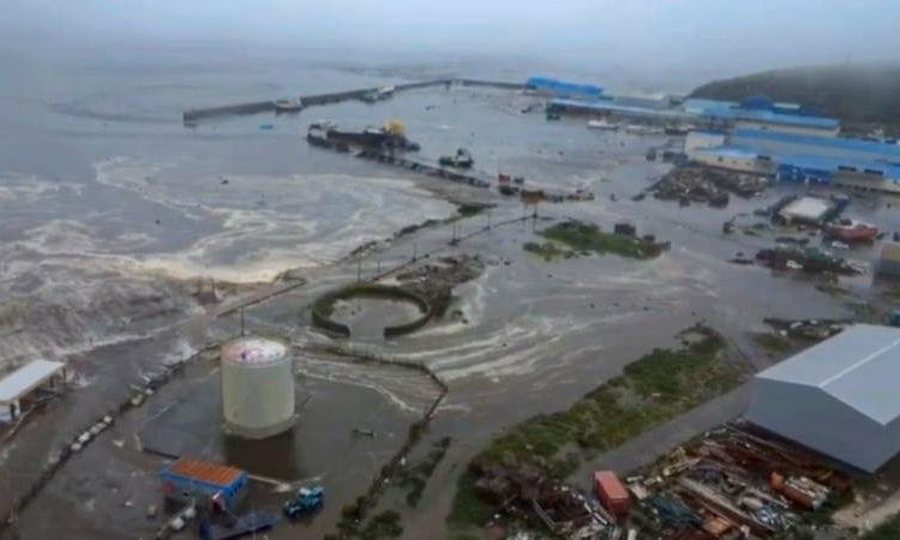
After today's earthquake, the PP Shirshov Institute of Oceanology reported that the tsunami height in some areas of the Kamchatka coast could reach 10-15 meters...
One after another, warnings of the worst are coming, following the apocalyptic earthquake, with a magnitude of 8.8 on the Richter Scale, that was recorded in Kamchatka.
The Russian Academy of Sciences has warned of further aftershocks and volcanic eruptions in Kamchatka. However, a tsunami alert was recently issued in Severo-Kurilsk, Russia, according to the state news agency Tass.
According to Russian media reports, aftershocks of up to 7.5 on the Richter scale are expected in Petropavlovsk-Kamchatsky after the 8.8-magnitude earthquake. A tsunami is also possible on the coast of Avacha Bay.
All information refers to the Central Directorate of the Emergencies Ministry of Russia for the Kamchatka Territory, citing scientists.
"Scientists have concluded that tremors of up to 7.5 on the Richter scale and dangerous tsunamis caused by them on the coast of Avacha Bay are expected in the urban area of Petropavlovsk-Kamchatsky," a post on the Emergencies Ministry's Telegram channel said.
Rescue teams have recommended that in the coming hours people not visit areas adjacent to the waters of Avacha Bay and the Pacific Ocean, in particular Khalaktyrsky Beach, Anglichanka Bay, Lake Prilivnoye, the coastline of the Nikolskaya Hill slope and others.
After today's earthquake, the PP Shirshov Institute of Oceanology reported that the tsunami height in some areas of the Kamchatka coast could reach 10-15 meters.
The tsunami caused by the earthquake also reached several US territories, the states of Hawaii, California and Washington.
4-meter tsunami warning
According to AFP, citing local authorities, waves of up to 4 meters are expected to hit the Marquesas Islands in French Polynesia in the early hours of the morning (local time). The waves are expected to hit the island of Nuku Hiva in the archipelago overnight, according to a statement from the High Commission of the French Republic in French Polynesia, which added that the islands of Oa Huka and Hiva Oa are also expected to be affected.
In Colombia, the National Disaster Risk Management Unit said strong currents and tsunami waves were expected along the Pacific coast between Wednesday morning and noon (local time). The unit called for an early evacuation of beaches and low-tide areas in the western departments of Nariño and Chocó.
"Please move to higher ground away from the coast," the notice on "X" says.
In Chile, the Education Ministry suspended classes in schools along parts of the Pacific coast, while the National Agency for Disaster Prevention and Response issued a yellow alert for a possible tsunami. The agency's director, Alicia Cebrián, told reporters that the waves were expected to hit Easter Island first on Wednesday morning (local time). "The information is dynamic and is being constantly monitored," Cebrián said, adding that evacuations would be carried out three hours in advance.
In Panama, Omar Smith Gallardo, head of the National Civil Protection System, appealed for calm and asked residents of the Pacific coast to stay away from the coast until noon. Panama had not been hit by major earthquakes in the past, but it was not possible to guarantee "100%" that it would happen again this time.
The Ecuadorian Navy's Oceanographic Institute announced that there was an "immediate risk" of a tsunami and that waves of 1.4 meters were expected to hit the Galapagos Islands on Wednesday morning, local time, with the possibility of larger waves coming later.
What are tsunami warnings?
Throughout the morning, various tsunami warnings were reported around the world following the 8.8 magnitude earthquake.
But what do all these warnings mean? Below is a breakdown of the different categories.
According to the U.S. National Weather Service, there are four levels of tsunami warnings: warning, advisory, watch, and informational statement.
Warning: There is a possibility of dangerous coastal flooding and strong currents. Move immediately to higher ground or inland.
Advice: There is a possibility of strong currents and waves that are dangerous to those in or near the water. Stay away from the water and beaches.
Warning: There is a possibility of a distant tsunami. Stay tuned for more information and be prepared to take action.
Update statement: There is no threat or the phenomenon/threat is too distant and has not been identified.
Several other countries also issue tsunami warnings, but they have different classification systems.
In Japan, for example, they have a three-tier system.
Severe Tsunami Warning: A tsunami of over 3 meters is expected and immediate evacuation of coastal areas is required. Major damage is expected to buildings near the water.
Tsunami Warning: A tsunami of up to 3 meters high is expected with damage to low-rise buildings and evacuation has been ordered.
Tsunami Warning: A tsunami of up to 1 meter is expected. It poses a threat to those in the water and people are urged to leave the sea immediately.


Lini një Përgjigje