


 Shkruar nga Christoph Reuter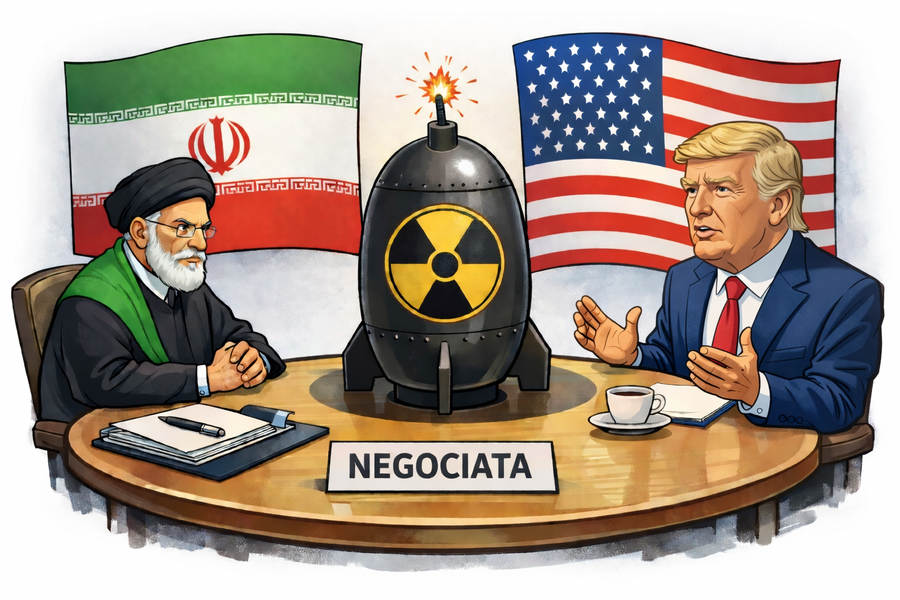
It was precisely in this current war that the Iranian regime noticed that it has long possessed an extremely powerful weapon...
The mullahs have long been busy developing the bomb. That has brought them sanctions and airstrikes. Now they have revealed the Strait of Hormuz as a weapon. What does this mean for talks with the US?
A nuclear weapon, according to the common and well-reasoned assumption, constitutes the ultimate deterrent to any adversary who thinks of attacking. Because he must reckon that his capital would be destroyed in a nuclear counterattack, his country, his population, his economy would disappear.
Consequently, the Iranian regime has been trying for decades to create at least the technological conditions to make itself invulnerable in this way. Against Israel, against the US above all. Similar to Pakistan, which decades ago managed to secretly develop its own nuclear weapons for more than a quarter of a century, in order to keep its main rival, India, under control.
However, Pakistan had powerful allies in its weapons program, China, Saudi Arabia, and occasionally the United States. Iran has enemies above all. Although the former leader of the revolution, Ali Khamenei, recently assassinated, even tried to back it up with a fatwa, a religious edict, that Iran was not aiming for nuclear weapons, the United States and Europe did not believe this, and Israel even less so.
-The nuclear program has ruined Iran
Instead of increasing its power and deterrence with its expensive advanced nuclear development, the program initially isolated Iran politically, pushed it economically towards ruin through Western sanctions, and in late February made it the target of military attacks by the US and Israel for the second time in nine months. It thus achieved exactly the opposite of what it was supposed to achieve.
But in this current war, the Iranian regime has long realized that it has possessed an extremely powerful deterrent weapon: its topographic position. A knee-shaped sea strait, surrounded on three sides by rugged mountains that rise steeply into its territory. And through which a fifth of the world's oil and gas exports must pass, transported by ship to markets: the Strait of Hormuz.
This bottleneck is in a way a nuclear weapon, which has a decisive advantage over real atomic bombs: it does not need to be used at all, to destroy something irreversibly, but it can gradually increase the pressure to push the world economy into an increasingly dramatic recession.
The jagged mountains along the narrow sea route, extremely cheap kamikaze drones, and perhaps a few sea mines have been enough to block the world's most important energy supply passage.
Chain reactions worth billions
The loud radio statements by Revolutionary Guard officials that the Strait of Hormuz was being closed immediately were enough to set in motion chain reactions worth billions: almost no shipowner wanted to expose their ships to risk, insurance costs rose rapidly, tankers piled up on both sides of the strait, full ones couldn't leave, empty ones couldn't enter.
The consequences are not only high energy prices, but also a dramatic decline in fertilizer production. Chip production is suffering from shortages. In Asia, entire economies have been brought to their knees, which until now received almost all of their energy imports from the Gulf.
This is, at least for the unexpected US President Donald Trump, the starting point for the ceasefire agreed at the last minute. All the military superiority of the attackers, the ability to destroy Iran's naval fleet, air defenses, airports, military bases, factories, had not broken the Iranian leaders. The regime only needs to continue to directly or indirectly block the Strait of Hormuz to push the chain reaction of a global economic crisis further and further.
At the height of the conflict, both sides promised destruction: Trump threatened Iran with the “destruction of a civilization,” which was unusual even by his standards.
Iran, in turn, threatened to destroy oil and gas fields, terminals, and desalination plants in neighboring Arab countries on the other side of the Gulf. The result of this kind of war would be a kind of extended self-destruction that would have brought the world economy to its knees for years.
-A victory from which Tehran can buy nothing
That didn't happen for now. But the 14-day ceasefire brokered by Pakistan 88 minutes before Trump's ultimatum expired is a very fragile deal. The negotiating positions couldn't be further apart.
With Trump on one side of the table is an overworked and deeply humiliated narcissist. Through him, the US has lost all trust in the Iranians, twice – last summer and recently – he ordered attacks during negotiations. On the other side, the Iranian leadership, partially renewed after targeted assassinations by Israel, has achieved a partial victory. From an adversary that Trump said had been completely destroyed, it has become a negotiating partner.
-But this does not bring concrete benefits to Tehran.
That is precisely what the new leadership must achieve if the fighting is to end. The Iranian economy, weakened for decades by sanctions and corruption, was barely able to provide for the population even before the war. Now thousands of businesses have been bombed, steel mills have stopped production, large fuel depots in Tehran have been destroyed.
Any reconstruction requires money that Iran does not have. The regime must achieve financial relief if it is not to collapse economically after military survival.
-Radicals often overestimate themselves
As Iran threatens massive destruction in the region, it must simultaneously ensure a functioning economy at home. But the obstacle is not only external enemies, but also radicals within the country. They have often overestimated their ability to impose their demands. This pattern has been seen in the past, including the Iran-Iraq war.
Today, Iran’s military leaders face a similar situation: they have achieved an initial victory, but to avoid economic ruin and collapse they must show flexibility. Meanwhile, the Revolutionary Guard remains the real center of power, with great influence over both the military and the economy. Its interests also include maintaining sanctions, since much economic activity takes place under conditions of limited market forces.
In this context, reaching an agreement remains difficult. Meanwhile, recent developments show that the situation remains unstable. According to reports, Iran has again blocked the Strait of Hormuz, while reports about its passability remain contradictory. Its opening had been the main point agreed upon between Tehran and Washington./ Adapted by "Pamphlet" from "Spiegel"



Lini një Përgjigje