


 Shkruar nga Pamfleti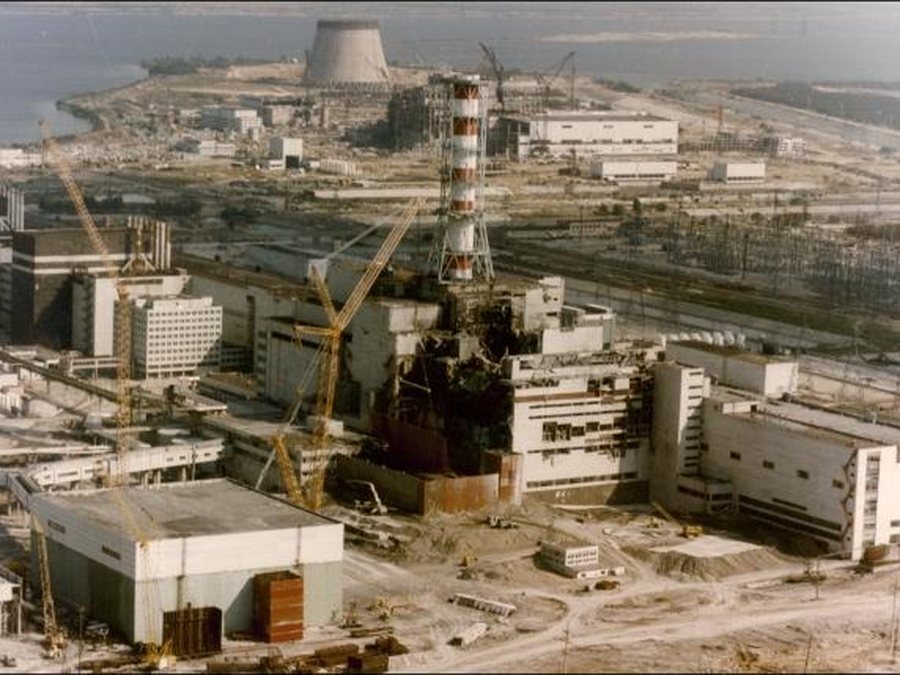
The specter of nuclear war that awoke in April 1986 has still not found peace...
The Chernobyl disaster was "perhaps the real cause of the collapse of the Soviet Union," as Mikhail Gorbachev, the last president of the USSR, himself said. And looking back, it is not difficult to understand how the chain reaction of events triggered by the explosion at the nuclear power plant in Ukraine on April 26, 1986, led, within a few years, to the lowering of the red flag with the hammer and sickle from the Kremlin dome on the evening of December 26, 1991.
It was only on April 27, 1986, that the Swedes discovered an abnormal increase in radioactivity in their atmosphere. After confirming that everything was fine at their nuclear power plants and since nothing was reported from neighboring countries, it did not take long for them to suspect that something must have happened in the Soviet Union. But it was not until the evening of the next day that the first, brief, reports about the Chernobyl accident arrived from Moscow.
There is no absolute certainty about what really happened at the Soviet nuclear power plant in the early hours of that fateful April 26. Apparently, the disaster was caused by procedural errors during a safety test at the plant's reactor number 4: however things turned out, that night the reactor exploded, collapsing the roof of the plant and releasing a dose of radioactivity hundreds of times greater than that of the Hiroshima bomb. The toxic cloud spread, driven by the wind, towards Belarus, from there it hit Scandinavia and then moved towards Western Europe, reaching even the regions of northeastern Italy. It was the worst disaster in the history of civilian nuclear energy.
While the immediate aftermath of the accident killed 65 people, including heroic rescue teams who rushed to the scene without any protective equipment, it is estimated that at least 4,000 people subsequently died from radiation, including rescue teams and residents of the surrounding areas who were evacuated. To these must be added another 5,000 deaths in the wider contaminated areas, for a total of 9,000. However, a Greenpeace report estimated the death toll at between 100,000 and 270,000, going so far as to suggest that 6 million cancer deaths worldwide were directly attributable to Chernobyl.
But the most prominent alleged victim, it has been said, was the Soviet regime itself. Gorbachev had been in power for little more than a year and had begun the era of glasnost, or transparency, by which he aimed to revive the sclerotic USSR by overcoming the stifling censorship that oppressed it. But his first test, Chernobyl, had unforeseen consequences.
The initial reaction of the Moscow authorities to the incident was the usual one: denial, minimization, and obfuscation. Only the alarm and outrage in the West forced the Soviet government to reveal, at first incompletely, the nature and scale of the disaster. This exposed the incompetence, dysfunction, and duplicity of the regime, fueling dissent and distrust. On May 1, the traditional military parade on Red Square took place in Moscow, as if nothing had happened, and only on May 16 did Gorbachev address the issue on television, going so far as to accuse the Western media of “malicious lies” and an “immoral campaign.” Soviet citizens were now turning to them to find out what was happening in their country.
However, Soviet journalists, taking advantage of the wave of glasnost, began to investigate the disaster, while intellectuals sought clear answers: and if at first these shocks seemed to strengthen the reformist wing of the Soviet regime, gathered around Gorbachev, ultimately the Chernobyl disaster acted as a catalyst that exposed the contradictions of the USSR, fueled distrust in the system and led to its final collapse.
The consequences, including political ones, were also felt in Italy. Those who remember those weeks in May will recall the anxiety among the people facing an invisible threat, with the authorities banning the consumption of the most dangerous foods, such as milk and salad. And already on May 10, a large anti-nuclear demonstration took place in Rome, the first step towards the referendum that in 1987 sanctioned the abandonment of nuclear energy in our country.
Ten years later
Only ten years after the disaster, in 1996, the government of Ukraine, which by then had become independent, allowed Western journalists into Chernobyl for the first time.
Once past the security checkpoints in the exclusion zone, abandoned houses, empty warehouses and abandoned bus stations lined the road: everything seemed to have stopped at the time of the evacuation, ten years earlier. But the surprise was inside the plant, which was still operational and fully functional, thanks to reactors 1 and 3: the plant would only be completely dismantled at the end of 2000. And even in the rest of the exclusion zone, after the main road was abandoned, families, especially the elderly, could be found secretly returning to their homes, unaware of the still high levels of radiation.
But the real ghost town was Pripyat, just a short walk from the power plant: for, although the disaster took its name from Chernobyl, this city is located a little further away, while Pripyat was built right in the shadow of the nuclear power plant. Fifteen thousand people lived there, all evacuated in the first hours after the explosion: and even ten years later, a sad picture of the disaster remains before our eyes.
Everything remained of Pripyat: buildings, streets, squares, cinemas, post offices. But there was also nothing left in Pripyat: empty houses, furniture moved and buried, slaughtered animals. Only the wind and dust broke the silence.
The Chernobyl disaster has been a hot topic for years, especially regarding the so-called sarcophagus, which was hastily built to contain reactor number 4, the one that exploded, and to prevent further radiation from spreading. The structure of the sarcophagus suffered damage and collapse over time, raising constant alarm. It was only nine years ago that a new, safer sarcophagus, built with funding from the European Union and the United States, was installed.
But the nuclear power plant, which had been permanently shut down in 2000, returned to the spotlight after the Russian invasion of Ukraine: first at the beginning of the conflict, when the country was temporarily occupied by Moscow's troops, and the second time when a Russian drone deliberately hit the new sarcophagus over reactor number 4. In both cases, Putin's military broke the taboo that kept nuclear sites safe from war.
In the first half of December, the United Nations General Assembly adopted a resolution, sponsored by Ukraine, to strengthen international cooperation and minimize the consequences of the Chernobyl disaster. The document was supported by 97 countries, but the United States joined Russia and Belarus in voting against it.
And the Chernobyl issue also brings to mind the fate of Ukraine's other major nuclear power plant, Zaporizhia, occupied by Russian troops, who are using the facility as a shield against Ukrainian attacks: a very dangerous game. This plant is the subject of peace negotiations, where it will be decided if and how it can be returned to Ukrainian hands: Putin is using it as a bargaining chip. The specter of nuclear war that was awakened in April 1986 has still not found peace. / Adapted from "Pamphlet" by "Corriere della Sera"



Lini një Përgjigje