


 Shkruar nga Pamfleti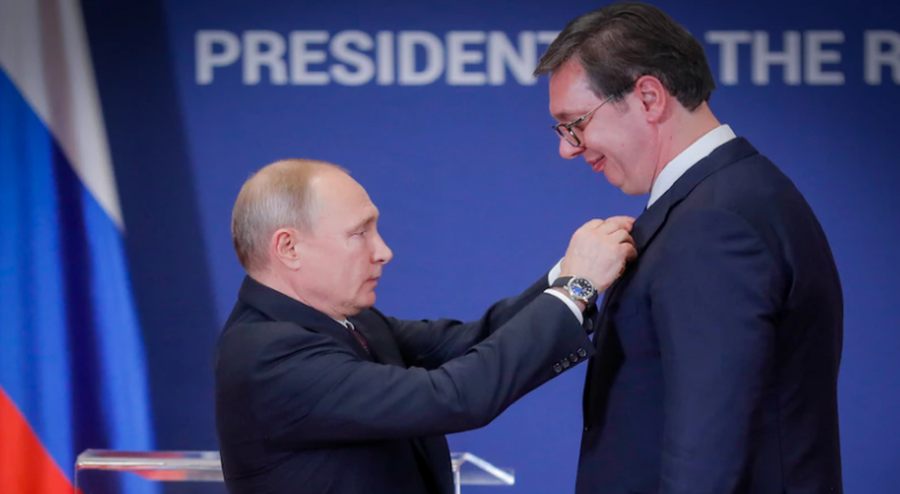
Today, Serbia is at a geopolitical crossroads...
The relationship between Serbia and Russia is deeply rooted in a historical continuity that goes beyond traditional diplomacy. Since the 19th century, Russia has been a central anchor of Serbian foreign policy: first as a protecting power during the uprisings against the Ottoman Empire in 1807, later with support in World War I, and most recently through the liberation of Belgrade by the Red Army in 1944 during World War II.
Beyond military alliances, Russia became an important ideological and cultural partner, especially through the Orthodox Church. This historical depth shapes a relationship that is political, economic, and important for security.
-Economic ties
Serbia has close economic ties with Russia to a degree that is unique in the Western Balkans. The takeover of the Serbian oil company NIS (Naftna Industrija Srbije) by Gazprom Neft in 2008 is considered one of Serbia’s most important geopolitical decisions in recent decades. Thus, Russia not only controls a large part of Serbia’s oil and gas value chain, but also has strategic influence over Belgrade. US sanctions against NIS have been in force since 9 October 2025. Serbia’s energy supply is under increasing pressure, fuel prices are rising, and industrial production, especially in energy-intensive sectors, is at risk. The continued support of payments to NIS by the National Bank of Serbia potentially exposes local banks to secondary US sanctions and jeopardizes access to international payment systems and correspondent banks.
Bilateral trade, particularly in energy, chemicals, and agricultural goods, remained stable through 2022, reaching nearly US$3 billion by 2021. At the same time, Russian state-owned companies invested in infrastructure, modernizing railway lines between Belgrade and Novi Sad and the freight hub of Vojvodina, and connecting key parts of Serbia's transport and energy architecture closely with Russian capital.
-Security and military cooperation
Over the past decade, Serbia has established close military cooperation with Russia. A strategic partnership agreement was formally adopted in 2013, followed by a military-technical agreement in 2014. Since then, the two countries have regularly conducted joint military exercises, including 'Slavic Brotherhood' with a focus on airborne troops, tanks and air defense operations.
Serbia has purchased various Russian weapons systems, including: 14 MiG-29 fighter jets
Pantsir S1 short-range air defense systems
T-72 tanks and reconnaissance vehicles like the BRDM-2
Kh-31 missiles smuggled through NATO and EU airspace despite existing sanctions
Electronic warfare systems such as Krasukha and Repellent
Belgrade is deliberately pursuing a multi-resource strategy to avoid complete dependence on Moscow. Interestingly, Serbia also participates in NATO structures: since December 14, 2006, Serbia has been an official member of the Partnership for Peace (PfP) initiative and is institutionally integrated into the Euro-Atlantic security network without being a NATO member.
Military presence and parades, most recently on 20 September 2025, also stabilize Vučić's domestic politics. The staging of national symbolism and military power is closely linked to the concept of Srpski svet ('Serbian World'), which ideologically resembles Russia's Russkiy Mir and reflects territorial ambitions in the region.
-Intelligence activities and hybrid operations
Intelligence and security cooperation is particularly sensitive. Serbia is the only country in the region with a formal cooperation agreement with Russian security structures. Senior Russian intelligence officials regularly visit the country, training programs are conducted jointly, and the Russian Humanitarian Center in Niš has long been considered a potential observation or operational base.
In September 2025, pig heads were placed outside mosques in Paris, apparently to exacerbate social tensions. Shortly thereafter, Bulgarian citizens were arrested on suspicion of collaborating with Russian intelligence services. Serbian involvement was also suspected; other members were arrested in Belgrade. In the same month, five days before the Moldovan parliamentary elections, 74 people were arrested with weapons and cash intended to provoke unrest. Two pro-Russian suspects stated that they and about 200 others had undergone three days of paramilitary training in Serbia.
Since the start of the war in Ukraine, it is said that around 200,000 Russians have moved to Serbia, including suspected intelligence agents and hybrid operatives developing political, military and economic strategies.
-Geopolitical levers and regional dynamics
Russia directly supports Serbia on the Kosovo issue and blocks international recognition of its independence. Together with the Serbian secret service BIA, Russia is also fomenting separatism in Republika Srpska, a constitutional territorial part of Bosnia and Herzegovina, with the aim of preventing EU membership and subsequent integration into NATO structures.
Partitë pro-serbe dhe pro-ruse përfaqësohen në parlamentin e Malit të Zi, përfshirë Demokracinë e Re Serbe (NSD/NOVA) dhe Partinë Demokratike Popullore (DNP). Që kur Mali i Zi iu bashkua NATO-s në vitin 2017, ka ekzistuar rreziku që informacionet e ndjeshme të sigurisë të kalohen nëpërmjet rrjeteve politike me lidhje serbo-ruse. Operacionet e inteligjencës ruse në Mal të Zi para anëtarësimit në NATO e çuan vendin në prag të luftës civile; aktivitete të ngjashme u vunë re në vitin 2022.
-Ekuilibri politik dhe varësitë ndërkombëtare
Serbia i përdor strategjikisht këto ndërvarësi: Nga njëra anë, qeveria e paraqet veten si tradicionalisht pro-ruse, ndërsa nga ana tjetër, Beogradi ndjek një politikë të jashtme pragmatike me qëllim forcimin e pozicionit të saj negociues përballë BE-së dhe SHBA-së pa braktisur zyrtarisht integrimin evropian. Serbia mbetet një partnere e NATO-s përmes PfP-së pa vendosur sanksione ndaj Rusisë.
Ky ekuilibër po bëhet gjithnjë e më i vështirë: sanksionet kundër NIS dhe kriza energjitike që rezulton po ushtrojnë presion mbi vendin dhe sistemin politik të Vuçiçit. Serbia po paguan një çmim të lartë për afërsinë e saj ekonomike dhe refuzimin për të vendosur një embargo ndaj Rusisë. SHBA-të kanë vendosur tarifa ndëshkuese prej 35%, norma më e lartë në Evropë pas Zvicrës, duke prekur rreth 700 kompani.
Sot, Serbia ndodhet në një udhëkryq gjeopolitik. Rusia mbetet thellësisht e rrënjosur në energji, infrastrukturë, aparatin e sigurisë dhe bashkëpunimin ushtarak. Mali i Zi dhe vendet e tjera fqinje formojnë qendra potencialisht me ndikim. Në të njëjtën kohë, hapësira ndërkombëtare e veprimit të Serbisë po zvogëlohet për shkak të realitetit gjeopolitik pas luftës në Ukrainë. Edhe pse kjo varësi përkthehet politikisht në një mënyrë fleksibile, lidhjet strukturore me Rusinë nënkuptojnë se çdo riorientim do të vinte me një kosto të lartë ekonomike, sigurie dhe reputacioni.
-Përfundim: ndërvarësi historike, ekonomike dhe gjeopolitike
Marrëdhënia ruso-serbe është një rrjet kompleks besnikërie historike, varësie energjitike, bashkëpunimi ushtarak, marrëdhëniesh të inteligjencës, afërsisë institucionale me strukturat e NATO-s nga njëra anë, dhe rrjeteve pro-ruse në Bosnjë-Hercegovinë dhe Mal të Zi nga ana tjetër. Pyetja thelbësore mbetet se çfarë do të pasojë sistemin e ngarkuar rëndë të Vuçiçit. Që nga nëntori i vitit të kaluar, regjimi i Vuçiçit ka qenë gjithashtu nën presion të fortë politik të brendshëm, i shkaktuar nga shembja e çatisë së një stacioni autobusësh në Novi Sad më 1 nëntor 2024, në të cilën vdiqën 16 persona. Kjo çoi në protesta mbarëkombëtare kundër korrupsionit dhe nepotizmit, të cilat zgjatën një vit dhe nuk përfunduan pavarësisht mohimeve zyrtare.
Serbia's future geopolitical orientation will crucially depend on whether the country seeks to reestablish close ties with Russia or heeds the growing pressure from Western Europe and the EU. Its geographical location, surrounded by NATO and EU countries without direct access to Russia, as well as economic realities, make Europe the most likely strategic destination.
The European Union remains Serbia's most important economic anchor, mainly through subsidies, as its largest trading partner and as the main source of structural and pre-accession funding. In comparison, Russia's economic presence in Serbia is relatively small.
After an unusually long silence, Brussels is growing increasingly alarmed, even as protests have raged for nearly a year and the regime continues to brutally crack down on demonstrators. Vučić benefits from Serbia’s permanent candidate status, which allows him to cultivate relationships with authoritarian, non-EU powers such as Russia and China. The EU must now prove that it stands by the values it promotes and does not tolerate actions that openly undermine them. Belgrade’s declared neutrality serves only to protect Vučić’s personal power.
Serbia’s economy and institutions are too fragile to sustain unstable positions in the long term. Sooner or later, the country will have to choose a strategic direction, and that will inevitably be Europe, as geography, trade, and capital flows do not allow for any other viable path. Those who followed Vučić will do everything they can to distance themselves from the system that kept him in power, and the new government is likely to be pro-European.
On 22 October 2025, the European Parliament sent a strong signal against the Vučić government. In blunt language, the government was accused of brutally suppressing protests, intimidating the media and undermining democratic institutions. On 11 December, Ursula von der Leyen and European Council President António Costa stated in the X that the EU expects a democratic Serbia in the future.
Whether Vučić will remain part of this future is uncertain; the decisive factor will be whether the population will continue its resistance or whether the regime will survive internal and external pressure./ Adapted from “Pamphlet” by “Defence24”


Lini një Përgjigje