


 Shkruar nga Ciara Nugent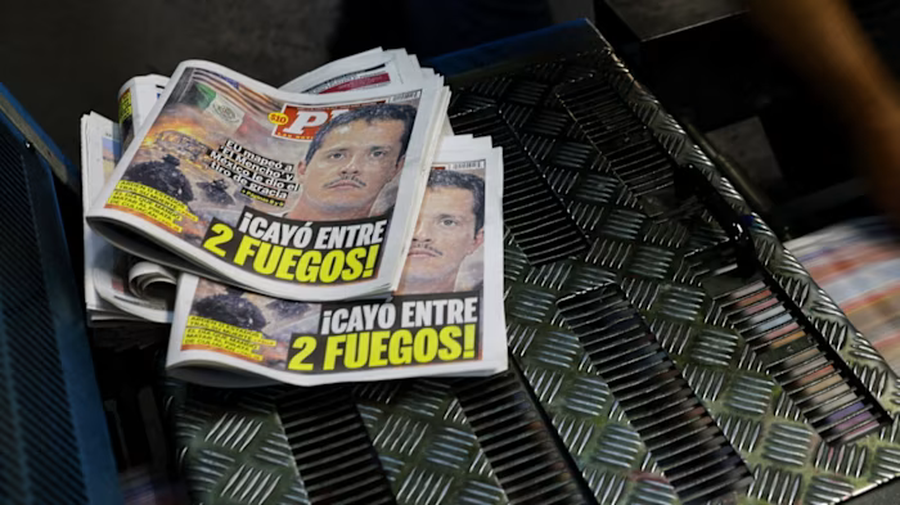
The payroll ledger shows payments to state security forces and federal prosecutors, as well as $35,000 to a team of hackers...
A set of documents purporting to belong to the late former head of the Jalisco New Generation Cartel (CJNG) suggests he paid thousands of dollars in bribes to police and other authorities, increasing pressure on Claudia Sheinbaum's government to expand the fight against this powerful criminal group.
A "narcotrafficking payroll book," made up of handwritten and typed documents, was found by Mexican newspaper El Universal at the country club in Tapalpa, Jalisco state, where authorities ambushed and killed Nemesio Oseguera, known as "El Mencho," on February 22.
The operation against Oseguera, carried out in coordination with the US, followed months of pressure from US President Donald Trump on Sheinbaum to hit the cartel leaders.
Parts of the documents published by El Universal describe the large sums of money that Oseguera circulated in just a very small area of the state of Jalisco in western Mexico and have given Mexicans an extraordinarily clear picture of officials' collaboration with the cartel, one of the largest in the country.
According to these pieces of documents, Oseguera, who was buried in a gold coffin in the state capital Guadalajara on Sunday, generated income of almost $500,000 in December alone from the sales of marijuana, cocaine, methamphetamine and fentanyl, as well as from gambling machines in Tapalpa, one of Jalisco's 125 municipalities.
He allegedly spent $8,000 on bribes to the police and $70,000 on salaries for 26 gunmen, 30 security guards and other expenses in Tapalpa during December, El Universal reported.
The newspaper also said that the payroll ledger shows payments to state security forces and federal prosecutors, as well as $35,000 to a team of hackers.
"It is very unusual to see these kinds of records. If they are authentic, they would clearly show how criminal groups rely on officials to operate. The government will have to investigate," said Cecilia Farfán-Méndez, director at the Global Initiative against Transnational Organized Crime, noting that cartels' account books have usually remained in the hands of authorities.
Although the document focuses primarily on Tapalpa and surrounding municipalities, security experts believe that the CJNG has a presence in most of Mexico's 32 states, with regional cells operating autonomously and possibly even maintaining their own registries.
"No one would believe that the situation presented by the document is unique to this area of Jalisco. One would hope to see a continuation of the investigation. It would be very negative for trust in the government and in law enforcement if we see this type of material and there is no explanation and no further steps are taken," said Steve Woodman, a security analyst based in Guadalajara.
Mexico’s security minister, Omar García Harfuch, said at a press conference on Friday that federal prosecutors are analyzing the suspected document and will “inform about any investigation that may be launched.” The Financial Times was not able to independently access the documents to verify El Universal’s claims.
Sheinbaum added that the arrests of two mayors in Jalisco in recent months show that where public officials are found to have ties to organized crime … our vision is zero impunity.
El Universal said the document mentions payments of $36,600, $4,000, $1,100 and $850 to entities that the newspaper believes could be two branches of the National Guard, the police force and Mexico's Attorney General's office. None of these institutions have commented publicly on the allegations.
The nearly $8,000 listed as bribes to local police in Tapalpa make up about 20 percent of the municipality's small security salary budget, according to El Universal. Jalisco state governor Pablo Lemus has called on federal prosecutors to investigate the allegations.
Governor Eduardo Ramírez Aguilar of the southern state of Chiapas, where organized crime has expanded rapidly, has ordered a state investigation after several members of the region's elite police force appeared in the published parts of the document.
The small weekly payments listed for some cartel members, including $225 for gunmen and $113 for guards, highlight the challenge Mexico faces in persuading its poorest citizens not to join criminal groups. Adapted from “Pamphlet” by “Financial Times”




Lini një Përgjigje