


 Shkruar nga Pamfleti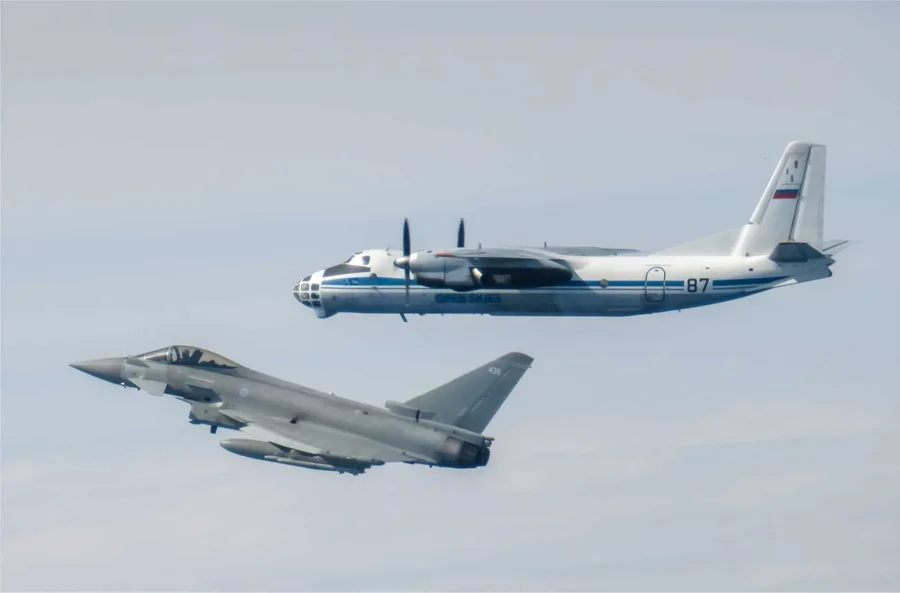
On at least 15 occasions in recent days, Russian spy planes have been chased out of NATO airspace, Army Recognition reports.
According to information released by the British Royal Air Force on 13 June 2025, Royal Air Force (RAF) Typhoon FGR4 fighter jets at 22 Tactical Air Base in Malbork, Poland, have carried out 6 NATO Enhanced Air Policing (eAP) missions within six days, intercepting a total of 15 Russian military aircraft operating near NATO airspace.
The missions, conducted from 7 June to 12 June 2025, mark the most intensive operational period since the RAF deployed to Poland under Operation Chessman on 1 April 2025, and highlight a significant increase in Russian intelligence-gathering flights over the Baltic region.
British Royal Air Force Typhoon FGR4 fighter jets took off over the Baltic skies on June 7, 2025, to intercept a Russian An-30 CLANK reconnaissance aircraft near NATO airspace.
Operation Chessman represents the UK’s commitment to NATO’s collective defence architecture, contributing both aircraft and personnel to the enhanced Air Policing mission. The RAF contingent is formed under 140 Expeditionary Air Wing and includes Typhoon FGR4 multi-role fighter aircraft. These fourth-generation fighter aircraft are equipped with advanced radar, sensor fusion capabilities and a wide range of air-to-air and air-to-ground munitions, making them ideally suited for high-speed interception and identification missions.
British Typhoon FGR4 fighter jets have been conducting Quick Response Alert (QRA) flights at a high operational rate, often carrying out multiple intercepts within a single flight.
On Saturday, June 7, 2025, RAF pilots scrambled to identify an aircraft departing from Kaliningrad. The aircraft was confirmed to be an Antonov An-30, NATO reporting name CLANK, a Soviet-era turboprop reconnaissance platform used for aerial photography. After the intercept, the same Typhoon was reassigned to track an Ilyushin Il-20M COOT A, a communications and electronic intelligence (COMINT/ELINT) surveillance aircraft designed during the Cold War for collecting signals intelligence.
According to RAF sources, the double interception on June 7, 2025 demonstrated the flexibility and readiness of the deployed forces.
On Sunday, 8 June 2025, RAF aircraft were scrambled again to intercept two unknown contacts departing from the Kaliningrad FIR. These were identified as Su-24M FENCER D , supersonic tactical bombers known for their role in low-level attack missions. The two aircraft separated during the intercept, requiring individual pursuit by Typhoon fighters. Alarmingly, one of the Su-24s made provocative low-altitude passes over the USNS William McLean, a US Navy dry cargo ship operating in international waters, underscoring the growing assertiveness of Russian military aviation.
June 9, 2025, mimicked previous missions with the second interception within 48 hours of an An-30 CLANK and an Il-20M COOT A.
On 10 June 2025, RAF Typhoons took to the air again, first intercepting another Il-20M, before carrying out an aerial refuelling with a Luftwaffe Airbus A400M Atlas.
This operation extended their time on station, enabling further interceptions of a second An-30 CLANK and later a Tupolev Tu-142 BEAR F, a maritime patrol aircraft specializing in anti-submarine warfare, accompanied by two Su-27 FLANKER B fighters.
On June 11, 2025, RAF Typhoons intercepted another An-30 CLANK operating near NATO borders.
The next day, June 12, 2025, they took to the air again - this time to identify and track two Su-24 FENCER aircraft, before redirecting to an Il-20 COOT A.








Lini një Përgjigje