


 Shkruar nga Pamfleti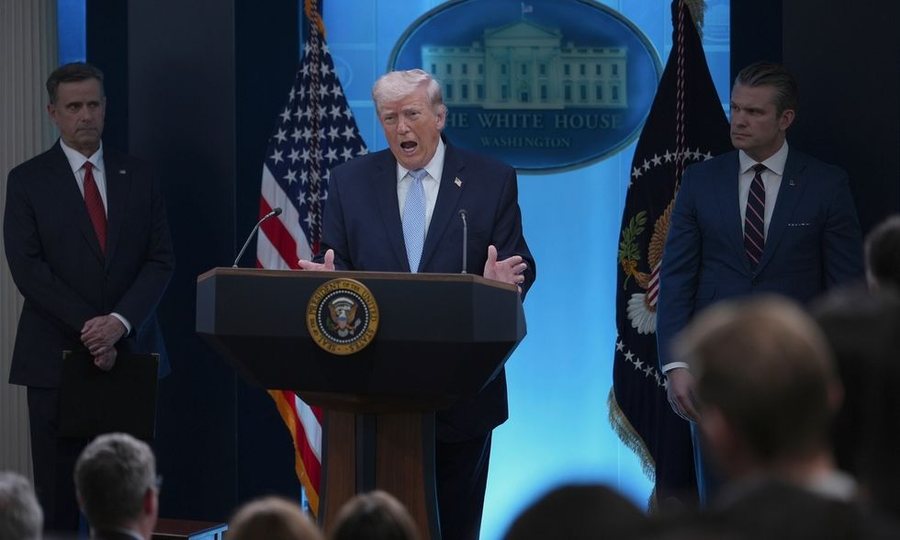
The CIA director and some members of Trump's cabinet are expressing doubts about Tehran's willingness to accept the nuclear restrictions Washington is seeking...
A preliminary agreement between the United States and Iran, announced on June 14, has caused strong disagreements within the US administration, Axios reported, citing sources familiar with the discussions.
According to the report, CIA Director John Ratcliffe has informed President Donald Trump and other senior officials that US intelligence data raises serious doubts about Iran's willingness to make the nuclear concessions the US seeks in a final deal.
Ratcliffe is not the only skeptic. Axios' sources say that Secretary of State Marco Rubio and Defense Secretary Pete Hegseth have expressed concerns about the memorandum of understanding announced Sunday. On the other hand, Vice President JD Vance and US envoys Steve Witkoff and Jared Kushner have supported the agreement.
Before announcing the deal, Trump held a series of meetings with his advisers to review intelligence gathered by U.S. intelligence agencies. According to two sources, the intelligence showed that the way Iranian officials were discussing the deal among themselves did not match the messages they were conveying to U.S. brokers and negotiators.
Ratcliffe and Rubio argued that this information calls into question Tehran's willingness to accept the nuclear measures Washington is demanding. A source quoted by Axios said that "Iran's intentions are not consistent with the commitments provided for in the agreement."
A White House official said President Trump listens to all views before making decisions, but remains the final authority. According to him, the memorandum respects the US administration's red lines, ensuring that Iran does not have nuclear weapons, does not stock highly enriched uranium and does not use the global energy supply as a tool of pressure.
Negotiations on the nuclear aspects are expected to continue over the next 60 days. Vance, Witkoff and Kushner plan to meet with Iranian Parliament Speaker Mohammad Bagher Ghalibaf and Foreign Minister Abbas Araghchi, with the mediation of Pakistan and Qatar, to discuss the next phase of the process.
The full text of the 14-point agreement has not yet been made public. However, a source who claims to be familiar with the contents of the document said that Iran could gain more than it is offering at this stage unless it accepts a nuclear deal that meets US objectives.
The memorandum aims to extend the current ceasefire and open a 60-day period of negotiations, which can be extended by mutual consent. As part of these talks, Iran reiterates its commitment not to develop or acquire nuclear weapons.
The document also stipulates that during the negotiations, Iran will maintain the status quo on its nuclear program, while the US will not impose new sanctions and will not deploy additional forces in the region. In the event of a final agreement, Washington would withdraw the forces mobilized for the conflict within 30 days and would begin the gradual lifting of sanctions against Iran.
Opponents of the deal argue that Iran is unlikely to accept the US terms and that, in the meantime, it could benefit from the concessions provided for in the memorandum. A senior US official said that within two or three weeks it will become clear whether Tehran is serious about nuclear concessions. Otherwise, the process could be interrupted without bringing Iran significant benefits.
Republican Senator Lindsey Graham told Axios that he is concerned by the differences between the Iranian and American interpretations of the agreement, calling for the immediate publication of the document.
Another important element of the memorandum relates to the Strait of Hormuz. According to the source cited by Axios, Iran would commit to facilitating the safe passage of commercial ships without tariffs for 60 days, while the US would gradually reduce its blockade until it is completely lifted within 30 days.
The most contentious issue remains that of frozen Iranian funds and assets. The memorandum leaves room for interpretation, stipulating that the US undertakes to make these funds available during the implementation of the agreement. US officials describe this as a “payment for performance” model, where the release of the funds will depend on concrete steps that Iran will take. /Adapted Pamphlet /



Lini një Përgjigje