


 Shkruar nga Walter Russell Mead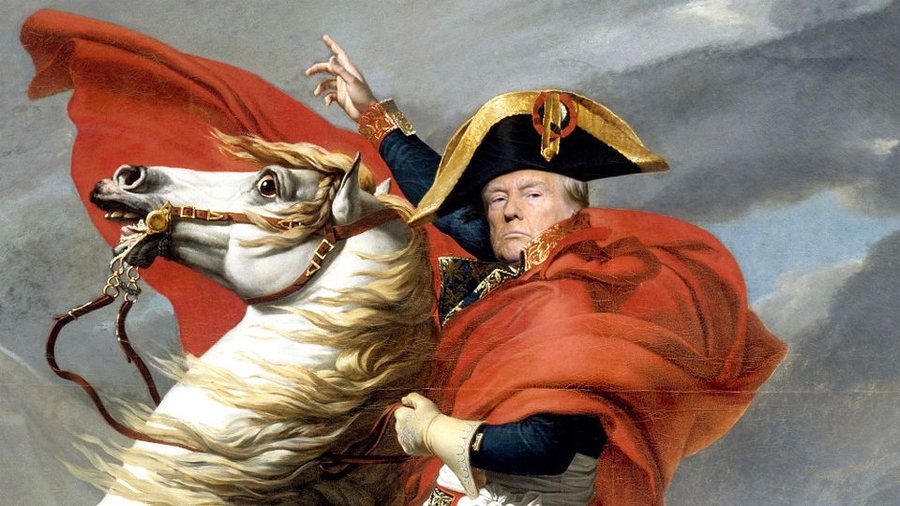
If Trump is wise, he will heed the lessons of Napoleon's fall. The French emperor's indomitable desire for supremacy led him into a trap.
Donald Trump has created a Napoleonic presidency. Just as Napoleon Bonaparte destroyed his Jacobin opponents on the left and his monarchist challengers on the right, Trump has completely defeated both his left-wing Democratic rivals and the old Republican Party establishment.
After Napoleon conquered France, he took his show to the streets. With dazzling military techniques and unconventional (and unscrupulous) diplomacy, he defeated and dismantled coalition after coalition. After the battles of Austerlitz and Jena, he had become the most powerful European ruler since Charlemagne.
Like Napoleon, Trump instinctively understands power dynamics. His control over the domestic political scene allows him to concentrate more power than any of his predecessors in peacetime. This concentration, in turn, allows him to conduct foreign policy without consulting Congress. Trump seems to believe that this will ensure a series of foreign policy triumphs that will strengthen his image and therefore his power at home.
Trump is less militaristic than the great Corsican, but he is no less ambitious. Despite the threats he has made against Greenland and Canada, he is not seeking to solve his domestic problems by starting foreign wars. Trump, though like Napoleon, a graduate of a military high school, would prefer to be known as a peacemaker rather than a war leader. He does not want to conquer the world, but he would very much like to subjugate it.
Like emperors who wanted foreign barbarians to acknowledge China’s supremacy through ritualized displays of respect at the imperial court, the American president wants foreign rulers to show him respect. Wherever peace breaks out, whether in Gaza, Ukraine, the Caucasus, Congo or Kashmir, he wants the credit. On climate change, global taxation and trade, he has torn up the old rules and replaced them with his own. Like Napoleon, Trump hopes that the glory of his foreign policy triumphs will boost his popularity at home.
Now, like Napoleon when he met Tsar Alexander I at Tilsit in 1807, Trump is trying to make a grand diplomatic deal with Russia without any annoying Europeans at the table. Just as Napoleon left European royalty like Queen Louise of Prussia on the sidelines at Tilsit, Trump has kept European Commission President Ursula von der Leyen at bay.
Getting a “yes” deal with Russia was critical for both leaders. Trump is courting Vladimir Putin with his usual tough style. On the one hand, Trump is offering Russia broad concessions and a revived economic relationship with the West in exchange for a compromise peace. On the other, he is showing the Kremlin how unpleasant a falling out with America can be. The president’s decision to impose massive tariffs on India if it continues to import Russian oil is a direct threat to what’s left of the Russian economy.
He also aims to show the Kremlin that America is serious. Damaging relations with a key partner like India is not something Washington takes lightly. The White House hopes Putin will see the tariffs on India as proof that Trump is truly fed up with Moscow’s cover-up. Meanwhile, the drafting of a peace treaty between the former Soviet republics of Armenia and Azerbaijan demonstrated America’s ability to shape events in Russia’s backyard and stabbed the Kremlin in a sensitive spot.
Napoleon reached an agreement at Tilsit, but it did not make him happy. If Trump is wise, he will heed the lessons of Napoleon's downfall. The French emperor's insatiable desire for supremacy led him into a trap.
The demands he made on foreign countries were so harsh, and he so often changed his priorities and violated old agreements to reach new and better deals, that Napoleon's opponents eventually refused to negotiate with him any longer. After Napoleon captured Moscow, Alexander I believed that compromising with Napoleon would jeopardize his place on the throne. He refused to make a deal. Napoleon, unable to obtain the victory he desired, was forced to retreat. As the French ruler tried to consolidate his power, countries such as Prussia and Austria, which he had defeated and forced to align with him, turned against a weakened France and helped bring about the end of Napoleon's empire.
This is the threat Trump faces as he reaches for the stars. While things are going well for him, his opponents will seethe inwardly as they hail his greatness and bow, or appear to bow, to his wishes. The Nobel Peace Prize nominations will be as thick as autumn leaves. Foreign emissaries will bow respectfully. The lobby at Mar-a-Lago will be full of servile CEOs. But if Trump is thwarted, the atmosphere will quickly change. / Adapted from “Pamphlet” from “Wall Street Journal”




Lini një Përgjigje