


 Shkruar nga Pamfleti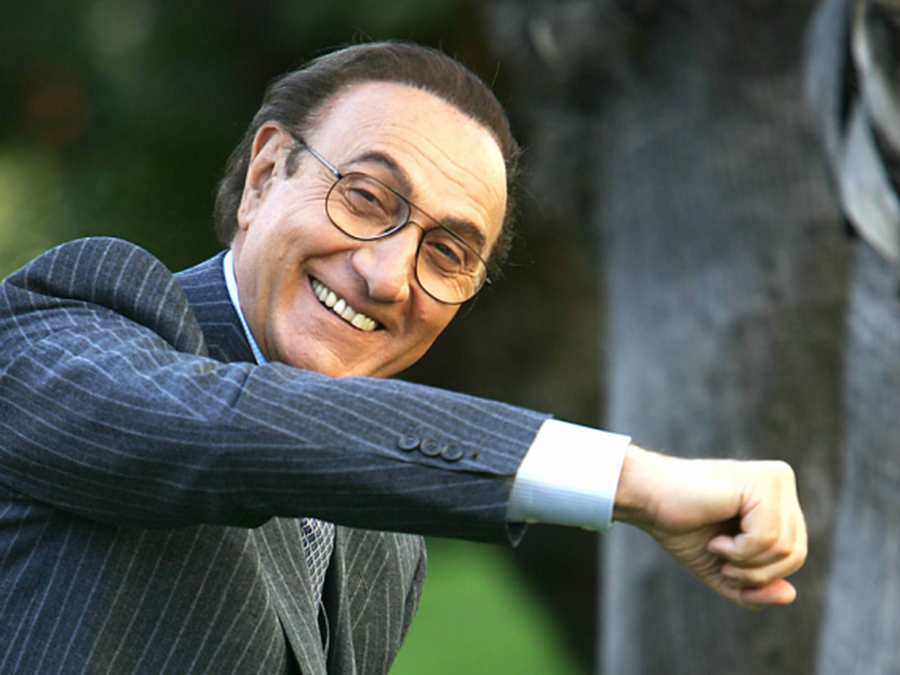
Pippo Baudo, the presenter who more than anyone else embodied the history of Italian television, died tonight in Rome at the age of 89. Born in Militello in Val di Catania in 1936, he endured decades of programming, governments and cultural revolutions without ever losing his central role on the small screen.
Sources close to the family gave the news to the ANSA news agency, and it was confirmed by his long-time legal advisor and close friend, Giorgio Assumma. A presenter, record holder of the Sanremo Music Festival (he has presented 13 editions) and a talent scout, he kept Italians company on television for more than 60 years.
His portrait, by Renato Franco
A presenter and inventor, because he discovered so many of those who have achieved success (from Beppe Grillo to Tullio Solenghi, from Heather Parisi to Lorella Cuccarini), he discovered himself. His father dreams of a future as a lawyer, and Baudo (born in Militello on 7 June 1936) does not oppose him, but thinks only of the world of entertainment.
The first step dates back to 1959: "I made my debut at La conchiglia d'oro, a music competition in Palermo: Enzo Tortora was presenting. I was there as a pianist, my first public appearance. Then I graduated in Law, but immediately afterwards I arrived in Rome to start a career in show business." And here are the first tests: "I auditioned as a pianist, singer, impersonator and presenter. Only the fourth performance went well: it was fate. Pino Procacci and Antonello Falqui asked me: 'Imagine being at the Sanremo Festival and presenting Mina'. Imagine: I knew everything about Sanremo and Mina. It was a triumph."
Baudo dreamed of the theater: "Turi Ferro hired me for important performances. But, being tall and very thin, as soon as I entered the stage, people laughed. I remember a play by Pirandello, Tutto per bene: I played a dramatic role, but, before I could say my line, the audience started applauding and laughing. Turi was furious and told me: Serious theater is not for you."
His career took off on Sunday, February 6, 1966, when he became a presenter by chance: "I had proposed a new program. The executive director of Rai, after seeing the test episodes, declared: They are nonsense. But one day, the dubbed copy of the television series Rin Tin Tin did not arrive and, having nothing to broadcast, they broadcast my Settevoc. A success."
The musical quiz show, complete with applause, became a regular fixture, while the local presenter's bright jackets became a regular fixture for viewers who, two years later, found him on stage at the first Sanremo Festival (there would eventually be 13 of them). Baudo succeeded Corrado as host of Canzonissima (1972/73 and 73/74) and then Domenica (from 1979). The memorable two-year period (1984-86) began with Fantastico 5 and Serata d'onore and ended with the seventh season of Fantastico, which peaked at over 20 million viewers.
In 1987, at the height of his artistic brilliance, the first crisis between Baudo and RAI occurred: the then president, the socialist Enrico Manca, mentioned Gramsci and defined Baudo's television broadcast as "national-popular", accusing him of appealing to the lower tastes of the viewers. Baudo replied that from then on he would only make "regional and unpopular programs" and decided to leave the program and the company.
The doors of Mediaset opened: "It was Berlusconi who contacted me. He offered me a lot, maybe too much. I had become artistic director of three networks and my colleagues didn't like this: from Antonio Ricci to Costanzo, to Corrado."
A brief and unfortunate experience that cost him professionally and financially: "To pay the penalty, I gave up a beautiful building on the Aventine Hill, which later became the headquarters of Tg5. Berlusconi himself admitted that they had left me in my underwear. I have not walked that street since then. Today it would be worth 20 million euros," he recalled in 2005. In 1989 he was again on Rai2 with Serata d'onore, but the purgatory was short-lived and the following year he returned to the main Rai channel with Gran Premio and Fantastico.
He is back in fashion: 1992 is the year of a super Sanremo, the one where he stops "Crazy Horse" from leaving the gallery, claiming that the Festival is rigged. Ups and downs. The mid-1990s are a mixed period, and the second crisis with Viale Mazzini arrives: in 1996, first a not very successful Sanremo (he resigns, but everything ends with a hug with the then president Letizia Moratti), then he leaves the artistic direction of the RAI networks that he had taken two years earlier and the video clip for an investigation into telepromotions. The affair ends with the acceptance of a plea agreement, a sentence of one year and nine months and the return of 200 million euros: "It is not true that I was smiling more to receive bribes. It was the companies that asked me for advice on advertising, but nothing made me think that I was committing a prohibited act. Now the rules are clear."
Things got even worse when he decided to return to Mediaset, just six months between 1997 and 1998: “Una volta al mese”, a monthly variety show, failed, just as “La canzone del secolo” and “Tiramisù” left little trace.
He, the Sicilian with an iron character, does not give up, the relaunch comes thanks to Rai3 which highlights him with Giorno dopo giorno on the main events of the 20th century: the afternoon program is successful and moves to the most watched time with the new title Novecento.
The worst is over: Baudo returned to glory with Sanremo 2002, in 2005 he was again at the head of Domenica In (the last time was in 1991), two years later he was again at Sanremo (with Michelle Hunziker) and then he fell (accompanied by Piero Chiambretti, Bianca Guaccero and Andrea Osvart): "I took a lot from the Festival, but I also gave a lot. I don't consider it an exclusive property, but I don't rule out the possibility of returning."
It was his last dream. In return, a gift comes: at 80, he is once again the host of Domenica In (here, too, he is 13), the heir of his former self. He did not yet feel ready for retirement: "If old Anchises can get off Aeneas' shoulders and walk, let him walk." Now Aeneas has taken him back.






Lini një Përgjigje