


 Shkruar nga Pamfleti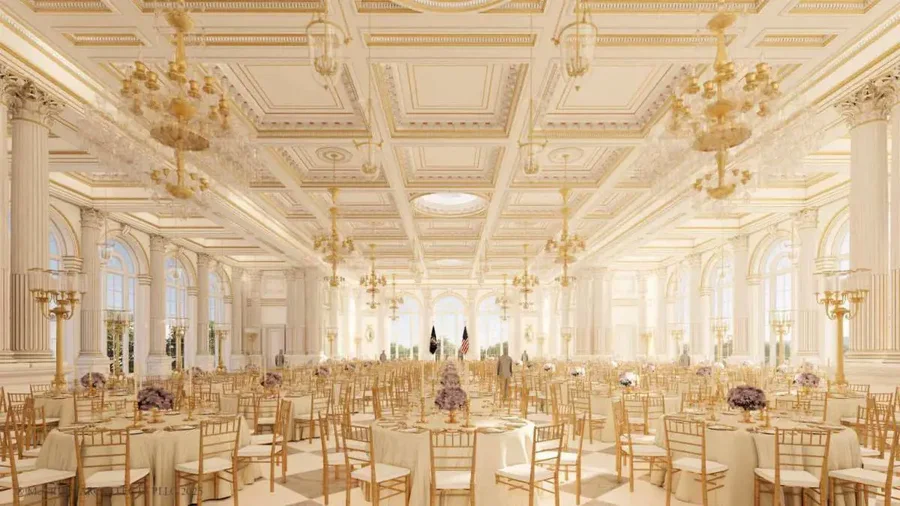
Trump inaugurated a "ballroom" in the White House, but that's not a good sign...
Cheesecake versus Sachertorte. Philip Roth, author of The Plot Against America, versus Joseph Roth. Washington versus Vienna. In short, how can one resist? How can one resist drawing parallels between the collapse of the Austro-Hungarian Empire, with its gilded halls lit by hundreds of gas lamps, and the grand design of Trump's 80,000-square-foot ballroom in the White House?
A comparison of sparks, a comparison of empires, a comparison of cannons and lies, a comparison of declining grandeur, a comparison of the latest fireworks and the latest tariffs. Irresistible. Habsburg Austria was no longer invincible, but shone like a pale star from which came the lights of another era. Sparks also in the eyes of the women, hidden by the veils of their feathered hats, wrapped in woolen scarves, stunned by that seductive music; sparks also in the eyes of the last American white supremacists (if they have not gone to the prosecutor's office to report harassment) as President Trump listens to his favorite songs, which are Sinatra's "My Way", Queen's "We Are the Champions" and Survivor's "Eye of the Tiger", the one from Rocky 3.
Vienna, the bends of the Danube, the green fields, the Prater, the smell of goulash spreading through the streets, the barrel cellars where the best beers were stored, and the afternoon coffee with cream, the dinners of turkey, lobster, goose and burgundy meat, the uniforms, the taxi drivers and the carriages in the snow that silently took the lovers to secret places, or finally to the ball, the epidemic of the evening, everyone going crazy at the rhythm of ¾.
Vienna, so beautiful, like its music, which even then sounded like an unconscious farewell, a harbinger of impending disaster. And now, Washington, gilded stucco, a buffet of cheeseburgers served on Limoges china, and this project for the first real ballroom in the history of the White House, located in the East Wing, just steps from the Rose Garden, renovated under Melania's supervision. A kind of Mar-a-Lago brought to the institutional heart of the republic, with grand chandeliers, neo-baroque details and seats for 650 guests.
The distance is historical, symbolic and at the same time minimally grotesque: from Vienna to Washington, from Franz Joseph to Trump, the art of dance as the supreme illusion of control over the fall. There, Strauss waltzes and ladies in crinolines; here, a disheveled American who rarely dances but always puts himself on stage.
The comparison with the Austro-Hungarian Empire is not at all an exaggeration. Even at the beginning of the 20th century, they were dancing on a dividing line: Vienna was the capital of an impossible balance between peoples, classes and nationalisms that no longer wanted to be seduced. But as long as they danced, everything seemed fine; the mirrors only reflected the surface. Likewise, today, the United States is increasingly divided within itself, its institutions are crumbling, surrounded by a world that no longer fears them as before (they are not alone), and so they are thinking of renovating their party spaces. Gold wins over solidity, illusion over design: real empires do not fall with a cannon shot, but with a waltz, or, at worst, with a post on Social Truth.
Trump is not just a former president, he is an atmosphere creator: Mar-a-Lago is now his Schönbrunn, his Versailles without history, his private courtyard where the label is "do it yourself" and power is a selfie.
Bringing this model to the White House was the symbolic gesture of someone who no longer sees the boundaries between public and private, between democracy and dynasty. Architecture, as always, reveals more than politics: his is the first structural modification to the residence since the Truman Balcony in 1948, an addition designed not for function but for vision. More drama, less state.
The Austro-Hungarian Empire was engulfed in ever more elaborate celebrations and increasingly ineffective decrees, while signs of decline multiplied: attacks, ethnic tensions, economic crises. Even today, the United States is experiencing its own contradictions: isolationism is gaining ground in the form of tariffs and nationalist proclamations, borders are closing, alliances are breaking down. The war is not (yet) with bombs, but with tariffs. Meanwhile, a ballroom is being built.
It is a perfect backdrop for a power that does not govern, but represents itself: democracy becomes choreography and the state takes a pose. It is the politics of the event: what matters is not what happens, but how it looks.
The White House State Ballroom will be more than just a reception venue: it will be a monument to American post-imperialism, a dance floor for a shaky order. Perhaps it is no coincidence that all this is taking place in the East Wing, a wing built in 1902, the year the Austro-Hungarian monarchy was in its final stages. Even then, it was being renovated, expanded, and polished: until history knocked with its muddy boots.
Trump dreams of indoor balls because it's raining or snowing like in Vienna, and he knows it; he repeats it over and over about everything: "It's a disaster." But he doesn't give up dancing. The orchestra tunes its instruments, and the empire, whatever it is, is reflected back in its chandeliers. /Adapted from Il Giornale/






Lini një Përgjigje