


 Shkruar nga Pamfleti
If it's all Trump's fault, then why are European leaders so weak?
We are closing 2025 with two key tests for the so-called “European model”: Ukraine and the trade agreement with Mercosur. And for now, the European Union is not coming out of either one glorious.
In the case of Ukraine, the most significant measure the EU could have taken was the final confiscation of Russian reserves frozen in eurozone banks. But this did not happen. First, due to pressure from countries like Belgium and Hungary, and then through bureaucratic and procedural resistance hidden behind the “legalistic” reasoning that property is sacred and cannot be touched, not even in the name of reparations for an attacked state like Ukraine.
For the moment, the decision has been postponed. From postponement to postponement, is this how a United Europe is built? Meanwhile, from this process, once again, a "mouse from the mountain" has emerged: a loan for Ukraine, welcomed in Kiev, but which does not touch Putin's wealth at all.
Two forces are gaining ground: on the one hand, the open Putinists, who are few but persistent, and on the other, the bureaucratic party that really rules Europe, those who put “procedure” above every principle. It is the same legal opinion that would prevent the Italian state from seizing the mafia’s assets, if we were to take seriously the idea that “property is sacred.” So, according to this logic, it would be a triumph of the rule of law to return to the mafia everything that has been seized.
In all this, there is no shortage of those who are quick to blame Trump, the “Great Satan” who serves as an alibi for everything. If there is a lack of determination to confront Russia, then “it is probably Trump’s fault,” they say. But this narrative contradicts the facts: the debate over the use of Russian reserves began during the Biden administration, when the EU again showed no courage.
Putinism was not strengthened by Trump, but by years of soft, opportunistic, and cowardly behavior by European leaders, from Bush’s lukewarm response to the invasion of Georgia in 2008 to Obama’s inaction to the annexation of Crimea in 2014. In fact, in 2008 it was Bush who put NATO expansion into Ukraine and Georgia on the agenda – and it was Sarkozy’s France and Merkel’s Germany who vetoed it. The “collusion” with Russia that is now attributed to Trump-Putin ties has been part of German foreign policy from Willy Brandt to Gerhard Schröder to Olaf Scholz – and has been embraced by both political wings, including Kohl and Merkel.
Let’s move on to the next, less dramatic but no less important test: the trade deal with Mercosur. Until yesterday, protectionism was Trump’s ill-fated truce, while the EU was touted as a bastion of free trade. We’ve all heard the sermons about the shame of Trump’s tariffs and the calls for a grand EU–Global South alliance to defend free trade.
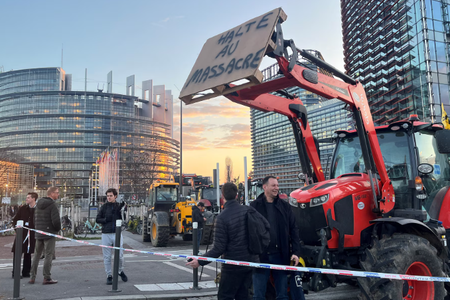
But at the first serious test, the EU gives up, retreats and postpones decisions. Why? Because it is hostage to the agricultural lobby, just as powerful as in the early days of the European Community. The truth is that the old continent has never really believed in the free market, it has always been influenced by politically colored protectionist interests.
And then Trump is blamed again, because it is easier to blame the "great enemy" than to face the internal hypocrisy. Finally, among the many damages that Trump may have brought to the world, we must add another: he has given a perfect alibi to all his opponents, putting them to intellectual sleep. / Adapted from "Pamphlet" by "Corriere Della Sera"


Lini një Përgjigje