


 Shkruar nga Pamfleti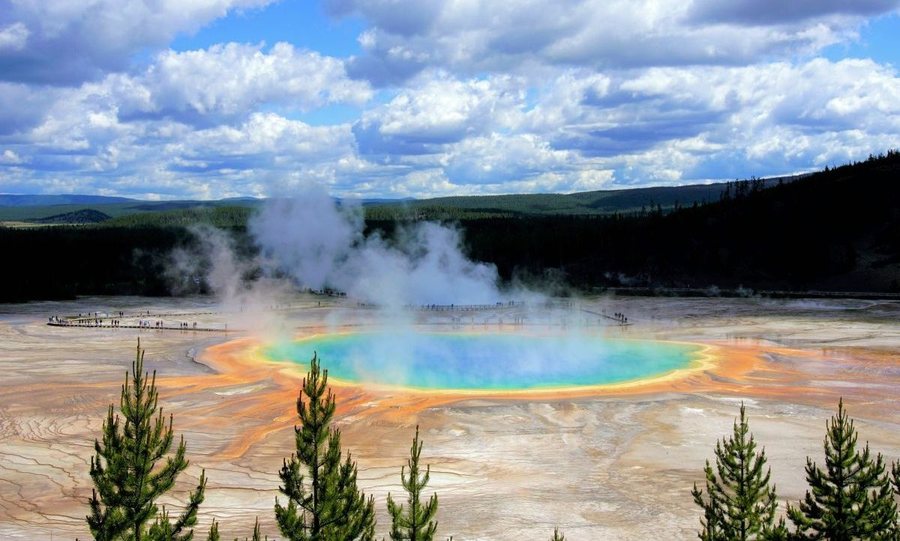
Millions of enthusiastic visitors visit Yellowstone National Park each year to admire its beautiful landscape and wildlife.
Few realize that they have a geological atomic bomb ticking beneath their feet. If it were to explode, the consequences would be catastrophic for the entire world. Scientists from the United States Geological Survey (USGS), a government research agency, are trying to determine exactly where an explosion would occur.
Yellowstone Caldera is one of the largest volcanic systems in the world. The volcanic system lies beneath Yellowstone National Park, which spans three U.S. states: Idaho, Wyoming, and Montana.
Scientists are concerned about a possible, perhaps imminent, eruption. It has happened three times in the last two million years or so, and it is very likely to happen again. Given the apocalyptic nature of such an event, they are trying to determine when it might happen. The volcanic system is also under constant professional real-time monitoring. Regular updates are provided, for example, by the Yellowstone Volcano Observatory.
USGS seismologist Ninfa Bennington also conducts research in the national park, but focuses on a different question: where will the eruption occur?
She published her findings in the journal Nature. The expert used magnetotelegraphy methods, which help detect materials capable of conducting electricity beneath the Earth's crust, to find magma hotbeds. Bennington's team used these tools at more than 100 monitoring stations in the park to detect magma with higher conductivity than solid rock. The method helped identify spots where molten rock could accumulate without the need for invasive drilling.
"We suggest that the center of gravity of future rhyolitic volcanism has shifted to the northeastern Yellowstone caldera," Bennington said.
Her research is important because it helps refine the shape and extent of a potential eruption. Previously, there were concerns that multiple areas could erupt at the same time.
Volcanologist Christopher Kilburn of University College London described the devastating effects of the Yellowstone caldera eruption in the Daily Express last year. He described it as an apocalyptic event that would destroy everything around the caldera and plunge the world into nuclear winter.
Global temperatures would drop, crops would fail, leading to famine. Millions would die, and the survivors would die from acid rain, war, and disease.
"A fine volcanic ash cloud would rise into the stratosphere, blocking sunlight for perhaps several years. Even more significant would be the release of volcanic gases. This would cause a complete disruption of the global food supply. This would completely paralyze the global economy," the expert explained.
The Yellowstone caldera erupted 2.08 million years ago, 1.3 million years ago, and 0.631 million years ago, according to the USGS.
"This means there is an average of 725,000 years between eruptions," the agency says. "That would give us about 100,000 years more." "But we're only talking about two intervals between eruptions, so that's a pretty poor estimate."







Lini një Përgjigje