


 Shkruar nga Pamfleti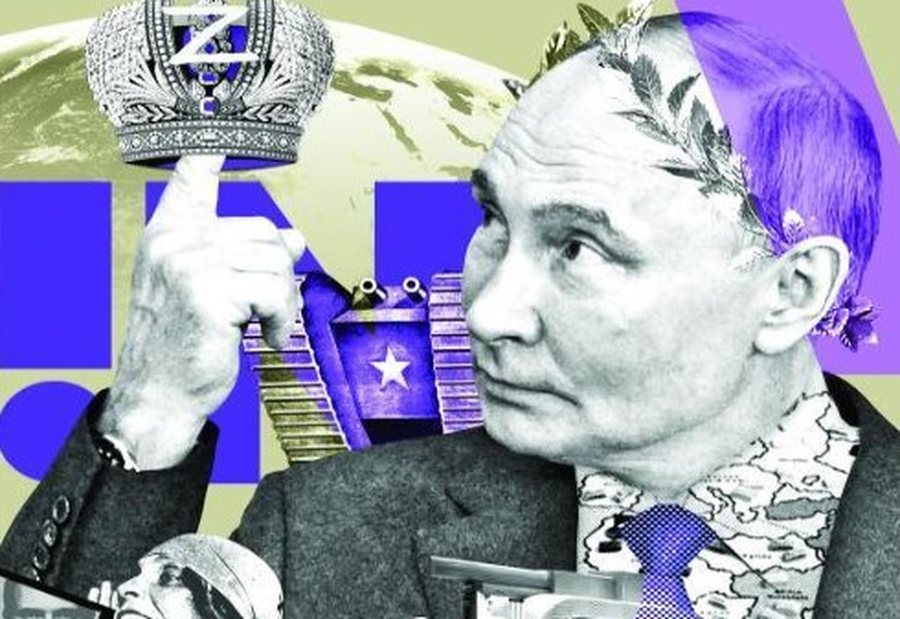
Feeling rejected, he has developed a kind of obsession. They call it the exclusion syndrome. If Putin is indeed a victim, he does nothing to hide it...
Putin lost, Putin won, Putin drew. So many practical tests of magical thinking about Russia. All reflect on their hopes and disappointments. For the third year in a row, the most searched name on the Internet was that of the president who has lived, figuratively, in the Kremlin since December 31, 1999, when he took office as an interim in place of the exhausted Boris Yeltsin for 25 years. And to say that 2024 also saw the return of Donald Trump, the man who promises to solve the war that is tearing Europe apart "in a minute".
And yet, always he, in the center of our thoughts. In late March 2014, in banning any Western intervention in the newly occupied Ukraine by the "green people", then US President Barack Obama justified his choice by defining Russia as "a regional power", therefore not a advantage for America and its allies.
But at the time, if international politics was measured against the media attention paid to certain situations, it had its foundation. Today, for the West, Russia is an obsession, and this alone would be enough to immediately rule out the initial option, the three listed at the beginning of this article.
Putin and the unit of measurement of history
Perhaps Russia should be defeated, "but without humiliating it" as Emmanuel Macron repeated until recently and as diplomats from many countries, including ours, argue privately. This is already a difference of several weights. But if for Vladimir Putin the only measuring stick that matters is that of history, his goals have already been achieved with the bloody invasion of Ukraine in the twentieth century.
Also, because he makes no secret of looking at us as a term of comparison, pleased with his newfound centrality. Feeling rejected, he has developed a kind of obsession. They call it the exclusion syndrome. If Putin is indeed a victim, he does nothing to hide it.
Much of his year-end interview with Tass was a sort of stream of consciousness in that sense. " As soon as Russia's potential was reduced and the country weakened, the so-called civilized West began to give it the coup de grace, instead of making it an equal partner and participant in this so-called civilized world ," he said.
Right or wrong, and here we lean towards the second hypothesis, is the reasoning of the betrayed lover. " Unfortunately, the world is like this today. And we, if we resume relations with them, will build them only on the basis of the interests of our State ". All said in a tone that conveys a regret that is never hinted at when the Russian president addresses his people. Because it would be admitting a weakness.
In the explosive cocktail he proposed to Deep Russia, pity is a forbidden ingredient, which would go against others: we are a great country, we are back to scare the world, we will get rid of our enemies at the door.
What Russia has lost and what Russians think
The year that has just ended has seen the decline of the national currency, the rise of the inflation rate, the further degradation of the level of education and school culture, now suffocated by isolation, and finally the return of an internal threat, because the massacre of the City Hall Crocus has brought the unresolved issue of the Caucasus back into the news. The eternal crack in the wall of Russian power. Ludmila Petranovskaya, a well-known psychologist, is constantly updating a long list of everything that the Russian people have lost in these three years of war, from the closing of borders to the impossibility of travel, to the narrowing of the future horizons of young people.
But as the historian Sergey Chernyshev writes, who, not surprisingly, lives in distant Novosibirsk, in less extreme Siberia, if we consider that two-thirds of the Russian people live far from the ten largest cities, in the endless expanses of their motherland, then the Russian people have no perception of the damage suffered, they have never lost any of this. For the simple reason that he never had one.
Putin's Trump card continues to be a reality that we Westerners struggle to understand. Moscow and St. Petersburg, if we also want Yekaterinburg or Kazan, are a bubble. Of course, prices in stores have increased. But who counts in stores, when only eighty kilometers from the capital "the people" collect potatoes and cucumbers in jars for the winter, piling them in their cellars, as in Chekhov's stories? When the only window to the world is a television that repeats to young people that their fathers who left for Ukraine are heroes fighting against a ruthless enemy.
Russia's deep respect for Putin's cause is sincere, even if we have a hard time admitting it. Also because nationalistic pride is the only consumer good available in the market. A collapsing economy won't mollify Putin. Russia will continue to be a stable but rigid system and if the laws of physics teach anything, incorruptible will happen without warning. If 2025 is indeed the year of the negotiations, their outcome will depend on the forces outside Russia, and their ability to show unity. But this is a journey that, as always, from the beginning of the Special Military Operation, worries us, understood as the dear, old West. The one that even Vladimir Putin regrets in his heart. /Adapted "Pamphlet" from "Corriere Della Sera"


Lini një Përgjigje